What if the most productive thing you could do today is absolutely nothing?
Not the nothing of scrolling through your phone while waiting for coffee. Not the nothing of half-watching television while checking email. Not the nothing of pretending to relax while your mind races through tomorrow’s to-do list. I’m talking about a deliberate, structured, almost aggressive form of nothing—intentional time with zero inputs, no objectives, and absolutely no opportunity for productivity.
We have been sold a lie about what productivity looks like. The modern worker treats every waking moment as a resource to be optimized, every idle second as waste to be eliminated. We fill our commutes with podcasts, our workouts with audiobooks, our showers with mental task lists. We have become so afraid of empty time that we manufacture constant stimulation, mistaking busyness for effectiveness and motion for progress.
The result is not the high performance we were promised. It is a profound cognitive depletion that masquerades as normal. The same professionals who pride themselves on their hustle find themselves unable to think deeply, solve complex problems, or sustain focus for more than a few minutes. They experience decision fatigue by mid-morning, creative block by afternoon, and complete mental fog by evening. They are working harder than ever and achieving less than ever.
This is where strategic boredom enters the picture. It is not a luxury for the idle or a consolation prize for the unsuccessful. It is a rigorous practice that reverses cognitive depletion, restores decision-making capacity, and creates the neurological conditions for what Cal Newport calls deep work—the kind of focused, high-value output that actually moves careers and projects forward. Strategic boredom is not the opposite of productivity. It is its foundation.
In the following sections, you will learn exactly what strategic boredom is, why most people misunderstand it, and how to implement it without losing your edge. You will discover the specific types of boredom that serve different cognitive functions, how to identify your personal boredom deficit, and the hidden costs of filling every moment with stimulation. Most importantly, you will receive a complete framework for scheduling nothing and turning that nothing into your most productive hours.
The approach described in this guide is not about doing less. It is about creating the cognitive conditions to do your best work. It is not about becoming passive. It is about strategic aggression toward the forces that steal your focus. And it is not about guilt or shame for your current habits. It is about recognizing that the modern environment is designed to deplete you and choosing to opt out deliberately.
If you are skeptical, good. You should be. The idea that doing nothing could improve your performance contradicts everything you have been taught about success. But the research on attention restoration, the neuroscience of the default mode network, and the lived experience of high performers who use boredom strategically all point to the same conclusion: the most productive minds are those that know how to turn off.
What Strategic Boredom Means
Strategic boredom is not the absence of activity. It is the deliberate removal of cognitive inputs during specific windows of time to enable neurological recovery and attention restoration. It is a practice, not a state. It requires intention, structure, and protection from the forces that would fill every available second with stimulation.
Understanding strategic boredom requires first understanding what it is not. It is not the accidental boredom of being stuck in a waiting room without your phone. That kind of boredom produces anxiety and agitation because it feels imposed rather than chosen. It is not the passive entertainment of watching television or scrolling social media—activities that occupy attention without requiring focus. These are forms of stimulation that prevent the brain from entering the restorative states that strategic boredom creates.
True strategic boredom has three defining characteristics. First, it is intentional. You schedule it like any other appointment, protect it like any other priority, and enter it with the same preparation you would bring to an important meeting. Second, it is input-free. No podcasts, no music, no books, no conversations, no background entertainment. The goal is absence, the quiet that allows the mind to transition into different modes of processing. Third, it is time-bounded. This is not a vow of monastic silence. It is a specific duration—fifteen minutes, an hour, an afternoon—after which you return to engaged activity with restored capacity.
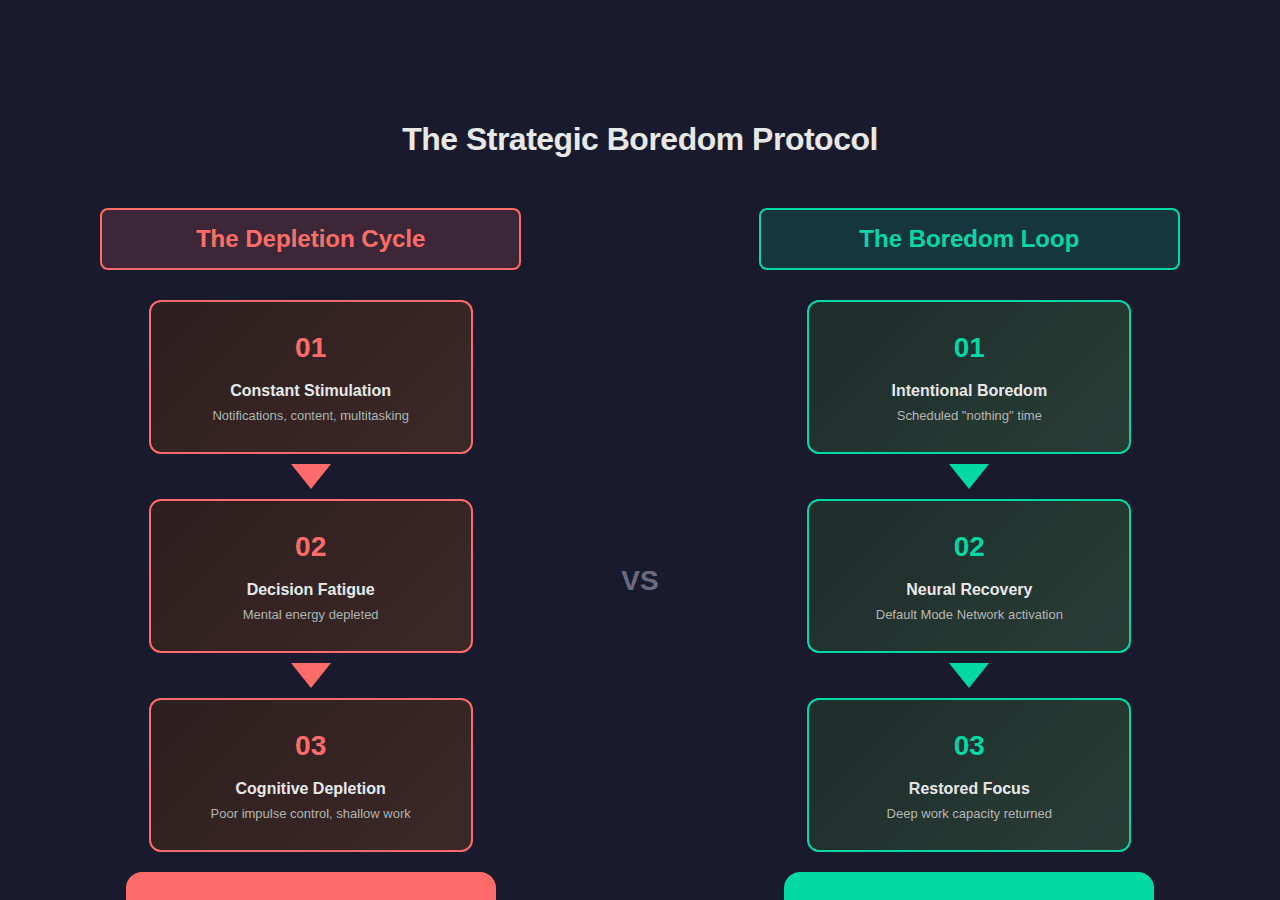
The neurological mechanism behind strategic boredom involves what neuroscientists call the default mode network—a set of brain regions that activate when we are not focused on external tasks. This network is responsible for memory consolidation, creative insight, self-reflection, and the integration of information into coherent narratives. It cannot operate when we are constantly processing inputs. Every notification, every podcast, every moment of passive entertainment keeps the brain in task-positive mode, actively directing attention outward. The default mode network requires quiet. It requires the absence of demands.
Strategic boredom is essentially a workout for this network. Just as you schedule time for physical training to build strength, you schedule time for cognitive absence to build the brain’s capacity for deep processing. The goal is not to become a person who does nothing. The goal is to become a person whose doing is powered by the restorative capacity that only nothing can provide.
This reframing is essential. Many high performers resist boredom because they associate it with laziness, unproductivity, or the absence of ambition. They have internalized the toxic productivity narrative that says your value is measured by your output volume. Strategic boredom invites you to reject this measure entirely. Your value is not in how many hours you can fill with activity. It is in the quality of thinking you can bring to the hours that matter.
The Types of Boredom
Not all boredom serves the same function. Understanding the different types allows you to deploy them strategically for different cognitive needs. Each type has distinct characteristics, produces different neurological effects, and requires different implementation approaches.
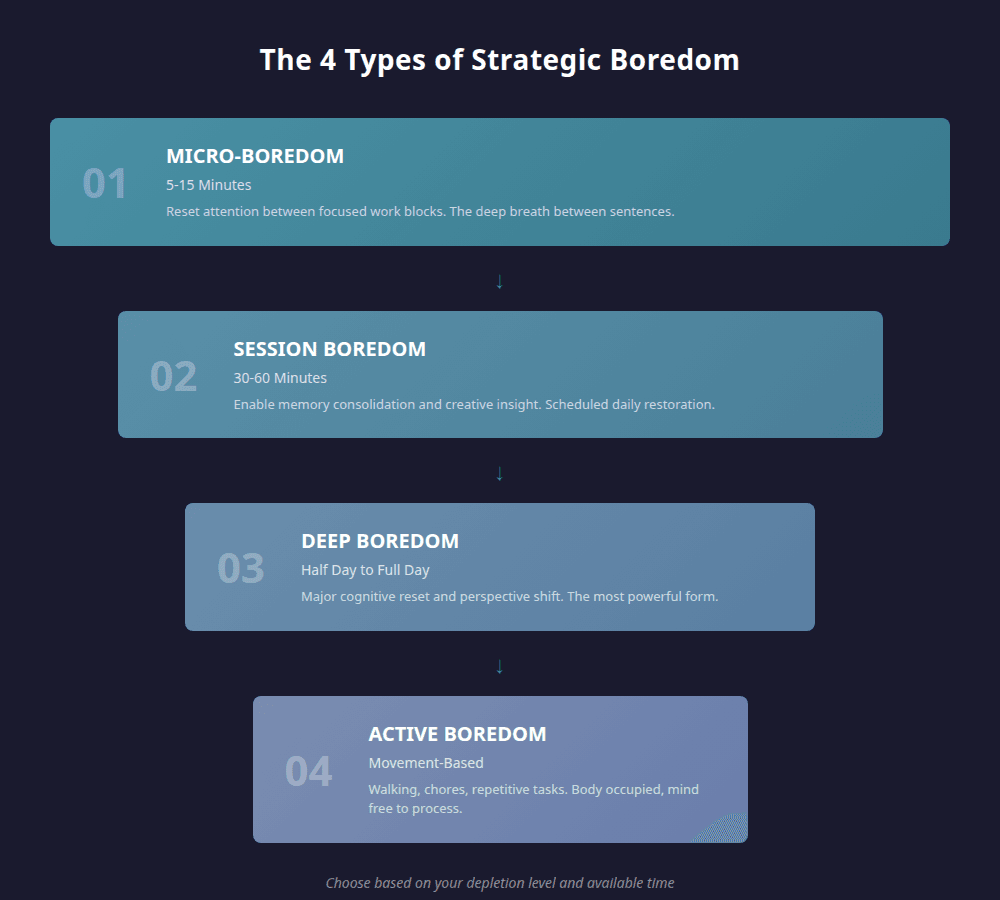
Type 1: Micro-Boredom (5-15 Minutes)
Micro-boredom consists of very short windows of intentional nothingness designed to reset attention between focused work blocks. It is the strategic equivalent of a deep breath between sentences—a brief pause that prevents the accumulation of cognitive residue.
Signs you need micro-boredom:
- Your attention starts drifting after 20-30 minutes of focused work
- You find yourself checking notifications “just for a second” during deep work sessions
- You feel mentally heavy or sluggish by mid-morning despite adequate sleep
- You experience eye strain or tension headaches during computer work
- Your work quality visibly declines the longer a session continues without breaks
How to get micro-boredom:
- Set a timer for five minutes before beginning a focused work block
- Close all browser tabs, turn off all notifications, and silence your phone
- Sit or stand without any materials, screens, or entertainment
- Look out a window, at a wall, or at a plain surface—avoid anything demanding attention
- When thoughts arise, observe them without engagement and return attention to the present
Type 2: Session Boredom (30-60 Minutes)
Session boredom involves longer periods of input-free time, typically scheduled once or twice per day between major work blocks. This duration allows the default mode network to fully activate, enabling memory consolidation and creative insight.
Signs you need session boredom:
- You struggle to solve complex problems that require sustained attention
- You feel creatively blocked or unable to generate new ideas
- You experience decision paralysis, unable to choose between reasonable options
- You forget information soon after learning it, requiring repeated review
- You feel emotionally reactive or irritable after focused work periods
How to get session boredom:
- Schedule 45-60 minutes of protected time in your calendar
- Leave your workspace entirely—go to a park, a quiet room, or a bench outside
- Bring nothing with you except possibly a simple notebook with no planned use
- Walk slowly or sit still, whichever feels more natural
- Allow thoughts to arise and fade without actively pursuing any of them
Type 3: Deep Boredom (Half Day to Full Day)
Deep boredom extends across multiple hours or an entire day, creating the conditions for major cognitive reset and perspective shift. This is the most powerful form of strategic boredom and the most difficult to implement, requiring significant environmental control.
Signs you need deep boredom:
- You have been running on empty for weeks or months, surviving on caffeine and willpower
- You have lost touch with why your work matters or what you originally found meaningful in it
- You are making poor decisions that contradict your stated values and long-term goals
- You feel disconnected from your own experience, operating on autopilot
- You have experienced significant life changes and need integration time
How to get deep boredom:
- Block an entire half-day or full day with no appointments, calls, or digital access
- Choose an environment with minimal stimulation—a quiet home, a cabin, a secluded outdoor space
- Remove all entertainment devices or store them in another location
- Have simple meals prepared in advance to avoid decision-making about food
- Allow the time to unfold without agenda, observing what emerges without judgment
Type 4: Active Boredom (Extended Low-Demand Activity)
Active boredom involves engaging in activities that require minimal cognitive engagement—walking familiar routes, washing dishes by hand, performing repetitive physical tasks. The activity occupies the body just enough to free the mind for processing.
Signs you need active boredom:
- You think best when doing physical tasks that do not require mental focus
- You find solutions to problems while showering, walking, or performing household chores
- Your creative insights emerge during routine activities rather than focused work sessions
- You feel mentally stuck when sitting still but clearer when moving
- You experience physical restlessness during purely passive boredom
How to get active boredom:
- Choose a familiar, repetitive physical activity—walking a known route, washing dishes, folding laundry
- Do not listen to music, podcasts, or audiobooks during the activity
- Keep the activity simple enough that it requires no active problem-solving
- Allow your mind to wander where it will without directing the content
- Notice when insights emerge without immediately pursuing them—let them develop
How to Identify Your Boredom Deficit
Most people have no idea how cognitively depleted they are. The absence of acute crisis creates a false sense of normalcy. You function, you produce, you meet deadlines—so you assume your cognitive capacity is fine. But functioning is not the same as thriving. Meeting deadlines is not the same as producing exceptional work. Getting through the day is not the same of having energy left for what matters most.
Identifying your boredom deficit requires honest assessment of your current state and behaviors. The following diagnostic questions will help you evaluate where you stand on the depletion spectrum.
Attention Quality Assessment:
- Can you read a book for thirty minutes without checking your phone?
- Can you sit through a meeting without opening your laptop or checking email?
- Can you have a conversation without your mind wandering to other topics?
- Can you work on a complex project for ninety minutes without context-switching?
Cognitive Resilience Indicators:
- Do you feel mentally exhausted by mid-afternoon most days?
- Do you rely on caffeine to maintain basic functioning?
- Do you make poorer decisions in the evening than in the morning?
- Do you struggle to articulate complex ideas that once came easily?
Stimulation Addiction Signs:
- Do you reach for your phone during any pause longer than thirty seconds?
- Do you feel anxious or agitated when you forget your phone at home?
- Do you fill all commute time, meal time, and waiting time with media?
- Do you sleep with your phone within reach and check it upon waking?
Rest and Recovery Indicators:
- Do you feel truly rested after sleep, or merely less tired?
- Do you have any input-free time in your average day?
- Do you feel guilty when you are not being productive?
- Do you recover adequately between demanding days?
Score each yes as one point. A score of 0-2 suggests you have a healthy relationship with cognitive rest and likely maintain adequate boredom in your life. A score of 3-5 indicates mild depletion—you are functioning but not optimally. A score of 6-8 indicates significant depletion requiring immediate intervention. A score of 9-12 suggests severe depletion that is likely affecting your health, relationships, and long-term effectiveness.
Be honest with yourself during this assessment. The goal is not to achieve a perfect score but to honestly recognize your starting point. Many high performers score in the 6-8 range and have normalized their depletion to the point where they no longer recognize it as a problem. This is dangerous. Chronic depletion accumulates like debt, eventually demanding payment through burnout, health crisis, or catastrophic decision-making.
The good news is that boredom deficit is reversible. Unlike many chronic conditions, cognitive depletion responds quickly to rest. Within days of implementing strategic boredom, most people notice improved focus, faster problem-solving, and greater emotional stability. Within weeks, deeper changes emerge—improved creativity, better decision-making, restored perspective. The investment in boredom pays dividends immediately and compounds over time.
The Hidden Cost of Not Embracing Boredom
The modern professional operates in a state of chronic cognitive depletion and calls it normal. They have no reference point for what rested focus feels like, so they cannot recognize their own impairment. This is the tragedy of the slow decline—the gradual erosion of capability that goes unnoticed until a crisis forces recognition.
The costs of chronic stimulation without recovery fall into three categories: cognitive costs, emotional costs, and existential costs. Each compounds the others, creating a spiral that becomes increasingly difficult to escape.
Cognitive Costs:
The brain is not designed for constant activation. It requires cycling between focused attention and diffuse processing to consolidate learning, generate insights, and maintain executive function. When you eliminate boredom from your life, you eliminate the conditions necessary for these processes. The result is superficial thinking, where you process information without integrating it, solve immediate problems without understanding underlying patterns, and work longer hours without producing better results.
Decision quality suffers first. Decision exhaustion—the degradation of judgment that occurs after making too many choices—becomes a daily experience rather than an occasional challenge. You begin defaulting to easy options rather than optimal ones, maintaining the status quo rather than pursuing improvement, saying yes to demands rather than protecting your priorities. Each poor decision creates consequences that require more decisions, accelerating the depletion cycle.
Creativity collapses next. Innovation requires the mental spaciousness to make unexpected connections, to hold problems in awareness without immediately solving them, to tolerate ambiguity while solutions gestate. Constant stimulation fills this spaciousness with noise. You become capable of execution but incapable of invention. You can implement others’ ideas but struggle to generate your own. You mistake efficiency for effectiveness and optimization for progress.
Emotional Costs:
The emotional impact of chronic depletion is equally severe but less visible. Cognitive fatigue produces irritability, anxiety, and emotional volatility. Small setbacks feel like major crises. Minor frustrations trigger disproportionate responses. Relationships suffer because you lack the mental resources for patience, empathy, or presence.
Many people respond to these emotional symptoms by seeking more stimulation—social media for distraction, entertainment for escape, food or substances for temporary relief. This creates a secondary addiction to stimulation that further prevents recovery. You become trapped in a cycle where depletion creates distress, distress drives stimulation-seeking, and stimulation-seeking deepens depletion.
The worst emotional cost is the gradual loss of access to your own interior life. When every moment is filled with external input, you stop processing your own experience. Emotions go unacknowledged. Needs go unmet. Values go unexamined. You become a stranger to yourself, performing competence while internally hollow. This is the condition that leads to midlife crises, career changes that seem to come from nowhere, and the sudden collapse of seemingly successful lives.
Existential Costs:
At the deepest level, chronic depletion costs you your relationship with meaning. The capacity to care about what matters, to pursue what is important, to orient your life around values rather than demands—all of these require cognitive resources that depletion steals. A depleted person is not just less effective. They are less connected to purpose.
This is why recovery from depletion is not just about rest. It is about restoration—the return of the capacity to care, to choose, to create. Strategic boredom is not a luxury or an indulgence. It is a requirement for maintaining the human capacity for meaning-making in an environment designed to prevent it.
The hidden cost, ultimately, is time itself. Years spent in depletion are years spent below your potential—not just in productivity but in aliveness. The opportunity cost is everything you might have created, experienced, or become if your mind had been operating at full capacity. This is what is at stake. This is what strategic boredom protects.
How To: The Strategic Boredom Framework
Implementing strategic boredom requires more than intention. It requires a system that protects the practice from the forces that would eliminate it. The following framework provides a complete approach to embedding strategic boredom into your life without sacrificing effectiveness or triggering the guilt that often accompanies rest.
Phase 1: Environmental Audit (Week 1)
Before you can add boredom, you must remove stimulation. This phase involves systematically identifying and eliminating the inputs that currently fill your time.
Begin with a 48-hour observation period. Track every input you consume—podcasts, music, television, social media, audiobooks, articles, conversations. Note when you reach for your phone and what prompts the reach. Notice the moments you feel the urge to fill silence and what you choose to fill it with. Be granular. The goal is complete visibility into your current stimulation patterns.
Next, categorize each input by necessity. Some inputs are genuinely essential—work calls, important conversations, educational content for active projects. Most are not. They fall into the category of convenient stimulation: podcasts that mildly interest you, music that merely occupies you, scrolling that only distracts you. These are the inputs that must be eliminated to create space for boredom.
Finally, identify your trigger environments. Where are you when you most compulsively seek stimulation? For many people, it is transitional moments—waiting rooms, commute times, queues. For others, it is anxiety-producing contexts or boring tasks. Understanding these triggers allows you to prepare specifically for them rather than hoping willpower will suffice.
Phase 2: Boredom Scheduling (Weeks 2-3)
Once you understand your current patterns, you begin replacing them with scheduled boredom. This is not about finding time for boredom. It is about protecting time that already exists but is currently filled with stimulation.
Start with micro-boredom. Identify five natural transition points in your day—between meetings, before lunch, after finishing a task—and convert them to input-free time. Set a rule: no phone, no music, no content during these windows. Simply be where you are, doing only what is necessary. This might mean waiting five minutes in line without your phone or walking to lunch in silence.
Next, add one session boredom period per day. This should be 30-45 minutes scheduled at a consistent time—mid-morning works well for many people. Treat this as a non-negotiable appointment with yourself. The content of the session is absence. You need not meditate (though you can). You need not reflect (though you might). The single requirement is no inputs.
For this phase, location matters. Choose a place that supports absence—a park bench, an empty conference room, a quiet corner of your home. Do not attempt session boredom at your desk where work cues trigger task-focused thinking. The environmental shift helps the brain transition into diffuse mode.
Phase 3: Deep Boredom Integration (Weeks 4-6)
Once micro and session boredom are established, introduce deeper practices. This might mean a half-day per week with no inputs, a full day per month of complete rest, or a quarterly period of extended absence.
Deep boredom requires more preparation than shorter forms. Clear your calendar completely. Notify colleagues that you will be unreachable. Prepare your environment by removing all entertainment devices. Have food and necessities arranged so you need not make decisions during the period.
The first few deep boredom experiences will likely produce anxiety. This is normal. Your nervous system has adapted to constant stimulation and interprets its absence as threat. This anxiety passes, usually within the first hour. What follows is a state of profound calm that many people describe as more restorative than sleep.
Phase 4: Maintenance and Optimization (Ongoing)
Once the basic framework is established, focus on optimizing the practice for your specific needs. Track your cognitive state before and after boredom sessions to identify what duration and type work best for you. Notice which times of day yield the greatest benefits. Adjust your schedule accordingly.
Protect the practice against erosion. The forces that eliminated boredom from your life originally are still present. They will gradually reclaim time if you do not actively defend it. Regularly review your calendar to ensure boredom sessions remain protected. Notice when you begin filling transition times with stimulation and recommit to the practice.
Unconventional Ways to Use Boredom
The standard approach to strategic boredom involves removing inputs and allowing the mind to rest. But there are unconventional applications that leverage boredom for specific outcomes. These approaches are not for everyone, but they can accelerate certain types of growth.
Boredom as Problem-Solving Tool
When you are stuck on a complex problem, the conventional response is to work harder—to push through with more effort, more research, more analysis. Often, this is exactly the wrong approach. The problem is not lack of information. It is excessive mental noise preventing insight from emerging.
The unconventional approach is to schedule deliberate boredom immediately after problem immersion. Spend 90 minutes deeply engaged with the problem, exploring it from all angles, gathering all relevant information. Then stop completely. Enter a period of strict boredom—no thinking about the problem, no background processing, total cognitive rest.
What happens next is counterintuitive. In the boredom period, insights emerge unbidden. Solutions that eluded conscious effort bubble up from the unconscious processing that boredom enables. The incubation effect—well-documented in creativity research—requires absence to operate. By deliberately creating that absence, you shorten the incubation time from days to hours.
Boredom as Decision Aid
Major decisions benefit enormously from boredom. When you must choose between options with serious consequences, the conventional approach is to gather more data, make pro/con lists, seek advice. These have value, but they also add noise.
The unconventional approach is to eliminate all decision inputs and enter extended boredom with the decision held loosely in awareness. Not actively thinking about it. Not trying to solve it. Simply allowing it to exist in your peripheral attention while your mind processes it through diffuse mode.
What emerges from this process is not logical analysis but felt sense—a bodily knowing that one option feels right while another feels wrong. This is not irrational. It is the integration of far more information than conscious analysis can hold. The default mode network has access to your entire history, all your implicit learning, all the patterns you have absorbed but never articulated. Boredom lets it speak.
Boredom as Craving Training
For those struggling with specific stimulations they wish to reduce—social media, sugar, alcohol, shopping—boredom can function as controlled exposure to the craving state. The technique is simple: when you feel the craving, do not satisfy it. Instead, enter deliberate boredom. Experience the craving in the absence of any alternative stimulation.
This is initially unpleasant. Cravings are designed to feel urgent, and boredom removes the usual distractions that make them bearable. But over time, the craving loses its power. You discover that it is just a sensation, that it passes, that you can survive it without acting. This discovery fundamentally weakens the behavior patterns that sustain the unwanted habit.
Paradoxical Ways Boredom Works
Some of boredom’s most powerful effects seem to contradict common sense. Understanding these paradoxes helps explain why the practice feels counterintuitive and why it works anyway.
The Paradox of Effortless Effort
Productivity culture teaches that output requires effort—the more you exert, the more you produce. Boredom reveals the opposite. Many people find that after periods of deep boredom, work flows with minimal effort. Focus is automatic. Creativity is abundant. Motivation requires no management.
This is not mystical. It is neurological. The brain’s capacity for effortful work is finite and depletable. By removing all demands during boredom, you restore that capacity. The subsequent work period operates on full reserves rather than depleted ones. What feels like effortless effort is actually effort from a restored state.
The Paradox of Slowing Down to Speed Up
Devoting hours to doing nothing seems like it would slow your overall progress. In fact, it accelerates it. People who practice strategic boredom consistently report accomplishing more in four focused hours than they previously accomplished in eight distracted ones.
The mechanism is attention quality. Shallow work—the constant task-switching of the depleted brain—consumes enormous time for modest output. Deep work—the sustained focus of the restored brain—produces exceptional output in compressed time. The hours invested in boredom purchase multiples of productive time by restoring the capacity for depth.
The Paradox of Emptiness Generating Fullness
Boredom empties the mind of content. Yet people emerge from deep boredom describing their experience as full, rich, even overwhelming in its intensity. The emptiness of inputs reveals the fullness of consciousness itself. Without the constant chatter of stimulation, the intrinsic vividness of perception emerges. Colors are brighter. Sensations are richer. Thought is clearer.
This paradox challenges the assumption that we need constant entertainment to feel alive. In fact, entertainment often serves to distract us from how alive we already are. Boredom removes the distraction and reveals the underlying vitality.
Hard Truths About Rest and Productivity
There are realities about the relationship between rest and performance that most productivity advice avoids. They are not encouraging, but they are necessary. Understanding them clearly allows you to approach strategic boredom with realistic expectations rather than magical thinking.
Hard Truth 1: Your Current Capacity Is Below Your Potential
You think you know what you are capable of because you know what you currently produce. But depletion has been your baseline for years. You have no idea what your actual capacity is. The version of you operating at full cognitive resources might be unrecognizably more capable than the version you know.
This creates both opportunity and discomfort. The opportunity is that substantial improvement is likely available. The discomfort is that you have been underperforming without knowing it. Accept this without self-criticism. You were not lazy or indifferent. You were responding rationally to an environment structured around constant activity. But now you know. And now you can choose differently.
Hard Truth 2: The Recovery Period Will Be Uncomfortable
When you first implement strategic boredom, you will experience withdrawal. Your nervous system has adapted to constant stimulation and will interpret its absence as threat. You may feel anxious, agitated, or despairing. You may become convinced that boredom is not working for you, that your personality requires stimulation.
This is temporary. The discomfort is not evidence that you are doing something wrong. It is evidence that you were doing something right—the removal of the stimulus your system had adapted to. The withdrawal passes, typically within days or weeks. What replaces it is a calm alertness that many people describe as the best mental state they have experienced.
Hard Truth 3: Some People Will Not Understand
Protecting time for doing nothing will be incomprehensible to people who operate within the productivity paradigm. Colleagues may see it as slacking. Family may interpret it as withdrawal. Friends may experience it as rejection. You will need to explain, repeatedly, that this practice serves your work and relationships rather than diminishing them.
Not everyone will accept this explanation. Some relationships may strain under the new boundary. This is a cost of the practice that must be acknowledged and accepted. You are choosing long-term effectiveness over short-term social harmony. This is not wrong, but it is not free.
Hard Truth 4: The World Is Designed to Prevent This
Every institution, platform, and product in the modern economy is designed to capture and hold your attention. They employ teams of engineers and psychologists to eliminate boredom from your life. They are very good at this. You are not just fighting your own habits. You are fighting billions of dollars of research and development explicitly aimed at keeping you stimulated.
This means strategic boredom requires active defense, not passive intention. Willpower is insufficient against designed addiction. You need systems—app blockers, schedule boundaries, environmental controls. You need to approach this as a serious practice requiring serious infrastructure.
Hard Truth 5: The Benefits Are Delayed
You will not feel amazing after your first boredom session. You will not solve your hardest problem after one incubation period. The benefits of strategic boredom compound over time, like physical fitness or financial investment. Early sessions may feel pointless or even unpleasant.
This creates a dangerous period where the practice seems worthless just when it is beginning to work. Many people abandon boredom during this phase, returning to stimulation just before the benefits become apparent. You must persist through the delayed gratification period with faith in the mechanism.
The Enemies of Boredom
Strategic boredom has many enemies, both external and internal. Understanding them allows you to prepare specific defenses rather than hoping general intention will suffice.
Culture
The broader culture celebrates busyness as virtue and rest as indulgence. The successful person is always available, always responding, always engaged. This narrative is enforced through social media, workplace norms, and professional expectations. To practice strategic boredom is to visibly violate these norms.
The defense against cultural pressure is clarity of purpose. You must know, with certainty, why you are protecting boredom time. When questioned, you respond not with apology but with explanation. This is how I maintain my effectiveness. This is when I do my best thinking. This is non-negotiable. The confidence of your boundary invites respect more often than resistance.
Technology
Technology is the most sophisticated enemy of boredom. Every device, app, and platform is designed to eliminate empty moments. Notifications appear at precisely calculated intervals to recapture attention. Infinite scroll removes natural stopping points. Autoplay removes even the decision to continue watching.
The defense is technological. Use app blockers during boredom sessions. Turn off all notifications. Delete the most addictive apps entirely. Create friction between impulse and action—log out of accounts, remove bookmarks, make stimulation harder to access than presence. Fight design with design.
Habits
Your own habits are the enemy you know best. The automatic reach for phone during any pause. The reflexive opening of distracting websites when work gets difficult. The unconscious filling of every transition with content. These patterns operate below awareness until deliberately observed.
The defense is substitution and replacement. When you notice a boredom-destroying habit, do not try to simply stop it. Replace it with a boredom-supporting alternative. The urge to check your phone becomes the trigger for a minute of breathing. The impulse to open social media becomes the signal to look out the window instead. Change the pattern, not just the behavior.
Mindset
The internal narrative that equates rest with laziness, quiet with waste, and absence with failure is perhaps the most insidious enemy. It speaks in your own voice, using your own values. It tells you that important people do not have time for boredom, that success requires constant motion, that you are falling behind while others work.
The defense is reframing and evidence. You must actively construct a new story about what productivity looks like. Collect examples of high performers who use rest strategically. Track your own output quality before and after boredom periods. Build a body of evidence that contradicts the old narrative until the new one feels natural.
Environment
Your physical environment constantly suggests stimulation. The television in the corner, the phone on the desk, the tablet on the nightstand. These objects cue the behaviors they enable. Even when turned off, they represent possibility that draws attention.
The defense is environmental design. Create specific spaces for boredom and keep them free of stimulating objects. The park bench, the empty room, the corner without outlets. When you enter these spaces, the absence of stimulation cues supports the practice. Design your environment to make boredom easier than distraction.
Letting Go of Productivity Guilt
Even with all the evidence and all the frameworks, strategic boredom will trigger guilt. This guilt is not a response to actual wrongdoing. It is a conditioned response from years of internalizing productivity culture. Learning to release it is essential for sustainable practice.
Guilt about boredom typically manifests as background anxiety or specific self-criticism. You may find yourself reviewing what you should be doing instead, calculating lost progress, or creating mental lists of tasks to justify the time. Notice this without engaging it. The guilt is a signal that you are violating old programming, not that you are making a mistake.
More challenging is productivity theater—the performance of busyness to reassure yourself and others that you are still valuable. This includes visible stress, constant communication, and the public display of effort. Letting go of productivity theater means accepting that your value is not demonstrated by visible activity. It is demonstrated by results, and results require the restoration that only boredom provides.
The ultimate release of productivity guilt comes from experience. After enough cycles of boredom-then-effectiveness, the pattern becomes undeniable. You see, directly, that the unproductive time produces the productive outcomes. The guilt loses its grip when repeatedly contradicted by evidence. Persist through the guilt period knowing that it will dissolve as the benefits accumulate.
Building the Boredom Habit
Like any practice, strategic boredom becomes sustainable when it transitions from decision to habit—from something you must choose each time to something that happens automatically. Building this habit requires understanding how habits form and applying that understanding specifically to boredom.
Habits require three components: a cue that triggers the behavior, the behavior itself, and a reward that reinforces it. For strategic boredom, the cue can be time-based (specific times of day), location-based (specific places), or transition-based (after completing certain activities). Choose cues that are already consistent in your life.
The behavior is the boredom practice itself. Start with the smallest viable version—five minutes of input-free time. This is too short to produce major cognitive benefits but long enough to establish the pattern. Once the habit is formed, you can extend the duration.
The reward is the improved state that follows. Immediately after boredom sessions, engage in work that allows you to feel the benefit. Notice the clarity, the focus, the ease of concentration. This immediate positive experience reinforces the habit more effectively than abstract future benefits.
Consistency matters more than intensity for habit formation. A daily five-minute practice is more valuable than an occasional hour-long session. The goal is to make boredom a normal part of your routine, not a special event. When it becomes invisible—just what you do at certain times—the habit is established.
Examples of Strategic Boredom in Practice
Understanding the framework becomes easier with concrete examples. The following scenarios illustrate how different people apply strategic boredom in different contexts.
| Person | Context | Boredom Practice | Outcome |
|---|---|---|---|
| Elena, Software Engineer | Complex debugging requiring sustained focus | 15 minutes of micro-boredom between 90-minute focus blocks | Maintains deep focus throughout the day, solves problems faster with less fatigue |
| David, Executive | High-stakes decision-making under time pressure | One hour of session boredom every morning before work begins | Makes clearer decisions with less second-guessing, reduced daily stress |
| Sarah, Writer | Creative block and deadline pressure | Half-day of deep boredom every weekend, no exceptions | Generates ideas during boredom time, writes with more flow during work periods |
| James, Graduate Student | Research requiring synthesis of complex information | Active boredom: walking familiar routes without input for 45 minutes daily | Experiences insights during walks, returns to research with clearer thinking |
| Maya, Healthcare Worker | Emotional intensity and burnout risk | Micro-boredom during shift breaks, phone left in locker | Maintains emotional resilience, provides better patient care with less depletion |
These examples share common elements. Each person tailored the practice to their specific context rather than applying a one-size-fits-all approach. Each protected the time actively rather than hoping it would happen. Each persisted through initial discomfort to reach the benefit phase. And each experienced results that justified the investment of time.
Case Study: Marcus and the Recovery of Deep Work
Marcus was a marketing director at a tech company who had built his career on responsiveness. He was known for answering emails within minutes, joining calls from anywhere, and working through evenings and weekends. For years, this had felt like success. He was promoted rapidly, given more responsibility, and praised for his dedication. But beneath the surface, his actual effectiveness was declining.
The problem started with focus. Marcus found he could no longer work on strategic projects for more than twenty minutes without checking email or messaging. His days filled with reactive task-switching, urgent responses, and surface-level work that left him exhausted without advancing important initiatives. He would spend entire days busy and accomplish almost nothing of lasting value. He began to suspect that he had lost the capacity for deep work entirely.
Worse than the productivity decline was the anxiety. Marcus felt constant background stress—a sense that something important was always pending, that he was always behind, that any moment of rest was a mistake. He slept poorly, woke with dread, and spent weekends recovering just enough to survive the next week. He had become, in his own words, a human notification response system.
The change began with a conversation about focus in distraction-filled environments. Marcus realized he had not focused deeply on anything for years. He had been mistaking reactivity for productivity, availability for value. The insight was devastating—he had optimized himself into ineffectiveness.
Marcus began with micro-boredom. He identified his worst trigger moments—transitioning between meetings, waiting for calls to start, the ten minutes before lunch—and converted them to input-free time. At first, this produced intense anxiety. He felt like he was wasting time, falling behind, failing his responsibilities. But he persisted, using the discomfort as evidence that he was on the right track.
The breakthrough came when he noticed his post-boredom work quality. After just five minutes of intentional nothing, his next meeting would be more present, his next email more thoughtful, his next decision more considered. The effect was modest but undeniable. He began extending the practice, adding a morning session of thirty minutes before checking any messages.
Six months later, Marcus had transformed his workday. He now protects the first two hours of each day for deep work, beginning with thirty minutes of complete absence to restore his cognitive capacity. He has cut his email response time—choosing to be less available in service of being more valuable. He takes boredom breaks before important decisions and half-day weekends for creative projects. The anxiety has diminished, replaced by a confident calm he does not fully recognize as himself.
Marcus’s output has increased dramatically in quality while his hours have decreased. He has discovered, as he puts it, that the most productive version of himself is the one who regularly does nothing. The career benefits have followed—he was promoted to VP not despite his unavailability but because his thinking had become clearer, his strategy sharper, and his presence more impactful when he did engage.
The lesson of Marcus’s experience is that depletion often masquerades as diligence. The professional pride he felt in his responsiveness was actually pride in his dysfunction. Recovery required not just adding boredom but releasing the identity that had formed around constant activity. He is still unlearning the belief that his value equals his availability. But he has seen enough evidence to know that the old way was an illusion and the new way is real.
Myths vs. Facts About Boredom
Common misconceptions about boredom prevent people from experiencing its benefits. Correcting these myths is essential for adopting the practice with full commitment.
| Myth | Reality |
|---|---|
| Boredom is a sign of low intelligence or creativity | Boredom tolerance correlates with high executive function and creative capacity. Those who cannot tolerate boredom often struggle with sustained effort. |
| Successful people are always engaged and active | High performers use rest and absence strategically. Constant activity is more often a sign of poor prioritization than high dedication. |
| Boredom wastes time that could be used productively | Boredom restores the cognitive capacity that makes productive time effective. Without it, productive time yields diminishing returns. |
| I cannot afford to take time for boredom in my current situation | Crisis periods most need cognitive clarity, which only boredom provides. The cost of depletion always exceeds the time cost of restoration. |
| Boredom is passive and leads to laziness | Boredom requires active protection and discipline. It creates energy for focused work rather than diminishing motivation. |
| I need to be constantly learning and improving, which requires stimulation | Consolidation and integration—the processes that turn information into knowledge—require cognitive rest. Input without integration produces superficial understanding. |
| Some people are just naturally more focused and do not need this | Focus capacity varies, but everyone depletes with constant stimulation. Those who seem naturally focused often have better boredom habits, not better genes. |
| Boredom will make me more anxious, not less | Initial boredom often reveals existing anxiety that was being suppressed by constant distraction. This is healing, not harm—the opportunity to address what the distraction was hiding. |
Common Mistakes When Trying Boredom
Even with good intentions, people make predictable errors when beginning a strategic boredom practice. Knowing these mistakes in advance helps you avoid them.
Mistake 1: Starting Too Big
Attempting a full day of deep boredom without preparation is a recipe for failure. The withdrawal will be intense, the discomfort overwhelming, and the temptation to quit irresistible. Start with five minutes, not five hours. Build the capacity gradually just as you would with physical training.
Mistake 2: Not Preparing the Environment
Attempting boredom surrounded by devices and stimuli is like attempting sobriety in a bar. The environmental cues will trigger habitual behaviors before you even notice them. Prepare your space before you begin. Remove devices, close browsers, create physical distance from stimulation.
Mistake 3: Turning Boredom Into Another Task
Boredom is not meditation. It is not mindfulness practice. It is not reflection time. If you approach it as a task to be performed correctly, you have already added the structure that prevents true absence. Let boredom be truly empty. Let it be potentially wasted time. The pressure to make it meaningful destroys the meaning it might naturally generate.
Mistake 4: Expecting Immediate Bliss
The first boredom sessions will likely be uncomfortable. You will feel the urge to quit, the sense that this is not working, the desire to check if anything important has happened. This is normal. Do not interpret early discomfort as evidence of failure. Interpret it as evidence that you are successfully removing the stimulation your system had adapted to.
Mistake 5: Being Inconsistent
Occasional boredom is better than none, but it does not produce the compounding benefits of regular practice. The default mode network requires consistent activation to strengthen. If you practice boredom only when convenient, you maintain depletion as your baseline. Protect the practice even when difficult, even when busy, even when it seems impossible.
Mistake 6: Not Tracking Results
Without objective measures, you will rely on mood to evaluate the practice. On difficult days, you will conclude boredom is not working. On good days, you will credit other factors. Track specific outcomes—focus duration, decision quality, creative output, emotional stability. Build evidence that connects the practice to the results.
Mistake 7: Keeping It Secret
Strategic boredom will require explanation when others encounter it. If you keep it secret, you create shame that undermines the practice. Be willing to describe what you are doing and why. Not everyone will understand, but the act of explaining reinforces your own commitment and educates others about an alternative way of working.
Challenges to Try
The following progressive challenges help you build boredom capacity and discover what works for your specific context.
Level 1: The Transition Test
Identify five transition moments in your typical day—waiting for coffee, riding an elevator, walking to your car. For one week, convert these to input-free time. No phone, no music, no podcasts. Simply be present during these brief windows. Notice what emerges when the habitual filling stops.
Level 2: The Morning Protocol
Before checking any device, any message, any notification, spend fifteen minutes in complete absence. This might be drinking coffee in silence, sitting without activity, or walking without destination. Notice how the quality of your morning changes when it begins with restoration rather than stimulation.
Level 3: The Work Block Boundary
Between every ninety-minute work block, insert ten minutes of strict boredom. No checking messages, no quick browsing, no productivity theater. Complete cessation of work inputs. Notice how the subsequent work block feels different when it begins from a restored state.
Level 4: The Weekly Deep Session
Schedule one half-day per week with no inputs, no objectives, no plan. Protect this time like a critical meeting—not to be moved, not to be shortened, not to be filled. Notice what happens to your thinking, your mood, and your creativity when you regularly access this depth of rest.
Level 5: The Extended Retreat
Once per quarter, schedule a full day of deep boredom. This might require preparation, notification of unavailability, and environmental control. The challenge is not the duration but the protection—maintaining boundaries against all the forces that will attempt to reclaim this time. Notice the lasting impact on the weeks that follow.
Next Steps: 7-Day Quick Start Protocol
If you are ready to begin strategic boredom immediately, this seven-day protocol provides a structured entry point. Each day builds on the previous, developing capacity while managing the withdrawal that accompanies initial practice.

| Day | Action |
|---|---|
| 1 | Perform the environmental audit. Track all inputs for 48 hours. Notice when and why you reach for stimulation. |
| 2 | Begin micro-boredom. Choose three transition moments and convert them to five minutes of input-free time each. |
| 3 | Extend to five transition moments. Begin noticing the quality difference in the time immediately following these breaks. |
| 4 | Schedule your first session boredom. Block 30 minutes in your calendar and protect it completely. Prepare your environment. |
| 5 | Repeat the session boredom. Add one transition moment of active boredom—walking, standing, simple movement without input. |
| 6 | Implement work block boundaries. Insert micro-boredom between focused work periods, observing the quality difference. |
| 7 | Review and plan. Notice what worked, what was difficult, what you learned. Schedule your Level 4 challenge for the coming week. |
This protocol is a beginning, not a destination. The goal is not to complete it and stop but to develop the awareness and capacity for ongoing practice. After seven days, you will know more about your own patterns and needs than any article can tell you. Use that knowledge to design the ongoing practice that serves your specific situation.
Frequently Asked Questions
Question 1: How is strategic boredom different from meditation?
Strategic boredom and meditation share the characteristic of input-free time, but they differ in intention and structure. Meditation is a specific practice with techniques, goals, and often a spiritual or wellness framework. You focus attention on the breath, observe thoughts without attachment, or follow specific guidance. Strategic boredom has no technique and no goal. You are not trying to achieve calm, insight, or any particular state. You are simply removing inputs and allowing whatever emerges to emerge. Some people find meditation helpful and include it within their strategic boredom practice. Others find the structure of meditation itself becomes another task to perform. Strategic boredom is more primitive—just absence, just silence, just you with no external guidance. Both have value, but they serve different functions.
Question 2: What if I fall asleep during boredom sessions?
Falling asleep is not a failure. It is information. If you consistently fall asleep during boredom practice, you are likely profoundly sleep-deprived. Your body is using the absence of stimulation to catch up on essential rest that your schedule has not provided. This is not wrong, but it is a different need than boredom serves. Consider addressing your sleep first, then returning to strategic boredom when you can stay awake through it. Alternatively, if boredom consistently produces sleep, you might schedule it before bedtime as a wind-down practice rather than during times when you need cognitive clarity. The goal is not to force wakefulness but to understand what your system needs and provide it appropriately.
Question 3: Can I listen to instrumental music or nature sounds?
The strict answer is no. Any auditory input, even soothing or familiar sounds, activates attention processing and prevents the default mode network from fully engaging. Music you find calming still requires interpretation, pattern recognition, and emotional response. Nature sounds played through speakers are not the same as actual nature—they are processed, compressed, and delivered through technology. The goal of strategic boredom is complete absence of designed stimulation. That said, if absolute silence produces unmanageable anxiety, you might use a gradual weaning approach. Begin with very simple sounds like rain or white noise, then gradually reduce the complexity and volume until you are comfortable with true silence. The ultimate goal remains complete absence, but getting there through stages is valid.
Question 4: How long until I see benefits?
Most people notice immediate but modest benefits after their first few sessions. A sense of calm, a slight improvement in subsequent focus, a subtle clearing of mental fog. These early benefits are real but not transformative. The substantial benefits—significant improvement in deep work capacity, creative insight, decision quality, emotional stability—typically emerge after two to four weeks of consistent practice. This is the compounding period where the default mode network strengthens and cognitive resources begin to restore. The full transformation, where strategic boredom becomes a genuine competitive advantage, usually requires three to six months of established practice. The key variable is consistency, not intensity. Daily micro-boredom produces more benefit than occasional deep sessions.
Question 5: What about people with ADHD or similar conditions?
People with attention differences may find strategic boredom more challenging and more valuable. The challenge is that the withdrawal from stimulation can be more intense, and the capacity for stillness may be genuinely different. The value is that strategic boredom can provide a form of regulation that medication and other interventions do not address. The key adaptation is to begin with active boredom rather than passive absence. Walking, pacing, physical movement that occupies the body while freeing the mind. The goal is the same—removing cognitive inputs—but the pathway includes physical activity. Some people with ADHD also benefit from shorter, more frequent sessions rather than longer periods. Experiment with what allows you to reach the calm-alert state rather than following a prescribed format.
Question 6: How do I explain this to colleagues who think I’m slacking?
You have several options depending on your workplace culture and relationship with the colleague. The most direct approach is explanation with evidence: I am protecting this time because it makes my other hours more effective. Here is what I accomplished last month implementing this practice. The data usually convinces anyone who is actually interested in results rather than theater. A simpler approach is framing it as a health practice: I manage my stress through scheduled rest periods, like someone might take walking breaks or meditation time. Most workplaces accept health-related practices even if they do not understand them. For colleagues who will not understand regardless of explanation, you need not explain. Your calendar is your own. Block the time, protect it, and let your results speak. The people who matter will notice the improvement. The people who only care about visible activity were never going to be convinced anyway.
Question 7: Can I use boredom to recover from burnout?
Yes, but with important qualifications. Burnout is depletion beyond the point where normal rest restores function. Strategic boredom can help, but it may need to be more extensive and longer in duration than the standard practice described in this guide. Someone experiencing burnout might need daily deep boredom for weeks, or a multi-day period of complete absence, or a fundamental restructuring of their relationship with work. Boredom alone is rarely sufficient for recovery from severe burnout. It usually requires additional changes—boundary setting, load reduction, support systems, and sometimes professional intervention. Think of boredom as a necessary but not sufficient component of burnout recovery. It creates the cognitive space for healing, but healing also requires addressing the causes of the depletion.
Question 8: What about boredom during exercise?
Exercise is an ideal context for active boredom, and many people find their best insights during physical activity. The key question is whether your exercise includes cognitive inputs. Running while listening to podcasts removes the boredom component even while providing physical benefit. Running in silence creates the conditions for diffuse mode processing. Both have value, but they serve different functions. If you use exercise specifically for restoration and insight, try periods of complete silence during your workouts. Notice whether solutions to problems, creative ideas, or emotional clarity emerge during these input-free sessions. Many people discover that their exercise becomes more restorative and their insights more frequent when they eliminate the entertainment layer.
Question 9: How do I handle the anxiety that arises during boredom?
The anxiety that emerges during boredom is typically not caused by the boredom. It is revealed by the boredom. Constant stimulation serves partly as distraction from underlying concerns—worries about relationships, fears about the future, unprocessed emotions. When you remove the distraction, the underlying content becomes visible. This is uncomfortable but valuable. The practice is to allow the anxiety to be present without acting on it. Notice it, breathe through it, let it exist without trying to solve it or escape it. Over time, this capacity to be with difficult emotion without reaction strengthens. The anxiety that initially felt like evidence of boredom’s failure becomes evidence of its success—you are finally processing what the distraction was hiding. If the anxiety is overwhelming, consider working with a therapist alongside your boredom practice. Some content requires professional support to process safely.
Question 10: Can children practice strategic boredom?
Children can and should experience boredom, but the implementation differs from adult practice. Children’s brains are still developing the capacity for self-regulation and time perception. Extended periods of forced boredom can be counterproductive, producing distress rather than restoration. The approach for children is to provide opportunities for boredom without demanding it. Create periods where no screens or structured activities are available, where the child must find their own engagement. Do not immediately rescue them from complaints of being bored. Let them discover that boredom passes and that self-directed activity emerges from it. This is less strategic than adult boredom practice and more about developing the capacity to tolerate and eventually enjoy empty time. The goal is to raise children who will not need to unlearn constant stimulation as adults.
Question 11: What if my best ideas come when I’m busy, not bored?
Some people genuinely experience their most creative moments during active engagement rather than during rest. This is not a contradiction of strategic boredom’s value. What matters is not when insights emerge but what conditions produced the capacity for them. The insight that comes during a busy moment was likely prepared by prior rest. The brain requires both modes—focused engagement and diffuse processing—to complete the creative cycle. If you find that you generate ideas during activity, pay attention to what preceded that activity. Was there a rest period? A night’s sleep? A moment of earlier quiet? The insight that emerges during busyness often represents the completion of processing that began during prior boredom. You may be underestimating the role of rest because the payoff appears during work. Track the full cycle to see where the preparation actually occurs.
Question 12: How does strategic boredom relate to sleep?
Sleep and strategic boredom serve different but complementary functions. Sleep is primarily physiological restoration—cellular repair, memory consolidation, metabolic regulation. Boredom is cognitive restoration—attention reset, default mode network activation, creative incubation. Both reduce depletion but through different mechanisms. You need both. Excellent sleep does not eliminate the need for strategic boredom, and strategic boredom cannot compensate for poor sleep. Many people who sleep adequately still experience cognitive depletion during waking hours because they never activate the diffuse processing that boredom provides. Think of them as separate systems requiring separate maintenance. Your goal is excellence in both.
Question 13: Can I combine boredom with other productivity techniques?
Strategic boredom combines well with many productivity systems, but the combination requires attention to timing. Time-blocking, for example, pairs excellently with strategic boredom—you block specific times for deep work and protect the boredom periods that enable that work. The Pomodoro technique can include micro-boredom between work intervals rather than the usual check-breaks. Deep work protocols are essentially structured around the principle that strategic boredom serves. The technique that does not combine well is constant optimization—systems that fill every moment with assigned tasks or learning content. If your productivity system has no room for empty time, it will eventually deplete you regardless of how well designed it is. Any technique that increases efficiency without providing restoration will hit the same wall. Boredom is the complement to productivity systems, not a competitor.
Question 14: What about social media addiction specifically?
Social media addiction represents a particularly intense form of stimulation dependency that often requires specific intervention beyond general strategic boredom. The variable reward structure—unpredictable notifications, infinite scroll, constant novelty—creates a powerful neurological habit that simple rest may not break on its own. Strategic boredom is still valuable, but you might need additional supports: app blockers, account deletion, environmental changes that make access difficult. Some people find that a period of complete digital absence—days or weeks without any social media—resets the craving system enough that strategic boredom can then maintain the boundary. Others find that specific therapeutic approaches for behavioral addiction are necessary. Use strategic boredom as a core component of recovery, but do not hesitate to add other interventions if the addiction is severe.
Question 15: How do I maintain the practice during travel or disruption?
Travel and disruption are precisely when strategic boredom is most valuable and most difficult. The change in environment removes the cues that support your habit, and the stress of travel increases the temptation to seek comfort through stimulation. Preparation is essential. Identify in advance where and when you will practice boredom during the trip. Pack materials that support it—a physical book rather than a device, noise-canceling headphones for creating auditory space. Reduce your expectations during travel periods. Even abbreviated micro-boredom is better than complete abandonment. The goal is maintenance of the pattern, not perfection of the practice. Notice how much more you need boredom during high-stress periods rather than using stress as an excuse to skip it. When you return home, resume full practice immediately rather than gradually.
Question 16: Is there a point where too much boredom becomes harmful?
Excessive boredom—the chronic absence of meaningful engagement—can indeed be harmful, producing depression, apathy, or disconnection from life. But this is not what strategic boredom prescribes. Strategic boredom is brief, scheduled, and designed to serve engagement rather than replace it. Someone practicing strategic boredom spends a small percentage of their week in absence to make the majority of their time more present and effective. This is the opposite of the chronic emptiness that produces harm. The question of harm usually arises from misunderstanding the practice—imagining that it requires extended monastic silence or withdrawal from life. It does not. A few hours per week of strategic boredom within an otherwise active life produces only benefits. If you find yourself wanting to extend boredom indefinitely or using it to avoid responsibilities, that is not strategic boredom serving you. It is likely a different issue requiring different attention.
Question 17: How do I handle FOMO (fear of missing out) during boredom practice?
FOMO is a predictable response to strategic boredom and represents the same anxiety that drives constant checking. You worry that while you are doing nothing, others are achieving, experiencing, connecting without you. This fear is not rational—it is a conditioned response from years of treating every moment as an opportunity for consumption or production. The practice for handling FOMO is the same as for handling any other discomfort during boredom: allow it to be present without acting on it. Notice the feeling. Acknowledge it. Do not check your phone to reassure yourself. Over time, as you experience the benefits of boredom and see that the world continues without your constant monitoring, the FOMO diminishes. You develop what some researchers call JOMO—the joy of missing out. You begin to value your empty time too much to fill it with the activities that once seemed essential.
Question 18: Can strategic boredom help with relationships?
Strategic boredom benefits relationships indirectly but significantly. The primary mechanism is presence. Depleted people are not present with others even when physically present. They are checking devices, thinking about other tasks, or simply too cognitively exhausted to engage fully. Boredom restores the capacity for presence, allowing relationships to deepen simply because attention becomes available. Additionally, shared boredom—time together without external entertainment—can strengthen relationships in ways that shared stimulation cannot. Conversation emerges when silence removes the option of distraction. Vulnerability emerges when the noise that usually covers it stops. Many people report that their relationships improved significantly when they began protecting input-free time together, even if they initially resisted the emptiness.
Question 19: What is the minimum effective dose of strategic boredom?
The minimum effective dose varies by individual and by depletion level. Someone who is only mildly depleted might notice benefits from just fifteen minutes of micro-boredom per day. Someone severely depleted might need an hour or more to begin restoration. As a general guideline, aim for at least one percent of your waking hours in strategic boredom. For most adults, this means roughly ten minutes per day. This is a floor, not a ceiling. More produces more benefit, up to a point. The research suggests diminishing returns beyond approximately ninety minutes per day for most people. The optimal range for most adults appears to be thirty to sixty minutes daily, distributed across micro and session formats. Start with what you can manage consistently and increase gradually. Some boredom is infinitely better than none.
Question 20: How do I know if strategic boredom is working for me?
You know strategic boredom is working when you notice changes in your experience of work and life. Specific indicators include: your focus lasts longer without effort, you solve problems more easily, you feel less anxious overall, your sleep improves, creative ideas emerge without forcing, you feel more present in conversations, you make decisions with less second-guessing, you feel genuinely tired at the end of productive days rather than depleted, you look forward to your boredom time, and you prefer its aftermath to the aftermath of stimulation. Not all of these will appear, and they will emerge gradually rather than dramatically. Keep a simple log of your cognitive state before and after boredom sessions to track patterns. The evidence accumulates over weeks. Trust the process through the early period when benefits are not yet obvious.
Final Thoughts
The modern world offers endless stimulation and calls it opportunity. It fills every moment with content and calls it learning. It eliminates every pause with productivity and calls it success. But we are not designed for constant activation. We are designed for rhythm—periods of engagement and periods of rest, times of focus and times of diffuse processing, days of effort and days of restoration.
Strategic boredom is how you reclaim this rhythm. It is not a retreat from the world but a preparation for better engagement with it. It does not reduce your output; it increases the quality of everything you produce. It does not make you passive; it restores the energy that makes meaningful action possible.
The practice will feel strange at first. You will doubt it. You will want to quit. The forces that eliminated boredom from your life are powerful and persistent. They will not yield easily. But if you persist—if you protect the empty time, tolerate the discomfort, and allow the restoration to accumulate—you will discover something surprising. You will discover that the person you become with regular boredom is more capable, more creative, more present, and more alive than the person you were trying to optimize.
What the world calls wasting time is often the most productive thing you can do. What looks like doing nothing is actually the foundation of doing everything well. Embrace the paradox. Schedule the absence. Protect the silence. And watch as your best work emerges from what appeared to be emptiness.