

Introduction
Somewhere between childhood and adulthood, most of us developed a reflex. Before taking action, we look up. Not for information. Not for guidance. For permission. We scan the room, check the faces, wait for a nod. And if the nod doesn’t come, we stay put. We tell ourselves we’re being responsible, thoughtful, considerate. But underneath that reasoning lives a quieter truth: we’re afraid to move without clearance.
The hidden cost of this reflex is staggering. Every day you wait for “okay” is a day you don’t move. The compound interest of hesitation doesn’t just delay your progress—it erodes your identity. You become someone who waits rather than someone who acts. The projects that matter to you gather dust. The relationships that need attention calcify. The life you imagine stays imaginary because you keep waiting for someone to authorize it into existence.
Consider the sheer volume of life currently on hold in this moment, right now, across the world. The novels unwritten because the writers haven’t been “discovered.” The relationships unstarted because no one made the first move. The careers unchanged because the timing never felt perfect. The apologies unoffered because pride demanded the other person go first. This is the Permission Myth in action—not a myth in the sense of falsehood, but a myth in the sense of a shared story we tell ourselves about how life works. A story that keeps us stationary.
This article is your unauthorized permission slip. By the time you finish reading, you’ll know how to identify who actually has authority over your choices—and spoiler alert, that authority lives inside you far more often than you’ve been led to believe.
What It Means
The Permission Myth is the unconscious belief that you need external validation before taking action on your own life. It’s distinct from legitimate authorization—things like visa applications, safety clearances, or contractual agreements where someone genuinely holds gatekeeping power. The myth operates in the gray zone of personal decisions where no actual authority exists, yet you behave as if someone else’s approval is required.
What the Permission Myth is NOT: responsible planning, seeking expertise, or getting buy-in from genuine stakeholders. If you’re building a house, consulting an architect is wisdom, not myth. If you’re making a career change that affects your family’s finances, having honest conversations is partnership, not pathology. The myth specifically targets areas where you’re legally, ethically, and practically free to move—and still you wait.
Most people get this wrong because we confuse social acceptance with logical necessity. We treat “what will people think” as a legitimate constraint when it’s really just a preference weighted toward discomfort avoidance. The myth thrives in this confusion, disguising itself as caution when it’s actually fear wearing responsibility’s clothing. We believe we’re being prudent when we’re really being paralyzed. We think we’re respectful when we’re actually avoiding ownership. The Permission Myth isn’t about external reality—it’s about internal story. And stories can be rewritten.
Types of Permission
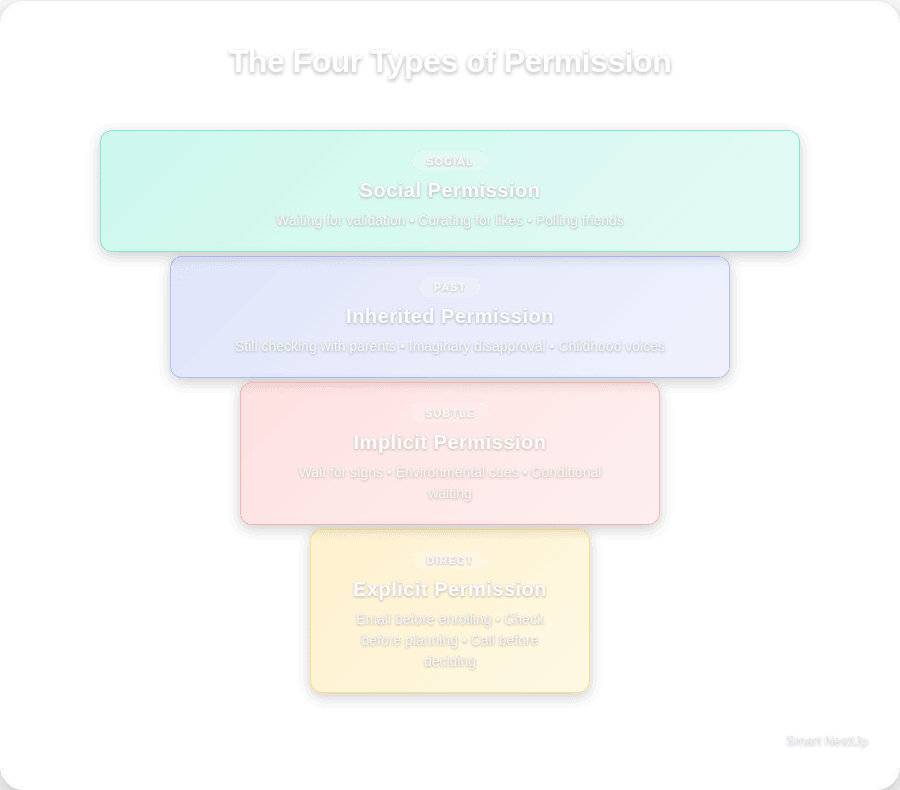
Understanding how permission-seeking manifests helps you spot it in your own behavior. These four types cover the majority of cases, though they often blend together in practice, creating complex permission architectures that can take years to dismantle.
Explicit Permission: The most visible form. You ask directly and wait for a yes. You email your boss before enrolling in the course. You check with your partner before making weekend plans. You call your parents before a major decision. The signs you’re trapped here: phrases like “I should probably ask first” and the feeling that action is blocked until a specific person responds. People caught in explicit permission patterns often have extensive “waiting to hear back” lists—decisions effectively frozen while they await responses that may never come. They treat non-responses as implicit no’s rather than opportunities to proceed. The psychological cost is a perpetual state of suspended animation, living in the conditional tense rather than the active.
To self-authorize: Conduct a reality check. Is there a rule requiring yes, or just a habit? If the latter, try informing instead of asking: “I’m enrolling in this course next month” rather than “Do you think I should?”
Implicit Permission: More subtle and therefore more insidious. You wait for environmental signals that never come. You’ll apply for the promotion if the posting is still up next week. You’ll start the business once you see someone similar succeed. You’ll have the conversation if they bring it up first. The signs: endless conditional statements (“if X happens, then I’ll move”) and the feeling that you’re always one sign away from starting. Implicit permission-seekers are often skilled at reading the room, picking up on subtle cues, interpreting silences. This perceptiveness becomes a trap when every decision requires external environmental alignment. The world rarely provides perfect alignment; it provides possibility and uncertainty in equal measure.
To self-authorize: Recognize that implicit permission is designed to keep you stationary. The conditions you set will always expand to fill the available space. Set a calendar date instead of a conditional trigger. The question shifts from “will the conditions be right?” to “will I be ready by this date?”
Inherited Permission: The childhood echo. You act as if parents, teachers, or early authority figures still hold veto power over your adult decisions. You’re thirty-five and considering whether Dad would approve of your career change. You’ve been financially independent for a decade but still feel you need to “check in” before big moves. The signs: thinking about what an authority figure from your past would say, feeling guilt about not consulting them, using their imagined disapproval as a reason to delay. Inherited permission is particularly stubborn because it operates below conscious awareness. You’re not asking because you intellectually believe they have authority; you’re asking because the neural pathway from childhood still fires. The parent who once controlled your bedtime now controls nothing, but your nervous system hasn’t received the memo.
To self-authorize: Acknowledge the voice without obeying it. Your parents’ anxiety is not your navigation system. Grieve the childhood need for approval while building adult self-trust. The work here is neurological as much as psychological—you’re building new pathways that bypass the old authority circuits.
Social Permission: Waiting for peer validation. You won’t call yourself a writer until someone else calls you one. You won’t start the podcast until your friends express enthusiasm. You curate your ambitions based on what gets likes. The signs: testing ideas in conversations before committing, abandoning projects that don’t get positive early feedback, feeling embarrassed about goals no one else shares. Social permission merges seamlessly with contemporary life. Social media platforms are essentially permission-seeking engines, designed to make us dependent on external validation metrics. The follower count becomes proxy for legitimacy. The like count becomes measure of worth. To self-authorize: Recognize that most people won’t support your risk—they’re managing their own fear. Your creative identity is established by creating, not by polling. The You’re Not Lazy—You’re Just Uninspired article explores how external validation dependency kills creative momentum.
Identify Your Permission Patterns
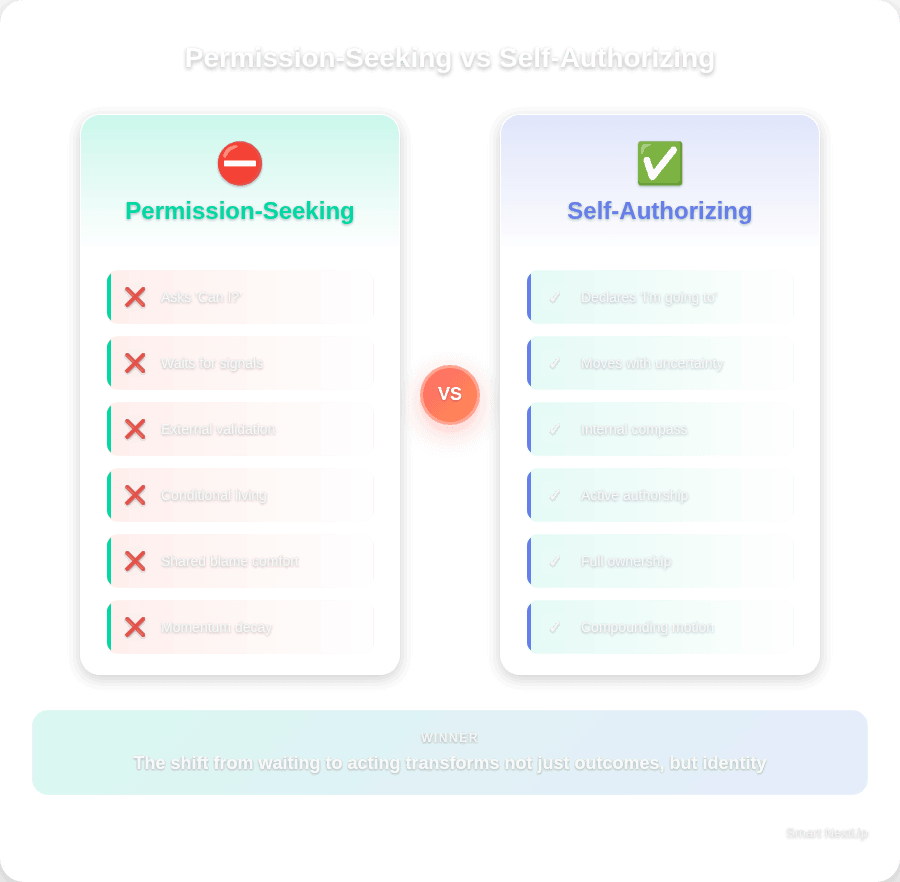
Before you can break the pattern, you need to see it clearly. These questions reveal where you’re outsourcing authority that belongs to you.
Self-Assessment Questions:
- Who do you mentally check in with before big decisions? (Name three people immediately.)
- If you couldn’t ask anyone’s opinion for thirty days, which decisions would feel impossible?
- What do you tell yourself you’re “waiting to hear back about” when no one is actually reviewing an application?
- Whose disapproval do you imagine most vividly?
- What would you do this month if no one could judge you for it?
- Which areas of your life do you treat as requiring committee approval?
- How many times this week did you say “I should ask…” or “I need to check…”?
- What decisions have you been “thinking about” for more than six months?
- Who would be most surprised if you moved without consulting them first?
- What’s the last thing you did that you didn’t tell anyone about beforehand?
| Signal | What It Reveals | Self-Authorization Response |
|---|---|---|
| “I should probably ask…” | Habitual deference to external authority | Ask: Is there a rule, or just a habit? |
| “I’m waiting to hear back…” | Treating non-responses as blocks | Set a deadline; act if no response |
| “What would [person] think?” | Imaginary audience control | Their thoughts don’t change the facts |
| “I can’t until I know for sure…” | Perfectionism disguised as caution | Clarity comes from motion, not waiting |
| “Is it okay if I…?” | Subordinating your needs to others | Shift to “I’m planning to…” |
| “I don’t want to disappoint…” | Carrying others’ expectations | You’re not responsible for their hopes |
| “I just need their blessing…” | Confusing approval with love | Love doesn’t require compliance |
| “What if they say no?” | Anticipatory obedience | Their no doesn’t bind if the yes is yours |
The Hidden Cost of Not Self-Authorizing
Short-term costs: Every delayed decision exacts its price. The job posting closes while you’re drafting the email asking if you should apply. The early-bird pricing expires while you’re polling friends about the retreat. The conversation window slams shut while you wait for the perfect moment. Beyond missed opportunities, hesitation breeds momentum decay. Objects in motion stay in motion; objects waiting for permission stay waiting. The longer you pause, the harder it becomes to start. Hesitation also builds resentment—you feel stuck but tell yourself it’s circumstantial, creating a low-grade frustration that poisons your mood without producing action.
But the short-term costs extend further. Each permission-seeking episode reinforces the neural pathways of deferral. Your brain literally gets better at waiting. Decision-making becomes harder over time, not easier. You develop decision fatigue not from making choices, but from the exhausting pre-choice consultation process. The cognitive load of managing other people’s potential reactions consumes bandwidth you could use for actual problem-solving.
There’s also a social cost. People notice. The colleague who always “checks in” stops being invited to the quick decisions. The friend who needs group consensus becomes exhausting to include in spontaneous plans. The partner who requires constant reassurance creates relationship friction. Permission-seeking doesn’t just delay your life—it gradually isolates you from the flow of normal social interaction.
Long-term costs: Identity erosion is the deepest wound. Each time you wait for permission you reinforce a story about who you are: someone who cannot be trusted with their own life. The Self-Forgiveness Protocol teaches us that our accumulated choices create our self-concept. If your history is full of waiting, you become someone who waits. The dreams that matter to you don’t die from opposition—they die from delay. The book remains unwritten not because you couldn’t write it, but because you kept waiting for someone to say you were qualified. The relationship stays unaddressed not because it couldn’t heal, but because you kept waiting for the other person to initiate. The business stays imaginary not because the market rejected it, but because you kept waiting for proof you weren’t foolish to try.
The permission debt accumulates. By age forty, many people carry decades of deferred decisions, each one a small weight on the psyche. The sum of these weights is often diagnosed as depression, anxiety, or midlife crisis—when it’s actually accumulated permission paralysis. The How to Quiet Your Mind framework addresses how accumulated indecision creates chronic mental noise.
Finally, there’s the opportunity cost impossible to calculate: who you would have become if you’d moved when you first felt the impulse. The version of you that exists in the parallel universe where you didn’t wait for permission. That person isn’t just ahead in career or relationships—that person has different neural pathways, different self-concept, different possibilities available. You’re not just delaying outcomes; you’re delaying your own evolution.
How To Self-Authorize
The Permission Reframe: When you catch yourself seeking permission, pause and ask: “Is there a rule, or just a habit?” Most permission-seeking collapses under this simple inquiry. Rules are real and must be navigated. Habits are just familiar grooves that feel necessary because you’ve traveled them so many times. This reframe shifts the question from social (will they approve?) to practical (is this actually required?). Most of the time, the answer is no.
Developing the permission reframe as a reflex takes practice. Start by catching yourself in the act. When you notice the impulse to ask, pause. Breathe. Ask the rule-or-habit question aloud if necessary. Create a moment of deliberation between impulse and action. Over time, this gap widens, and you find yourself making independent decisions as the new default.
The question itself is the threshold.
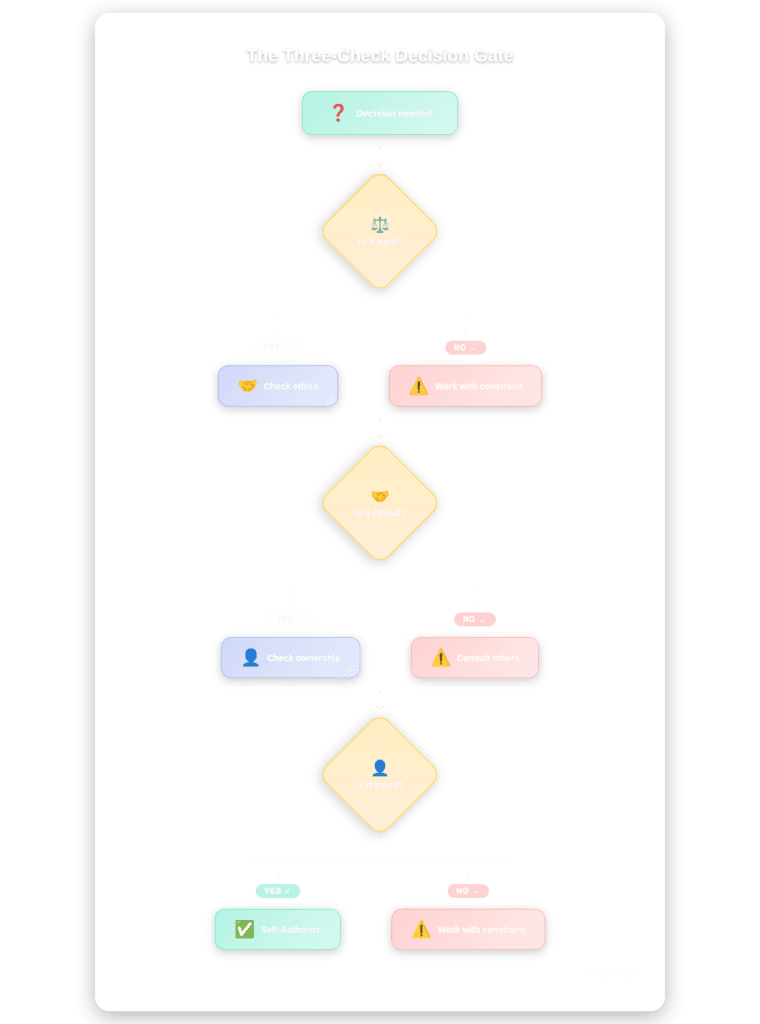
The Three-Check Decision Gate
Before accepting that you need permission, run three quick checks:
- Is it legal? – If you’re considering an action that violates law or contract, permission-seeking is appropriate.
- Is it ethical? – If your action would cause genuine harm to others, consultation matters.
- Is it mine to decide? – This is where most permission-seeking evaporates. If the choice affects primarily you, if the consequences fall on you, if the resources are yours—the decision is yours. No committee required.
The Three-Check Gate isn’t just a decision framework; it’s a permission detox protocol. Use it for every decision you’re tempted to outsource. Over weeks, you’ll notice patterns. Most of your decisions pass the legal and ethical checks easily. The third check—ownership—reveals the true scope of your authority, which is usually far broader than you’ve been acting.
Real-world applications: For career changes, the questions aren’t “Will my parents approve?” or “Will my coworkers judge me?” The relevant questions are legal (any non-compete issues?), ethical (will this abandon genuine obligations?), and ownership (is this my career to direct?). For creative projects, legality is rarely an issue. Ethics might involve commitments you’ve made. Ownership is definitive: your creative expression is yours to authorize. For difficult conversations, legality isn’t the barrier. Ethics requires honesty without cruelty. Ownership is shared when relationships are mutual—but you own your side of the street regardless of what the other person chooses.
The Three-Check Gate applies equally to small and large decisions. Whether you’re choosing a restaurant or choosing a life path, the framework holds. This consistency is part of its power—it trains you to treat your authority as a general condition of your life, not something you activate only for “big” decisions while surrendering it for daily choices.
Remember the Permission Reframe we explored earlier? These voices echo the same truth through different centuries.
Self-Authorization Quotes: Wisdom from Those Who Moved
“The question isn’t who is going to let me; it’s who is going to stop me.”
— Ayn Rand, Atlas Shrugged (1957)
Rand’s quote captures the fundamental reframe: the permission-seeker asks who grants authority, while the self-authorizer asks who removes it. Most of the time, no one is stopping you. The barriers are largely imaginary—fears dressed as facts, habits masquerading as requirements.
“Life shrinks or expands in proportion to one’s courage.”
— Anaïs Nin, Diary (February 1969)
Nin’s observation has resonated for decades because it names something true: the size of your life is directly correlated with your willingness to act without guarantees. Courage isn’t the absence of fear—it’s the decision to move despite it. Every act of self-authorization expands your life; every act of permission-seeking contracts it.
“You wanna fly, you got to give up the shit that weighs you down.”
— Toni Morrison, Song of Solomon (1977)
The “shit that weighs you down” includes all the accumulated expectations, imagined requirements, and borrowed anxieties that permission-seekers carry. You can’t soar while dragging a committee’s approval behind you. This is why the Three-Check Gate’s third question—Is it mine to decide?—matters most. The first two checks are usually clear; the third is where most permission-seeking quietly collapses on inspection.
Austin Kleon’s advice from *Steal Like an Artist* (2012) cuts through one of the most sophisticated forms of permission-seeking: the identity-based delay. “I can’t write because I’m not a writer.” “I can’t start the business because I’m not an entrepreneur.” “I can’t date because I’m not ready.” These statements all share a common logical error: the belief that identity precedes action.
The truth is the reverse. Action creates identity. You become a writer by writing. You become an entrepreneur by building. You become ready by doing. Waiting for your identity to crystallize before moving is like waiting for your muscles to develop before exercising.
Unconventional Ways to Self-Authorize
The Pre-Approval Strategy: Rather than asking “Can I?” operate on the assumption that you can, and adjust if genuinely necessary. The phrasing shift matters enormously. “I’m planning to start the coaching business next quarter” hits differently than “Do you think I should start a coaching business?” The first informs. The second invites veto. Most personal decisions don’t actually require a vote. Informing people who’ll be affected is courtesy. Asking permission you don’t need is surrender.
The Pre-Approval Strategy requires some discernment. It works best for decisions where the consequences fall primarily on you. It works less well for genuine partnerships where your choices materially affect others. The skill is knowing the difference. Most permission-seekers treat their decisions as requiring votes from people who aren’t actually affected—they just have opinions they like to share.
The Micro-Declaration: Announce what you’re doing to your circle before you’ve fully committed to doing it. Public commitment beats private hesitation. When you tell people “I’m writing a book this year,” the social cost of backing down outweighs the fear of starting. This isn’t manipulation—it’s using social pressure as fuel instead of an anchor. The declaration makes the thing real before your doubt can kill it.
The Micro-Declaration works because it leverages social consistency. Humans like to appear consistent. Once you’ve declared an intention publicly, your brain becomes invested in following through to avoid the discomfort of contradicting yourself. Permission-seekers often use this mechanism in reverse—they keep their intentions private to avoid embarrassment if they fail. The Micro-Declaration intentionally creates the mild discomfort that drives action.
The Historical Evidence Method: Look at past decisions where you moved without full clarity. How did they turn out? Most permission-seekers have a history of successful moves they made despite uncertainty. The evidence that you can authorize yourself already exists in your own life—you’re just not looking at it.
Our brains have a negativity bias. We remember the one time we moved without permission and something went wrong, while forgetting the dozens of times we moved successfully. The Historical Evidence Method corrects for this bias by systematically reviewing your actual track record. When you list your independent decisions and their outcomes, you’ll almost always see that your internal guidance system is more reliable than you’ve been giving it credit for.
Controversial Ways to Self-Authorize
These approaches aren’t universally applicable. They require discernment about context and consequences. Use when the conventional path has consistently failed you and you need to break patterns that have persisted for years.
Ask for Investment, Not Permission: Remember the Permission Reframe from earlier—is there a rule, or just a habit? This applies to partnerships too. In situations where you genuinely need someone’s involvement—boss, spouse, business partner—shift the frame. Instead of “Can I do X?” ask “Would you invest in X happening?” This changes power dynamics dramatically. Permission frames them as gatekeeper; investment frames them as stakeholder. People guard their gates jealously but evaluate investments pragmatically. The former invites reflexive no; the latter invites conversation.
The Investment Frame works because it honors their legitimate interest in the outcome while removing their illegitimate claim to process control. When you ask for permission, you’re implicitly saying they have authority over your direction. When you ask for investment, you’re saying they have a stake in the outcome—which they do—and you want to negotiate what that stake looks like. This preserves your authorship while addressing their valid concerns.
Remember the Three-Check Gate? If a decision passes all three checks—legal, ethical, and yours to decide—consider this approach.
The One Thing You Must Truly Do
Internalize this: You are the ultimate authority on your own life. No one else carries your consequences. No one else wakes up in your skin at 3 AM. No one else walks your path through time. This isn’t selfishness—it’s accuracy. You are the only one with full access to your interior experience, your values, your vision.
This truth can be terrifying. If you’re the ultimate authority, you don’t get to blame anyone else for outcomes. You don’t get to say “they told me to” when things go wrong. You don’t get to distribute responsibility when you’re uncertain. Total authority means total ownership. Many people prefer distributed authority precisely because it distributes blame. Self-authorization requires you to want ownership more than you want safety.
📜 Self-Authorization Declaration
Write these affirmations and sign your name below. This isn’t magical thinking—it’s a commitment device.
I am the author of my choices.
I consult wisdom, not approval.
I inform stakeholders, but I do not subordinate my life to their comfort.
I bear my consequences with dignity.
I move before I feel ready.
✍️ Sign it | 📅 Date it | 👁️ Keep it visible
The physical act of writing and signing shifts something in your psychology. You’re not just changing behavior; you’re changing identity. You become someone who self-authorizes by declaring that you are.
Treat this declaration as a living document. Review it monthly. Update it as your understanding deepens. The goal isn’t to create a perfect statement; it’s to create a reference point you can return to when your old permission-seeking patterns reassert themselves. And they will. Self-authorization isn’t a one-time achievement; it’s a practice you maintain. The declaration anchors that practice.
What If You’re Still Paralyzed?
Sometimes authority genuinely is external. You need the visa to immigrate. You need the funding to launch. You need the job offer to relocate. When you’re facing real constraints, permission-seeking isn’t pathology—it’s reality navigation. The key is distinguishing genuine external authority from imagined external authority.
Genuine constraints: Legal requirements, financial dependencies, contractual obligations, safety protocols, genuine partnership decisions. These require working with the constraint rather than pretending it doesn’t exist.
How to work with genuine constraints without letting them colonize your mind: Create parallel tracks. While waiting for the visa, learn the language. While waiting for the funding, build the prototype. While waiting for the job offer, develop the skills. Don’t let external gatekeeping occupy your entire mental bandwidth. Move everywhere you can move while waiting for permission where you truly need it. The Bounce-Back Formula offers strategies for maintaining momentum during unavoidable delays.
The parallel track approach prevents the all-or-nothing paralysis that often accompanies genuine constraints. You don’t have to stop everything while waiting for one gate to open. You can advance on multiple fronts simultaneously. This preserves your sense of agency and prevents the external constraint from defining your entire life experience.
Hard Truths
There are realities about permission-seeking that most advice glosses over. These truths are uncomfortable but necessary. Face them honestly.
Most people won’t explicitly support your risk. They’re managing their own fear. When you announce an ambitious plan, many people will respond with caution not because they doubt you, but because they doubt their own ability to handle uncertainty. Their “are you sure?” is often “I would be terrified.” Don’t mistake their fear for wisdom. The people cautioning you may have exactly zero experience with the path you’re considering. They’re projecting their limitations onto your possibilities.
Waiting for “the right time” is often waiting for zero risk. Ask anyone who made a major move. The right time didn’t arrive fully formed. They moved toward a tolerable risk level and accepted that clarity would come later. The perfect moment is a myth invented by people who never move. Real life provides windows of acceptable uncertainty, not guarantees of success. If you require certainty, you require stasis.
The people whose permission you seek often don’t want the responsibility of your decision. Your parents don’t actually want veto power over your career at age forty. Your friends don’t want to be held accountable if they encouraged you and you failed. Most of the time, people aren’t withholding permission—they’re just not that invested in your choice. The refusal you’re imagining might be projection. You’ve assigned them a role in your internal drama that they never auditioned for.
Self-authorization doesn’t guarantee success. It guarantees that you tried your way. The business might still fail. The relationship might still end. The decision might still hurt. But you’ll hurt having moved rather than having waited. That distinction matters enormously for the story you tell yourself afterward. The person who acts and fails has data for the next attempt. The person who waits and imagines failure has nothing but hypotheticals.
The world doesn’t reward permission-seeking. It rewards results. The person who waited for all-clear gets no extra credit for their caution. The person who moved with partial information and succeeded gets the opportunity. Caution isn’t a virtue if it prevents action indefinitely. The world has no memory of your careful deliberation. It only sees what you produced—or didn’t.
You’ll lose some relationships. Not dramatically, not through conflict, but through drift. The people who needed you to stay small will fade as you grow. This is natural selection applied to social circles. Don’t fight it. The Boundary Blueprint addresses healthy separation from limiting relationships.
The Enemies of Self-Authorization
These forces actively work against your ability to self-authorize. They’re not external villains; they’re internal patterns and social dynamics. Recognizing them is the first step toward neutralizing their influence.
The Childhood Echoes: Parental voices in your head don’t update automatically. The father who said “be realistic” when you were twelve might not say that today—but you’re still hearing it. The mother who worried about everything transferred her anxiety to you as a default setting. These echoes operate on old software. Update them: What would they say now if they truly saw who you’ve become? Better yet, ask them. You might discover they’ve been waiting for you to stop asking.
The Safety Bureaucrat: In every workplace, every family, every friend group, there’s someone who weaponizes procedure. They cite rules that don’t exist, raise concerns that are pure speculation, and present their anxiety as prudence. They don’t have actual veto power—they just sound authoritative. Learn to distinguish genuine risk assessment from bureaucratic obstruction. Ask for their data. If they can’t provide specifics, thank them for their concern and move anyway.
Social Comparison: Waiting until you’ve “earned” the right to try. You won’t start the business until you have an MBA like your competitor. You won’t write until you’ve read all the classics. You won’t apply until you’re overqualified. This is permission-seeking disguised as self-improvement. You’re not preparing; you’re waiting for external validation of your readiness. The You’re Not Lazy—You’re Just Uninspired article explores how comparison kills creative momentum.
The Good Child Identity: Believing obedience equals love. If you were praised for being easy, compliant, and low-maintenance as a child, adult permission-seeking might be a strategy to maintain worthiness. The belief: If I ask first and do what others want, I’ll be loved. The reality: Authentic love doesn’t require you to subordinate your life. You’re allowed to be easy to love and still take up space. The Good Child grows up to become the Confused Adult, wondering why their compliance never produced the intimacy they were promised.
Expert Worship: Over-deferring to credentials instead of intuition. Yes, experts know things. But you know you. When the doctor dismisses your symptoms and you doubt yourself anyway, that’s expert worship. When the consultant says your idea won’t work and you abandon it without testing, that’s expert worship. Use expertise as input, not authority. Your lived experience of your own life is data that no credential can override.
Fear of Disappointment: Not wanting to let down imaginary expectations. You’re paralyzed because you imagine your parents’ disappointment, your mentor’s surprise, your peers’ judgment. But have you verified these expectations exist? Often you’re protecting people from feelings they don’t actually have—or would have regardless of your choice. The Fear of Disappointment is particularly insidious because it masquerades as empathy. You’re not being considerate; you’re fortunetelling, predicting negative reactions that may never materialize.
Habitual Deference: You’ve asked for so long you’ve forgotten how to decide. The pattern becomes automatic. Before the thought “I want to do X” is fully formed, it’s followed by “I should check with Y.” The permission reflex fires before conscious evaluation. Breaking it requires catching the reflex in action and consciously overriding it. Treat every permission impulse as a notification to investigate, not an instruction to obey.
The Need to Be Seen as Responsible: Permission-seeking as impression management. You don’t actually need clearance—you just want to be perceived as someone who gets clearance. This is social performance rather than practical necessity. The question: Who are you performing for, and do they actually matter? The Responsible Person persona offers social acceptance in exchange for personal paralysis. It’s a bad trade.
Distraction as Permission-Avoidance: Sometimes staying busy is a way to avoid noticing you haven’t moved on what actually matters. If your days are full of activity but your life isn’t changing, you might be using motion to avoid the uncomfortable moment of self-authorization. Busyness is permission-seeking’s accomplice. It simulates productivity while preventing progress.
Past Experience Bias: One time you moved without permission and something went wrong. Now every decision requires a committee. One negative outcome creates a permanent permission requirement. This is trauma response masquerading as caution. Address the specific wound rather than applying universal restriction. A single failure doesn’t justify infinite hesitation.
The Comfort of Shared Blame: If you fail after getting permission, you can blame the permission-giver. “They told me it was okay.” This distributes risk but also distributes credit. The safety of shared blame costs you the dignity of ownership. The Boundary Blueprint addresses where your responsibility ends and others’ begins.
Time Distortion: “I just need a little more time to think.” Permission-seekers often experience time differently—deadlines feel arbitrary, urgency feels manufactured, delay feels wise. But time keeps moving regardless of your feelings about it. The window closes whether you feel ready or not. The subjective experience of time as infinite works against action. Objectively, you have finite days. Subjectively, it feels like you can always start tomorrow. The collision of these realities produces regret.
Comparison: Waiting to see what peers do first. You won’t be the first to leave the unhappy marriage, the dead-end job, the limiting city. You need someone else to prove it’s possible. This is permission-seeking by proxy—you’re waiting for social proof rather than personal clarity. The Life Reset Button explores breaking from peer-locked trajectories.
The Permission Paradox: The more permission you seek, the less competent you appear—and therefore the less permission you’re granted. It’s a feedback loop. People who act confidently are assumed to know what they’re doing; they get more leeway. People who constantly check in are assumed to need guidance; they get more oversight. Your request for permission creates the very conditions that make permission necessary. Breaking the loop means acting before you feel authorized.
Make It Yours
Personalization framework: Self-authorization looks different depending on who you are and where you operate. One size doesn’t fit all; the goal is finding your particular version of autonomy.
By Risk Tolerance: High tolerance people need guardrails against recklessness, not permission to act. Their work is slowing down enough to notice actual risks, not imaginary ones. Low tolerance people need graduated exposure to autonomy, not blanket encouragement. Their work is taking small independent steps, not dramatic leaps. Know your baseline. If you’re naturally cautious, start with 48-hour permission fasts on trivial decisions, not life-changing moves. If you’re naturally bold, focus on the ethical/legal checks rather than building more permission-seeking. Neither baseline is superior; both require calibration.
By Support Level: Solo decision-makers (single, independent, self-employed) have fewer structural constraints but may lack sounding boards. Their risk is over-isolation. Build intentional peer consultation—not permission-seeking, but perspective-gathering. Create deliberate spaces for input while maintaining ultimate authority. Partnered decision-makers (married, parents, collaborators) must balance self-authorization with genuine stakeholder consideration. Their risk is over-accommodation. The skill here is distinguishing stakeholder from bystander—not everyone with an opinion gets a vote. Negotiate clear domains of individual authority within partnership structures.
By Domain: Career decisions often involve genuine gatekeepers (hiring managers, licensing boards)—work with them strategically while self-authorizing your direction. You may need their approval for specific moves, but you don’t need their approval for your overall trajectory. Relationship decisions affect others but are still yours to make—consult for impact, not for permission. Creative decisions are almost entirely self-authorizable—outside agents don’t improve your art, they just delay it. Financial decisions require honesty about dependencies—coordinate when resources are shared, move when they’re yours. Each domain rewards different approaches; don’t apply a single template to all areas of life.
Non-negotiables: Safety and ethics are not up for self-authorization redefinition. If your autonomy harms others significantly, it’s not autonomy—it’s disregard. The goal isn’t to become unaccountable; it’s to become appropriately accountable. Accountable to law, to ethics, to genuine stakeholders—and free from imaginary gatekeepers. These boundaries aren’t limitations on self-authorization; they’re the conditions that make it meaningful. Unlimited license to harm isn’t freedom; it’s sociopathy. True autonomy exists within ethical constraints.
Improving the Odds
Environmental design: Your environment trains your behavior. If you surround yourself with “ask permission” people, you’ll keep asking. Seek out “ask forgiveness” people—those who move first and apologize later if necessary. Their energy is contagious. Just as permission-seeking is socially reinforcing, so is self-authorization. Find people who model the behavior you want to develop.
Find peers who track your progress, not veto your plans. The difference between an accountability partner and a permission-giver: An accountability partner asks “How’s it going?” A permission-giver asks “Should you really?” You want the former. If your current circle defaults to caution, add people who default to encouragement. You don’t need to abandon old friends—just balance them. Deliberately construct a social ecology that supports rather than suppresses your autonomy.
Physical environment matters too. If you make decisions in the same space where you were constantly corrected as a child, you might unconsciously recreate that dynamic. Change location when making big choices: coffee shops, nature, anywhere without the echo of old authority. The Strategic Boredom Protocol discusses how environment shapes decision-making patterns. Sometimes a new chair in a new room is enough to break the permission reflex.
Building self-authorization habits: Design your physical and digital environments to make independent action the default. Auto-save for significant purchases so you can’t impulsively ask permission. Schedule decision dates on your calendar. Create physical spaces that you designate as “permission-free zones” where you practice complete autonomy. These environmental cues build new patterns without requiring constant willpower.
Evaluate
Tracking progress: Measure decision velocity—how much time passes between idea and action. Permission-seekers often have idea-to-action timelines measured in months or years. Target idea-to-action within days for personal decisions, weeks for complex ones. Document your decision velocity weekly. Watch for the gradual acceleration as new patterns establish.
Track regret ratio: delayed decisions vs. rushed decisions. Most people assume self-authorization leads to recklessness, but the far more common outcome is realizing you should have moved sooner. Track actual outcomes. Are you making more mistakes by acting, or by waiting? The data usually surprises permission-seekers. They discover that their caution wasn’t preventing errors; it was just delaying them—and making them more expensive when they finally occurred.
Adjusting course: If you’re acting too fast and creating messes, slow down—but only after acting. The adjustment isn’t to ask permission; it’s to build in reflection pauses after action rather than before. Post-decision evaluation serves you better than pre-decision paralysis. The goal is iterative improvement, not perfect planning. Plan, act, evaluate, adjust. Missing the first two steps leaves you in endless preparation.
Monthly calibration: Set a monthly review of your permission patterns. Where did you ask when you could have informed? Where did you wait when you could have moved? Where did you seek input on decisions that were yours alone? This isn’t self-recrimination; it’s data collection. You’re building a profile of your permission-seeking that will reveal patterns invisible in day-to-day experience.
Flip-Flopping
Breaking the start/stop cycle: Permission-seekers often move in spasms. Brief flurries of action followed by retreat back into consultation. The “decide for a week” rule helps: When you make a choice, commit to it for seven days before reconsidering. The urge to reverse usually peaks at day two or three. If you can weather that urge, you often find the decision was sound—and your doubt was just habit asserting itself.
Flip-flopping isn’t just indecisiveness; it’s the backfire effect of suppressed permission-seeking. You force yourself to act, then your old patterns rebel, demanding to be heard. The urge to reverse is often not about the decision’s quality but about your nervous system’s discomfort with autonomy. Treat the urge as data about your adaptation process, not data about the decision.
Consistency over intensity: Small sustained actions build more momentum than dramatic declarations followed by collapse. Self-authorize modestly but reliably. The person who writes 200 words daily without asking anyone’s opinion builds more than the person who announces a novel and then waits for encouragement to continue. Permission-seekers often crave the dramatic transformation—the bold announcement, the visible break—but these high-intensity moments rarely stick. What sticks are the small, unglamorous daily choices to trust your own judgment.
The 90-day commitment: For any significant change, commit to 90 days of consistent action before evaluating whether to continue. This overcomes the initial resistance period while providing enough data for genuine assessment. Ninety days is long enough for new neural pathways to begin forming, short enough to be bearable even when uncomfortable. Mark it on your calendar. Don’t evaluate until the date arrives.
Examples
The thirty-five-year-old waiting for parental approval to marry. The partner is wonderful, the timeline is right, but she keeps imagining her father’s disapproval of the partner’s profession. She delays the engagement for two years, straining the relationship. Finally, she proposes first, tells parents second. Her father, confronted with a done deal, accepts warmly. The disapproval she’d feared was projection. The two years of delay served no one, protected nothing, prevented nothing. The fear was the only obstacle.
The employee waiting for manager sign-off on a project that’s her responsibility. The company culture encourages consultation, but she takes it to extremes—checking in on minor decisions within her mandate. Her manager, annoyed by the constant interruptions, finally says: “Stop asking me things you’re paid to decide.” The permission-seeking was costing her credibility, not building it. What she thought showed responsibility actually signaled incompetence. Her autonomy was expected; her deference was problematic.
The creative waiting for 1,000 followers before calling herself a writer. She writes daily but won’t claim the identity. She needs external validation of her legitimacy. After years of waiting, she posts a piece anyway. The response is modest but real. She realizes the follower count was a moving target—she would have needed 10,000 once she hit 1,000. The permission was never coming; she had to take it. The external validation she sought would have been a byproduct of claiming the identity, not a prerequisite for it.
The entrepreneur waiting for full funding before starting. He’s convinced he needs six months of runway to launch safely. He pitches for two years, getting partial commitments but never full funding. Meanwhile, competitors with less capital launch and iterate. When he finally starts with three months of savings, he realizes the full-funding requirement was fear disguised as prudence. The funding didn’t determine his readiness; his fear determined his funding requirements. The The Motivation Myth explores how external conditions are often justifications for internal hesitation.
The patient waiting for a symptom diagnosis before trusting her body. Doctors dismiss her concerns for years. She keeps seeking medical permission to believe something is wrong. Finally, she trusts her own experience and insists on testing. The diagnosis confirms what she knew. The self-authorization wasn’t about medical knowledge—it was about trusting her own embodied experience against external dismissal. Healthcare is one domain where expert authority is real, but it doesn’t override your authority over your own body’s signals.
Example (Detailed)
Kai had been talking about leaving finance for three years. Every conversation with friends started with “I’m thinking about…” never “I’m planning to…” or “I’ve decided to…” He’d built elaborate transition plans, researched teaching programs, saved six months of living expenses. He’d done all the preparation. But he kept waiting for signs that it was okay—his parents’ blessing for abandoning the lucrative career they’d encouraged, his boss’s understanding for leaving a “good job,” his peer group’s validation that this wasn’t a midlife crisis masquerading as purpose-seeking.
The preparation became its own form of permission-seeking. Each new certification, each additional month of savings, each completed research phase was another way to delay while appearing productive. Kai didn’t need more preparation; he needed permission to use the preparation he’d already done. But the permission wasn’t coming because the people he was asking weren’t the ones who could grant it—only he could.
The turning point came when his father, the original source of his permission-seeking pattern, actually said: “Why do you keep asking me? You’re forty.” The question hit him physically—he’d been performing a ritual his audience had stopped watching. His father didn’t want veto power over his life; he wanted his son to live it. The revelation that the authority figure didn’t want to be the authority figure anymore broke the spell. The permission Kai sought had become permission his father didn’t want to give—didn’t feel qualified to give, didn’t think he should give.
Kai enrolled in the alternative teaching certification program first, told people second. The fallout was real but brief. His mother worried publicly for three weeks, then adjusted when she saw he wasn’t asking for rescue. His coworkers expressed surprise, then curiosity—several confessed their own fantasies of leaving. One friend actually said he was jealous of Kai’s courage—revealing that the disapproval Kai feared was actually admiration he didn’t recognize because he was projecting his own fear onto others.
The hardest part wasn’t the transition—it was the identity shift. For two decades he’d been the cautious one, the responsible one, the one who checked all the boxes before moving. Becoming someone who moved without full clarity felt like betrayal of his old self. He grieved that identity while building the new one. The grief surprised him; he didn’t know he was so attached to being the person who waited. Now, two years in, he describes the experience not as jumping but as finally walking through a door that had always been open. The only thing that changed was his willingness to step through it.
Myths vs. Facts
| Myth | Fact |
|---|---|
| Good people consult others before acting. | Good people inform others when appropriate. Consultation is optional, not mandatory. Moral quality isn’t measured by how many people you ask. |
| Better safe than sorry. | Regret weighs heavier than embarrassment. Most people regret what they didn’t do, not what they did. Safety often masquerades as fear. |
| Wait until you’re sure. | Clarity often comes from motion, not meditation. You learn by doing, not by waiting. Perfect clarity is usually a post-hoc attribution. |
| Asking shows respect. | Respect equals information sharing, not subordination. You can respect someone without giving them veto power over your life. |
| If they object, you should reconsider. | Objection reveals their comfort zone, not your error. Evaluate objections on substance, not volume. Many objections are reflexive fear responses. |
| Responsible people get permission. | Responsible people own consequences. Permission and responsibility are different virtues. One distributes risk; the other distributes credit. |
| Approval protects against failure. | Approved projects fail all the time. Permission doesn’t create success; it just distributes blame. The person whose permission you sought won’t share your failure. |
| You’ll know when the time is right. | The right time is a myth. You create timing by moving, not by waiting for cosmic alignment. Circumstances rarely align perfectly; you align with imperfect circumstances. |
| It’s selfish to decide without consulting. | It’s self-abandoning to subordinate your life to others’ comfort. Healthy boundaries aren’t selfish. Selfishness harms others; boundaries protect you. |
| Experts should guide major decisions. | Experts offer perspective; you offer context. No one is more expert on your life than you. Expertise is a tool, not an authority. |
| Patience is a virtue. | Patience is sometimes procrastination’s virtue signaling. Know the difference between strategic waiting and fearful stalling. |
| Family always knows what’s best. | Family often knows what feels safest to them, which isn’t the same as what’s best for you. Their wisdom is limited by their own unexamined assumptions. |
| If it’s meant to be, it will happen. | Fatalism is permission-seeking disguised as spirituality. You are the agent of your life. The universe doesn’t orchestrate your choices; you do. |
| Don’t rock the boat. | Boats that never rock don’t move forward. Stability is often stagnation. Forward motion creates temporary turbulence. |
Common Mistakes to Avoid
Seeking permission to avoid blame. Why we do this: If we fail after getting permission, we can blame the permission-giver. “They told me to.” This distributes risk but also distributes credit. The safety of shared blame costs you the dignity of ownership. What to do instead: Own outcomes fully. The win is yours; the loss is yours. Dignity lives in ownership. Accept that autonomy means accepting consequences.
Thinking asking shows respect. Why we do this: We’re conflating courtesy with subordination. We think asking permission is the polite thing to do. What to do instead: Distinguish information-sharing from permission-seeking. “I’m planning X” is respectful. “May I do X?” is subordinate when X is yours to decide. The former acknowledges others without surrendering to them.
Confusing risk assessment with permission-seeking. Why we do this: Smart people analyze risks. Permission-seekers get stuck in analysis that masquerades as caution. What to do instead: Analyze risks independently, then move. Don’t use “I need to think about it” as code for “I need someone else to okay it.” Real analysis has endpoints; permission-seeking analysis expands to fill available time.
Announcing before you’re ready to commit. Why we do this: We want encouragement to carry us over the fear hump. But announcing prematurely invites doubt from others just when you need momentum. What to do instead: Move far enough that you’re committed before you announce. Let the action itself be your announcement. Momentum is easier to maintain than to restart.
Reversing when others disapprove. Why we do this: Disapproval feels like a signal to stop. We’re social animals; opposition triggers retreat reflexes. What to do instead: Evaluate disapproval on substance. Is there information you lack, or just discomfort you can weather? Substantive objection deserves consideration; reflexive objection deserves acknowledgment without adjustment.
Waiting for perfect conditions. Why we do this: Perfectionism feels like high standards. It protects us from the vulnerability of showing up imperfectly. What to do instead: Recognize that perfect conditions are a delaying tactic. Set a date. Move by the date regardless of condition satisfaction. You’ll almost always find the conditions were sufficient—and if they weren’t, you’ll adjust from a position of momentum.
Conflating stakeholder input with permission. Why we do this: In genuine partnerships, other people’s experience matters. But we sometimes treat bystanders as stakeholders and stakeholders as gatekeepers. What to do instead: Be honest about who is genuinely affected by your choice vs. who simply has an opinion about it. Affected parties get consultation; opinion-havers get information at most.
Using research as stalling. Why we do this: Learning feels productive. It satisfies the need for motion while avoiding action. What to do instead: Cap research time. After a certain point, you’re not preparing; you’re hiding. The 80/20 rule applies: 80% of useful preparation happens in the first 20% of research time. The rest is often anxiety management disguised as due diligence.
Demanding validation from the wrong people. Why we do this: We want approval from the people whose opinions we valued in the past, even when those people have no stake in our current choices. What to do instead: Identify who is actually affected by your decision. Consult those people. Everyone else gets information or silence, depending on relevance. The people who knew you at twelve don’t necessarily know you at forty.
Making self-authorization your new identity. Why we do this: We replace one rigid self-concept with another. We become the person who “never asks permission” just as rigidly as we were the person who “always asks permission.” What to do instead: Hold self-authorization as a practice, not an identity. Sometimes asking permission is appropriate. The goal is choice, not uniformity.
Challenges to Try
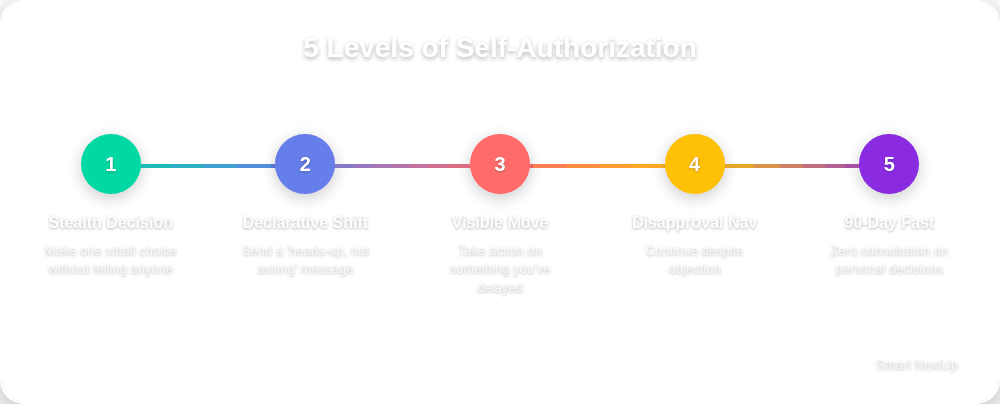
Level 1: The Stealth Decision Make one small decision today without telling anyone first. Choose the restaurant, book the ticket, buy the book. Notice how it feels. Notice the urge to announce. Let the action exist without external commentary. Track: How long did you wait before the urge to tell someone? How did you feel afterward compared to announced decisions? The goal isn’t secrecy; it’s experiencing your own authority without the buffer of validation.
Level 2: The Declarative Shift Send a “head’s up, not asking” message about a personal choice. “I’m enrolling in the course next month” rather than “What do you think about me taking a course?” This upgrades your language from interrogative to declarative. Track: How do people respond to information versus request? How does it feel to position yourself as informer rather than petitioner? Most people won’t notice the shift; your internal experience will be seismic.
Level 3: The Visible Move Take visible action on something you’ve been “thinking about” for months. The business registration, the relationship conversation, the creative publication. Do it first, discuss it second. Track: What actually happens when you move without the prolonged consultation period? Is the fallout you feared real, or imagined? Notice that consequences, when they occur, are manageable. The catastrophe you anticipated rarely materializes.
Level 4: The Disapproval Navigation Continue your course despite active objection from someone whose opinion matters to you. Not recklessly—after evaluating the objection’s substance—but firmly. Track: Does the relationship survive the disagreement? Does your self-concept survive acting despite opposition? What do you learn about the difference between comfort and compatibility? This is the graduate course in self-authorization.
Level 5: The 90-Day Permission Fast For ninety days, consult no one on personal decisions. Inform stakeholders as appropriate, but eliminate the consultation phase. Decide alone. Act alone. Own the results alone. Track: Decision velocity, regret patterns, relationship quality, self-trust levels. This is transformative if completed, but don’t start here if you haven’t worked through the earlier levels.
Next Steps
7-Day Self-Authorization Protocol:
Day 1: Identify your top three imaginary gatekeepers. Who do you consult most reflexively? Write their names and the specific domains where you seek their permission. Be specific: not “my parents” but “my father about career decisions.”
Day 2: Audit recent decisions. Look at the past month. Which moves did you delay seeking permission you didn’t need? Which small decisions could you have made unilaterally? Notice patterns in timing, domain, and gatekeeper.
Day 3: Practice declarative language. Convert three upcoming announcements from questions to statements. Write them out. Practice saying them. “I’m planning…” instead of “Should I…” or “Do you think…”
Day 4: Make one stealth decision. Something within your authority that you’d normally discuss first. Just do it. Notice the feelings—the urge to tell, the anxiety, the eventual relief. Document all of it.
Day 5: Write your Self-Authorization Declaration. Commit it to memory. Sign it if paper helps make it real. Post it somewhere visible if that reinforces the commitment.
Day 6: Evaluate a past regret through the permission lens. Where did waiting for permission cost you? Forgive yourself; update your early warning system. Extract one pattern to watch for going forward.
Day 7: Look ahead thirty days. Identify one move you’ve been delaying for permission reasons. Set a date. Commit to acting by that date regardless of external signals. Put it in your calendar as a non-negotiable appointment with yourself.
Prioritized Action List:
Immediate (today): Write your three gatekeepers and identify one stealth decision for this week.
This week: Complete at least Days 1-4 of the protocol above.
This month: Attempt Level 2 or 3 challenge from the previous section. Document outcomes.
This quarter: Evaluate whether your decision velocity has changed. Adjust your approach based on data, not mood. Consider whether deeper work (therapy, coaching) would support your self-authorization practice.
Bonus Section: Strategic Permission-Seeking
Self-authorization isn’t about refusing all permission-seeking—it’s about making it strategic rather than default. There are situations where seeking permission serves your interests.
Relationship alliances: In genuine partnerships, strategic permission-seeking builds goodwill. You don’t need your partner’s permission to buy a coffee, but checking in before major purchases preserves trust. The skill is calibrating: What’s a major purchase to you might be trivial to them, and vice versa. Negotiate the thresholds, then operate within them. The goal is mutual information, not mutual veto.
Workplace navigation: Bureaucratic environments reward visible deference. If your organization genuinely requires sign-off for certain moves, work with that structurally while maintaining internal self-authorization. Get the signature, but don’t let the wait-list colonize your mindset. Keep moving on parallel tracks. You’re playing the game while remembering it’s a game.
Legal and ethical zones: Permission-seeking isn’t weakness when there are genuine consequences. The visa, the license, the regulatory approval—these require patience and process. Strategic permission-seeking means recognizing where patience is necessary and where it’s a stalling tactic in disguise. It means knowing which delays are mandatory and which are optional.
The permission paradox: Sometimes seeking permission is a power move. When you ask someone with genuine authority for something you’re confident they’ll grant, you’re confirming their status while advancing your agenda. This isn’t self-abandonment; it’s chess. Know when you’re playing chess versus when you’re just afraid to move. The difference is intention and awareness.
Marianne Williamson wrote these words in her book A Return to Love (1992), and they have been widely circulated—often misattributed to Nelson Mandela, ironically, when they are exactly the kind of wisdom we seek external validation for. Williamson’s passage names something profound: playing small is a service to no one. When you shrink to make others comfortable, you don’t help them; you normalize shrinking.
The connection to permission-seeking is direct. Every time you wait for external authorization to pursue your ambitions, you are playing small. You are assuming that your light requires others’ blessing to shine. Williamson’s passage reframes this entirely: your authority doesn’t come from others’ approval. It comes from your existence. You don’t need permission to be brilliant, gorgeous, talented, fabulous. You need only to stop waiting for someone to tell you it’s okay.
And there’s an additional layer here: “As we are liberated from our own fear, our presence automatically liberates others.” Your self-authorization isn’t selfish. It gives others permission to do the same. The person waiting for their father’s blessing to change careers sees you change careers without that blessing. Your action becomes their new possibility. Your courage becomes part of their neural evidence that such courage is possible. Self-authorization ripples outward.
Affirmations
- I don’t need a committee to live my life. My choices are mine to make, mine to bear, mine to learn from.
- Informing is not the same as asking. I can share my path without requesting approval for my destination.
- My clarity comes from moving, not waiting. Action reveals what contemplation conceals.
- I am the only permanent resident of my life. Others visit; I remain. My authority is inherent, not granted.
- Disapproval is information, not instruction. It tells me about their comfort, not about my path.
- The worst decision I can make is staying stuck. Even imperfect movement teaches. Stasis only repeats.
- I do not need their blessing to proceed. Love that requires compliance isn’t love; it’s conditional acceptance.
- If I wait until I’m ready, I’ll wait forever. Readiness is a myth invented by people who never move.
- My discomfort is not a stop sign. It’s a growth signal. The feeling of risk is the feeling of expansion.
- I trust my track record. I’ve successfully made hundreds of decisions without committee approval. This one is no different.
FAQ
1. What if I make a mistake without getting input?
You’ll make mistakes regardless of consultation. The question isn’t whether input prevents error—it usually doesn’t. The question is who owns the learning. Mistakes made through self-authorization teach you about your own judgment. Mistakes made through permission-seeking teach you about other people’s limits. Your judgment is more valuable to develop. And consider this: when you consult widely and still make a mistake, you learn that consultation doesn’t prevent error. When you act independently and make a mistake, you learn something about the decision itself.
2. What if my partner or parents are genuinely affected by my decision?
Affected parties deserve consideration, not necessarily veto power. The line between consideration and subordination is simple: Do you inform them of decisions you’ve made, or do you wait for their approval before deciding? For genuine stakeholders, consult on impact; but retain authorship of direction. If your decision materially affects their lives—finances, living situations, shared responsibilities—they have a right to input on the impact. They don’t automatically have a right to input on the decision itself. Negotiate the boundary clearly.
3. How do I know if I’m being reckless versus self-authorizing?
Recklessness ignores consequences; self-authorization owns them. Ask: Have I evaluated the actual risks, or am I just ignoring them? Am I prepared to bear the costs if this doesn’t work? If you’ve done real risk assessment and you’re prepared to own the outcomes, you’re self-authorizing. If you’re hoping luck will save you from consequences, that’s recklessness. The difference isn’t in the action—it’s in the preparation and the willingness to own results.
4. What about decisions that require genuine expertise?
Expertise is input, not authority. A doctor’s medical knowledge exceeds yours; your experience of your body exceeds theirs. An accountant’s tax knowledge exceeds yours; your values about money exceed theirs. Use expertise for information; don’t surrender sovereignty to credentials. The expert offers probabilities and possibilities; you choose among them. The expert doesn’t live with your choice; you do.
5. How do I handle the guilt of not consulting?
Guilt in this context is often habit asserting itself. You’ve trained yourself to feel bad about autonomous action; now autonomous action triggers bad feelings. The guilt isn’t signaling genuine ethical violation—it’s signaling pattern disruption. Acknowledge the feeling, verify there’s no actual harm, and proceed. The guilt fades as the new pattern establishes. If the guilt persists beyond a reasonable adjustment period, examine whether you’re genuinely violating your own values or just disappointing others’ expectations.
6. What if I self-authorize and then realize I was wrong?
You correct course. Self-authorization isn’t about being right; it’s about being responsible. The person who moves and adjusts learns faster than the person who waits for perfect information. Wrong is data; waiting is just waiting. The self-authorizer who errs owns the error, learns from it, and adapts. The permission-seeker who errs blames the advice-giver and learns nothing about their own judgment. Over time, this difference compounds dramatically.
7. How do I deal with people who punish me for not consulting them?
Some people do use withdrawal or anger to enforce consultation patterns. Assess whether this is a relationship you can afford to educate versus one you need to manage. With close relationships, name the pattern: “I notice you’re upset I didn’t ask first. I’m working on trusting my own judgment. I value your input, but I need to be the final authority on my choices.” With less close relationships, sometimes you just let them be upset without adjusting your behavior. Their emotional reaction is their responsibility.
8. Isn’t some permission-seeking cultural? How do I honor my culture while self-authorizing?
Cultural norms around consultation vary widely. The goal isn’t to reject your culture but to locate yourself within it authentically. Some cultures emphasize collective decision-making as genuine value, not pathology. The question is always: Am I participating in this norm because it reflects my values, or because I’m afraid to deviate? Cultural participation chosen is different from cultural participation enforced. You can honor your heritage while still being the author of your individual choices.
9. What if my job genuinely requires sign-offs?
Work with structural constraints without letting them become psychological ones. Get the signature; don’t let the wait-list colonize your sense of agency. Build parallel tracks where you’re not waiting. The goal isn’t to eliminate all external dependencies—it’s to prevent them from occupying your entire mental bandwidth. Know which parts of your job require approval and which don’t. Don’t expand the approval requirement beyond its actual boundary.
10. How do I self-authorize when I’m depressed or anxious?
Mental health challenges complicate self-authorization because your internal signals are distorted. When depressed, everything feels like a bad idea. When anxious, everything feels risky. In these states, external consultation can actually help—if it’s with trusted people who know you. The key is distinguishing supportive consultation from permission-seeking. You’re not asking for approval; you’re asking for perspective while you navigate distorted signals. That’s wisdom, not weakness. Consider professional support as well; therapy can help you distinguish your authentic voice from the voice of your condition.
11. What if my intuition is genuinely unclear?
Sometimes you don’t know what you want. Self-authorization in these moments means authorizing the exploration. You don’t need to decide the destination to self-authorize the journey. Choose to explore rather than waiting for clarity to arrive fully formed. The act of moving helps clarify what you actually want in ways that contemplation doesn’t. Authorize a small experiment in each direction. See which one generates energy versus resistance.
12. How do I handle the loss of relationships that can’t accommodate my self-authorization?
Grieve them, but don’t reverse course to preserve them. Some relationships are built on your compliance; when you stop complying, the relationship ends. This is sad but not tragic. Relationships that require you to stay small to survive aren’t relationships that serve your growth. The grief is real; the return isn’t necessary. Some losses open space for new connections that can meet you where you’re growing.
13. Can I self-authorize too much? Is there a downside?
Yes, if self-authorization becomes disregard for others. If you stop consulting entirely, stop considering impact, stop acknowledging interdependence—you’ve swung too far. The goal is appropriate autonomy, not total independence. You want to be self-authorizing, not self-isolating. Healthy self-authorization exists in community; it just doesn’t subordinate itself to it. Watch for the signs: Are you losing meaningful connections? Are you harming others? Are you ignoring legitimate feedback?
14. How does this apply to parenting?
Parents do have genuine authority over minor children’s lives. But within that authority, you can model self-authorization. Show them how to decide, how to own outcomes, how to adjust. And as they age, gradually transfer authority to them. Don’t raise children who need external permission by never letting them practice internal authority. The goal is raising adults who don’t need your approval to live their lives; start that transition early.
15. What if I’m genuinely unsure what I want?
Self-authorization doesn’t require certainty about outcomes. It requires willingness to own the process of discovery. You don’t need to know the destination to authorize the first step. Sometimes the self-authorization is simply choosing to explore rather than waiting for clarity to arrive fully formed. The act of moving helps clarify what you actually want in ways that contemplation doesn’t. Try small experiments in multiple directions. See what generates energy. Follow that.
16. How do I handle backlash from multiple people at once?
When several important people oppose your choice simultaneously, the pressure is intense. Pause and evaluate: Is this substantive objection I need to hear, or collective discomfort with change? Sometimes multiple people object because you’re actually making a mistake. Sometimes they object because your move threatens their understanding of stability. The skill is distinguishing between these cases under pressure. Don’t confuse volume of objection with validity of objection.
17. What if the person whose permission I seek is paying for it?
Financial dependency complicates self-authorization legitimately. If someone funds your choices, they have genuine stake. The work here is to move toward financial autonomy while navigating current dependencies with integrity. Acknowledge their investment without surrendering your direction. And prioritize building your own resource base so future decisions are fully yours. The timeline for full self-authorization may be longer in these circumstances, but the direction should be clear.
18. I’m tired of being the only one who decides. I want someone else to take charge sometimes.
That’s human. Decision fatigue is real. The desire to outsource isn’t weakness—it’s overload. The distinction: Do you want to share the burden with a genuine partner, or do you want to abdicate responsibility to avoid accountability? Sharing is healthy. Abdicating perpetuates the cycle that created your fatigue. Consider whether you’re taking on decisions that aren’t actually yours. Delegate appropriately. But don’t delegate your life to avoid living it.
19. What if my self-authorization hurts someone I love?
This is the genuine ethical concern, not a permission-seeking rationalization. If your autonomy causes real harm to others—not just discomfort, but genuine harm—self-authorization becomes disregard. The task is distinguishing between harm and inconvenience. Changing careers might inconvenience your family’s schedule; it doesn’t harm them. Leaving a marriage harms the other person’s expectations and emotional stability. Harm requires different consideration than inconvenience. Don’t use self-authorization as an excuse to wound people carelessly.
20. How long does it take to change permission-seeking patterns?
Neural pathways change gradually. Expect 60-90 days of consistent practice to establish new defaults. Expect occasional backsliding for a year or more. Permission-seeking patterns developed over decades won’t disappear in weeks. But they will weaken. Each successful independent decision builds the new pathway. Each return to old patterns, when you catch it and correct it, also builds the new pathway. Over time, self-authorization becomes the default and permission-seeking becomes the conscious choice.
Final Thoughts
You’ve walked through the architecture of permission-seeking. You’ve seen where it hides, how it disguises itself, what it costs. You’ve met the enemies that enforce it and the practices that dissolve it. You’ve read the hard truths and the paradoxical strategies. You’ve heard from those who moved—Rand, Nin, Morrison, Mandela, Williamson, Kleon—and seen how their words apply to your particular stuckness. Now comes the moment that matters.
Not a comfortable conclusion. Not reassurance that the people in your life will come around eventually. They might; they might not. The validation you’ve been waiting for may never arrive. The permission slip may never be signed. The green light may stay red in perpetuity. And even if they do come around, if the validation does arrive, if the light turns green—you will have lost the years between now and then. Years that could have been lived in motion rather than hesitation.
Here’s the challenge: Move anyway.
The work of self-authorization isn’t about achieving comfort with uncertainty. It’s about acting while uncertain. It’s about choosing when you can’t be sure, owning when you can’t be safe, and bearing the consequences with whatever dignity you can muster. The goal isn’t to eliminate the fear of disapproval; it’s to make the fear irrelevant to your motion. The goal isn’t to be fearless; it’s to be courageous, which is fear plus action in the right ratio.
You are not a draft waiting for editorial review. You are the published work—imperfect, ongoing, but real. The only authority that matters has been inside you all along. The question was never whether they would give you permission. The question was whether you would accept that it was already yours. Whether you would trust your own judgment enough to act on it. Whether you would value your own direction more than you valued others’ approval.
Mary Oliver posed this question in her poem “The Messenger” (1986). It’s the question that haunts permission-seekers. Are you living fully, or just breathing enough to get by? Are you moving through your days with intention and authorship, or are you drifting on currents of others’ expectations, breathing just enough to maintain the illusion of participation?
The work starts now. Not when they approve. Not when you’re certain. Not when conditions align. Now. The committee is dismissed. The pen is in your hand. The next chapter is yours to write.
Write it.
Not a comfortable conclusion. Not reassurance that the people in your life will come around eventually. They might; they might not. The validation you’ve been waiting for may never arrive. The permission slip may never be signed. The green light may stay red in perpetuity. And even if they do come around, if the validation does arrive, if the light turns green—you will have lost the years between now and then. Years that could have been lived in motion rather than hesitation.
Here’s the challenge: Move anyway.
The work of self-authorization isn’t about achieving comfort with uncertainty. It’s about acting while uncertain. It’s about choosing when you can’t be sure, owning when you can’t be safe, and bearing the consequences with whatever dignity you can muster. The goal isn’t to eliminate the fear of disapproval; it’s to make the fear irrelevant to your motion. The goal isn’t to be fearless; it’s to be courageous, which is fear plus action in the right ratio.
You are not a draft waiting for editorial review. You are the published work—imperfect, ongoing, but real. The only authority that matters has been inside you all along. The question was never whether they would give you permission. The question was whether you would accept that it was already yours. Whether you would trust your own judgment enough to act on it. Whether you would value your own direction more than you valued others’ approval.
Mary Oliver posed this question in her poem “The Messenger” (1986). It’s the question that haunts permission-seekers. Are you living fully, or just breathing enough to get by? Are you moving through your days with intention and authorship, or are you drifting on currents of others’ expectations, breathing just enough to maintain the illusion of participation?
The work starts now. Not when they approve. Not when you’re certain. Not when conditions align. Now. The committee is dismissed. The pen is in your hand. The next chapter is yours to write.
Write it.


