
The phone sits in your palm like a smoking gun. You wake up reaching for it—already guilty, already behind. Three hours later, you’re still there, thumb aching, eyes dry, the vague sense that you’ve just lost something you can’t name. The screen time notification arrives on Sunday evening like a judge’s gavel: 6 hours and 47 minutes daily average. You feel sick. You feel caught. And the verdict seems obvious: the phone is destroying you.
But what if that certainty is the first thing you need to doubt?
The Device in the Dock
We have become a culture of accidental prosecutors, building cases against our phones with the fervor of someone who has finally found the culprit. Mark, a 34-year-old architect, describes his nightly ritual with the precision of a confession: “I tell myself I’m going to read before bed. I even put the book on my nightstand. But then I pick up my phone just to check one thing—email, maybe, or the weather—and suddenly it’s 90 minutes later and I’m watching videos about restoring vintage typewriters. I don’t even care about typewriters. I hate what this thing has done to me.”
The language is telling. The phone has “done” something to him. It is the active agent, the predator, the thief of time. Mark is its victim. And this framing feels so correct, so self-evidently true, that questioning it almost feels like defending the indefensible. We have all been Mark. We have all felt the hollow victory of deleting an app, only to reinstall it three days later, chastened by our own weakness.
But this is where we need to start seeing through the story we’ve been telling ourselves. The phone-as-villain narrative serves a function, and it isn’t the function we think it serves. It protects us from a far more uncomfortable possibility: that the phone is not the cause of our suffering, but the container for it.
Elena, a 29-year-old teacher, noticed something strange during a weekend retreat when phones were prohibited. “I thought I’d feel free,” she recalls. “That’s what everyone says, right? You get away from the phone and suddenly you’re present and mindful and all of it. But by hour four, I was climbing the walls. I wasn’t thinking about my phone. I was thinking about my marriage, my credit card debt, the conversation I’d been avoiding with my sister for six months. I realized I’d been using my phone to keep all of that at arm’s length. Without it, I was just… alone with myself. It was excruciating.”
This is the insight that changes everything. The phone is not the problem. The phone is the solution—to a problem we haven’t yet named.
The Function of a Scapegoat
The term “scapegoat” comes from an ancient practice: a community would symbolically load its sins onto a goat and drive it into the wilderness, carrying away collective guilt. The ritual worked because it was visible, tangible, and final. Everyone could watch the goat leave and feel cleansed. What they couldn’t do was confront the actual sources of their suffering—those were messier, more distributed, harder to exile.
Our phones have become the modern equivalent. They are the perfect scapegoat precisely because they are so obviously involved. We spend four, five, six hours a day on them. We watch our attention fragment. We feel our ability to focus erode. We see our children retreat into screens and feel our relationships thin into something performed. The evidence seems overwhelming. The phone is guilty.
But seeing through this apparent guilt requires us to ask a different kind of question. Not “what is the phone doing to me?” but “what am I doing with the phone—and why?”
David, a 52-year-old accountant, spent two years trying to control his phone use before he realized he was asking the wrong question entirely. “I tried everything,” he says. “App blockers, grayscale mode, dumb phones, scheduled screen time. I must have spent hundreds of dollars on digital wellbeing tools. And some of it worked, technically. My screen time went down. But I didn’t feel better. I just felt anxious in a different way—like I was white-knuckling through every evening. It wasn’t until I asked myself what I was actually trying to escape that things shifted. The answer wasn’t pretty. I was avoiding my wife. We’d been having the same argument for a decade, and I’d been using my phone to not have it. The phone wasn’t the problem. The problem was the problem.”
This distinction matters more than any advice about digital detox or attention management. If the phone disappeared tomorrow—if every smartphone on earth simultaneously vanished—what would remain? The boredom. The anxiety. The loneliness. The marriage that needs repair. The job that drains you. The creative project you’ve been too afraid to start. The grief you never fully processed. The phone has been holding all of this at bay, not causing it.
When the Scapegoat Fails
But what about those moments when cutting back on phone use actually does make things better? There’s a counter-example worth examining, because it reveals something important about the limits of this framing.
Priya, a 26-year-old medical resident, noticed that her anxiety spiked dramatically during her hospital shifts. She assumed her phone was the culprit—the constant checking, the dopamine hits, the compulsive scrolling during rare breaks. So she committed to a strict protocol: phone in her locker during all shifts, no exceptions. “The first week was brutal,” she admits. “But by week two, something shifted. I felt more present with patients. My memory improved. I wasn’t constantly fighting the urge to check. It worked.”
But here’s where it gets interesting. When Priya tried to apply the same logic to her life outside the hospital, it collapsed. “I did the same thing at home—phone in a drawer, scheduled check-ins, the whole thing. And I was miserable. I was just sitting on my couch, anxious, with nothing to do and no one to talk to. I realized my phone at work had been a genuine problem—constant interruptions in a high-stakes environment where I needed to be focused. But at home? My phone wasn’t the issue. My isolation was. I needed connection, not restriction.”
This distinction is crucial. Sometimes the phone genuinely is interfering with something we value. In those cases, boundaries help. But often, the phone is simply the most visible symptom of a deeper absence—the absence of meaning, connection, purpose, or rest. Treating the symptom without addressing the underlying condition doesn’t heal anything; it just moves the discomfort around.
The Noise That Hides the Signal
So how do we tell the difference? How do we know when the phone is a genuine problem versus a convenient distraction from the real one?
The answer requires seeing through the noise—both the literal noise of notifications and the psychological noise of our own avoidance. And this is where most approaches to “digital wellbeing” fail. They treat the phone as a self-contained problem with self-contained solutions: turn off notifications, use grayscale, delete apps, buy a dumb phone. These interventions might reduce screen time, but they don’t address what the screen time was masking.
Consider the average American, who spends approximately 4.7 hours per day on their smartphone. That’s over 1,700 hours annually—more than 70 full days each year. The numbers are staggering, and they invite a simple conclusion: if we could just reclaim that time, we’d be healthier, happier, more productive, more present. But this assumes the time was “ours” to begin with—that the phone stole something from us that we would otherwise have used well.
This is the uncomfortable truth that the scapegoat narrative protects us from: the phone is often the only thing standing between us and the void. Not a void of stimulation—we have plenty of that—but a void of meaning. We scroll because we cannot bear to stop. We cannot bear to stop because stopping requires facing what we’ve been running from.
“The mass of men lead lives of quiet desperation.”
— Henry David Thoreau, Walden (1854)
This isn’t about phones. It’s about the desperation we’ve been quietly living with, the void we’ve been filling with anything within reach.
The Question Behind the Question
So we return to the central question, the one that sits beneath all the hand-wringing about screen time and attention spans and digital addiction. It’s not about the phone at all.
If the phone disappeared tomorrow, what would remain?
Would you suddenly become the person you’ve been meaning to be? Would you finally start that project, have that conversation, face that fear? Or would you find another screen, another distraction, another way to avoid the life you’re afraid to live?
Carlos, a 38-year-old software engineer, tested this directly. He didn’t just delete apps or set timers—he got rid of his smartphone entirely for three months. “The first two weeks were withdrawal,” he remembers. “I was irritable, restless, constantly reaching for something that wasn’t there. But then something else happened. I started to feel… sad. Not about the phone. About my life. I realized I’d been using my phone to avoid noticing how lonely I was. How unfulfilled I felt in my career. How much I missed my friends who lived in other cities. The phone had been numbing me to all of it. When the numbness wore off, I had to actually deal with my life.”
Carlos’s experience is not unique. It’s what happens when we strip away the scapegoat and are forced to confront the underlying reality. Sometimes that reality is painful. Sometimes it requires change we’ve been avoiding. But it’s also the only path toward genuine wellbeing—not the false peace of restriction, but the true peace of alignment.
The First Cut
We begin here, with the scapegoat, because it’s the first illusion that must fall. The phone is not your problem. It might be part of your problem. It might be making your problem worse. But it is not the source of your suffering, and getting rid of it will not save you.
This is not a defense of phones. It is not an argument against boundaries, against limiting screen time, against creating spaces where devices are unwelcome. Those interventions have their place. But they are downstream of the real work.
The real work is seeing through the convenient story we’ve been telling ourselves—the story that blames the device and absolves the user, the story that treats symptoms and ignores causes, the story that lets us feel virtuous for restricting our phones while we continue to restrict ourselves from the lives we actually want to live.
What We’re Actually Doing Here
This is an excavation. We are going to dig beneath the surface of our relationship with technology—not to defend it, not to condemn it, but to understand it. We will examine the voids we fill with scrolling, the anxieties we soothe with checking, the connections we substitute with likes and comments. We will ask hard questions about what we’re avoiding and why.
And we will do it together, moving from confusion toward clarity. Because the state most of us inhabit—overwhelmed, distracted, guilty, and certain that our phones are to blame—is not a permanent condition. It’s a starting point.
How do you see clearly when everything is loud?
That’s the question we’ll be answering. But first, we have to stop looking at the phone and start looking at what’s behind it. The noise is not coming from your screen. It’s coming from your life.
And that’s where we’ll begin.
In the previous section, we left the phone sitting in your palm like a smoking gun—guilty by association, condemned by convenience. But if you’d pulled back the frame, if you’d looked at what was happening in the thirty seconds before your hand moved, you would have seen something far more interesting than a device winning the war for your attention. You would have seen yourself.
Here’s the uncomfortable truth: the phone doesn’t reach for you. You reach for it. And until you understand why, every screen-time limiter, every notification blocker, every well-intentioned digital detox will fail. Not because these tools don’t work, but because they’re solving the wrong problem. They treat the hand, not the hunger.
The Thirty-Second Window
Mark sits in his car after work, engine off, in the garage. His wife and kids are inside—voices audible through the closed door, the clatter of dinner preparation, the particular chaos of a household in transition from day to evening. He should go inside. He wants to go inside. And yet his hand is already in his pocket, thumb unlocking the screen before his conscious mind has authorized the mission.
What just happened?
If you asked Mark in that moment, he’d say he was checking work email. Important. Can’t wait. But if you could slow time down to the frame-by-frame analysis this moment deserves, you’d see a different story entirely. About forty-five seconds before his hand moved, Mark felt it: a tightening in his chest. Not dramatic, not a panic attack, just a small contraction. The transition from “employee” to “father” was happening too fast. The garage had become a liminal space—a threshold between identities—and the discomfort of that transition needed immediate management.
The phone wasn’t the problem. The problem was the thirty-second window between arriving and entering, between one version of himself and another. The phone was simply what was available.
This is the pattern beneath every ping, every scroll, every “just one more minute” that turns into forty-five. There’s a moment—a micro-moment—where something internal shifts. A discomfort arises. And before that discomfort can be fully felt, before it can deliver its message or complete its arc, the hand moves. Not randomly. Not habitually. Strategically. The phone is a solution to a problem you haven’t let yourself know you have.
Seeing through this pattern requires slowing down time to the pace of truth. It means catching yourself in the act—not the act of reaching, but the act of avoiding the reaching.
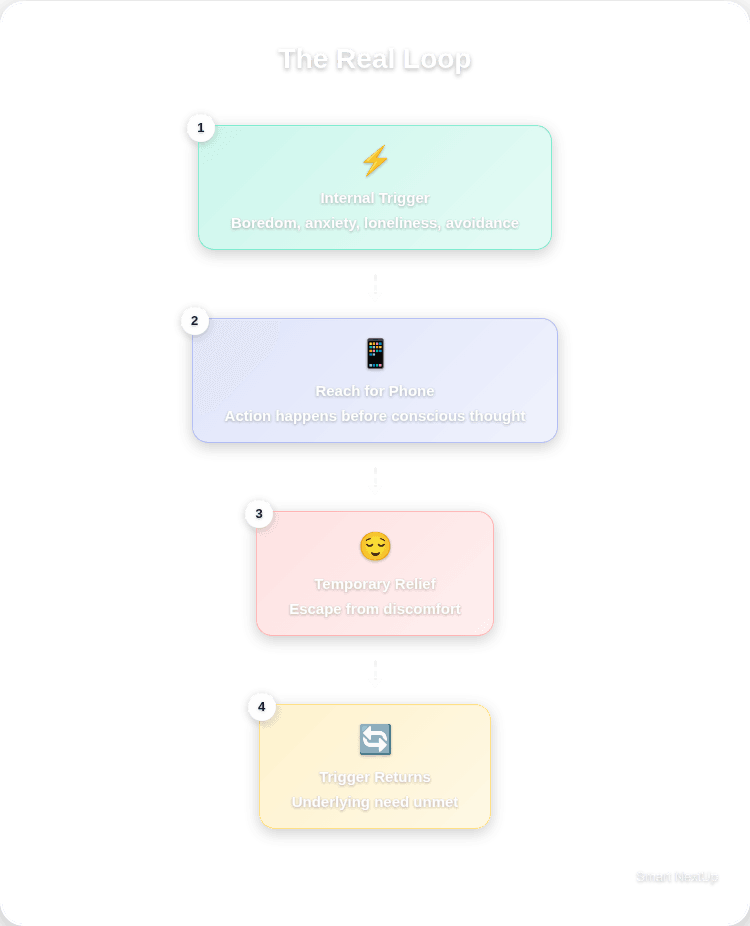
The Real Loop

The pattern that drives most phone use:
Let’s map this precisely, because precision is what cuts through the noise. The loop everyone talks about goes like this: notification → attention → engagement. But that’s the surface loop, the one the tech companies optimize for. The deeper loop—the one that actually runs the show—happens entirely inside you.
Here’s the real sequence:
Trigger: An internal state shifts. Boredom, anxiety, loneliness, avoidance, restlessness, uncertainty, emotional discomfort of any kind. This trigger is internal, not external. No notification required.
Action: You reach for the phone. The movement happens faster than conscious thought—typically within two to four seconds of the trigger arising.
Relief: The phone delivers. Not because the content is good, but because the action interrupts the internal state. You’ve successfully avoided the discomfort by redirecting attention outward. The relief is real but temporary, lasting anywhere from thirty seconds to several minutes before the cycle begins again.
Repeat: Because the underlying trigger was never addressed—only avoided—it returns. The loop restarts. Most people run this loop fifteen to fifty times per day without ever realizing it exists.
Elena runs this loop every afternoon around 3 PM. She’s a grant writer for a nonprofit, and the work requires sustained focus that drains her by mid-afternoon. At 3 PM, her brain hits a wall—not a creative block exactly, but a depletion. The trigger is exhaustion masquerading as restlessness. Her action is to pick up her phone and check Instagram. The relief comes from the visual stimulation, the small hits of novelty, the temporary escape from the demanding work. And then twenty minutes later, she returns to the grant she was writing, but now she’s not just tired—she’s also behind schedule, which creates anxiety, which becomes its own trigger, which sends her back to her phone.
The loop compounds itself.
But here’s what’s crucial: if you took Elena’s phone away at 3 PM, she wouldn’t suddenly become productive. She’d find something else. She’d go to the kitchen. She’d reorganize her desk. She’d start an elaborate email to a colleague that doesn’t actually need to be written. The phone is the delivery mechanism, not the cause. The cause is the exhaustion at 3 PM, and that exhaustion is the signal she’s been trained to ignore rather than honor.
How do you see clearly when everything is loud? You start by admitting that the phone is the quietest thing in the room compared to what’s happening inside you.
Four Patterns, One Mechanism
The triggers fall into recognizable categories. Not because humans are simple, but because we’re remarkably consistent. The same small set of internal states drives the vast majority of our phone reaches. Let’s map them with the specificity they deserve.
Boredom: The Intolerance of Empty Space
David is waiting for his coffee order. The café is busy, the wait time approximately four minutes. Four minutes of standing in a space that offers nothing to do, nothing to consume, nothing to optimize. His hand finds his phone before he’s made a conscious choice. The trigger isn’t the wait—it’s his intolerance for the wait. The empty space feels like a problem to solve rather than a moment to inhabit.
The boredom pattern is particularly insidious because it’s trained into us early. School, work, structured activities—we’re taught that empty time is wasted time, that productivity is virtue, that stillness is suspect. By the time we’re adults, a four-minute wait doesn’t feel like a pause. It feels like a failure. The phone is our rescue from the intolerable experience of simply being present with nothing to accomplish.
But here’s the pattern within the pattern: if David had left his phone in the car, if he’d been forced to stand there for four minutes with nothing but his own thoughts and the ambient café noise, something interesting would have happened. Around the ninety-second mark, the restlessness would have peaked. His mind would have scrambled for escape routes. And then, if he’d stayed with it, something would have shifted. The restlessness would have settled. His attention would have naturally found something worth noticing—the play of light through the window, the particular rhythm of the espresso machine, the conversations happening around him. He might have had a thought worth thinking. He might have experienced the rare pleasure of an unmanaged moment.
The phone doesn’t just relieve boredom. It prevents the transformation of boredom into something else—something potentially valuable that we’ll never experience because we interrupt the process before it can complete.
Anxiety: The Emergency That Isn’t
Priya is in bed, partner asleep beside her, the house quiet. It’s 11:47 PM. She should be asleep too. Instead, she’s scrolling through LinkedIn, reading posts from people in her industry, watching their career updates and professional achievements accumulate in an endless feed. The trigger isn’t the content—she’s not actually interested in most of what she’s reading. The trigger is the anxiety that woke her up forty minutes ago: a vague sense that she’s falling behind, that everyone else is moving forward while she’s standing still.
The anxiety pattern works like this: an uncomfortable feeling arises, and the phone offers a way to externalize it. Instead of sitting with the anxiety, feeling its texture, asking what it might be trying to communicate, Priya redirects her attention outward. The content on her phone becomes a container for her worry—she can pour her anxiety into the act of scrolling, and for as long as she’s scrolling, she doesn’t have to feel the anxiety directly.
But there’s a cruel irony here. The content she’s consuming is specifically chosen by the algorithm to amplify her anxiety. Posts about career success, industry changes, other people’s achievements—these are the exact things that triggered her worry in the first place. The phone isn’t just relieving her anxiety; it’s feeding it. She’s drinking salt water to quench a thirst.
This is the pattern that most people mistake for addiction. They think they’re hooked on the phone itself. But what they’re actually hooked on is the temporary relief of externalization. The phone offers a way to not be alone with their own anxiety. And in a culture that pathologizes negative emotion and demands constant positivity, the ability to escape your own anxiety feels like survival.
Seeing through this pattern means recognizing that anxiety is information, not malfunction. It’s a signal that something needs attention—perhaps real attention, perhaps a change in circumstance, perhaps simply the acknowledgment that uncertainty is part of being alive. The phone interrupts that signal before it can be received.
Loneliness: The Connection That Disconnects
Carlos lives alone, works from home, and spends most of his days on video calls with colleagues he’s never met in person. At 7 PM, after his last call ends, he feels it: the particular silence of an empty apartment. The trigger is loneliness, but it’s not just about being alone. It’s about the gap between the connection he had during the workday—connection mediated by screens—and the disconnection he feels when those screens go dark.
His phone offers a solution: open the dating apps, check the social feeds, send a few messages. Reach out into the digital void and see what reaches back. The action provides relief—a hit of potential connection, a reminder that people exist, a temporary bridge across the silence.
But Carlos has noticed something troubling. The more he turns to his phone for connection, the more lonely he feels. Each swipe on a dating app reminds him that he’s single. Each scroll through social media reminds him that other people are together, doing things, living lives that seem more connected than his. The phone offers connection in the abstract while deepening the disconnection in the concrete.
The loneliness pattern reveals something crucial about the phone as delivery mechanism. The phone promises to solve the problem of disconnection, but it can only deliver connection at a distance—connection mediated by screens, algorithms, and the particular limitations of digital communication. It offers the feeling of connection without the substance. And for many people, that feeling becomes its own form of hunger. They keep reaching for the phone because the connection it provides never quite satisfies, never quite becomes real enough to replace what’s missing.
Avoidance: The Task That Waits
Maya has a difficult email to write. It’s not catastrophic—just a conversation she’s been putting off, a boundary she needs to set with a colleague who’s been overstepping. (See The Boundary Blueprint: How to Say No Without Guilt for a framework on setting boundaries without the guilt.) She’s been avoiding it for three days. Every time she opens her laptop to write it, she feels the tightening in her chest, the vague dread of potential conflict, the uncertainty of how the colleague will respond.
And every time that tightening arises, her hand finds her phone. She checks Slack. She opens the news. She plays a few rounds of a puzzle game. The avoidance pattern is perhaps the most straightforward: the phone offers escape from the discomfort of difficult tasks. But it’s also the most costly, because the difficult tasks don’t disappear. They accumulate. The email Maya needs to write becomes heavier with each passing day, and each time she avoids it with her phone, she’s training herself to believe that avoidance is the solution rather than the problem.
The relief the phone provides in the avoidance pattern is particularly short-lived. Maya might feel a momentary reprieve when she redirects her attention to the puzzle game, but within minutes—sometimes seconds—a background process in her mind reminds her that the email still isn’t written. The anxiety compounds. The task becomes harder. And eventually, she’ll have to face it anyway, but now she’s facing it with the added weight of three days of avoidance and the knowledge that she’s been hiding from her own life.
When the Pattern Doesn’t Apply
Wei read an article about phone addiction and decided to pay attention to his own habits. What he found surprised him: he didn’t seem to have a problem. He used his phone for navigation, for communication with his family, for the occasional podcast during his commute. But he didn’t feel the compulsive reaching that others described. He didn’t lose hours to scrolling. He didn’t wake up and immediately reach for the screen.
Was he doing something wrong? Was he missing out? Or was the pattern simply not universal?
The truth is that the trigger-action-relief loop requires something to trigger it. Wei had structured his life in ways that minimized the underlying discomforts that drive phone use. He had a job he found meaningful, a social circle he saw regularly in person, a hobby that absorbed his attention, and a practice of meditation that helped him stay present with uncomfortable emotions. He wasn’t immune to the phone’s pull—he still experienced moments of boredom, anxiety, and loneliness—but he had other ways of meeting those needs. The phone was one tool among many, not the default solution to every internal state.
This is worth noting because it reveals something important: the problem isn’t the phone itself, and the solution isn’t necessarily to get rid of it. The solution is to develop a relationship with your internal states such that the phone becomes optional rather than obligatory. Wei’s phone wasn’t a problem because Wei had other ways of meeting his needs. His internal world was loud enough that he could hear what it was asking for, and he’d developed enough options that he could respond appropriately.
The Signal Beneath the Noise
What all of these patterns share is a common structure: something internal happens, and before that internal event can be fully experienced, the phone intervenes. The device is remarkably effective at what it does—so effective that we’ve come to believe it’s the cause of our behavior rather than the response to it.
But seeing through this pattern changes everything. When you catch the moment before the reach—when you feel the tightening in your chest, the restlessness in your body, the particular quality of discomfort that precedes the action—you gain access to information you’ve been trained to ignore. The boredom is telling you something. The anxiety is telling you something. The loneliness and the avoidance are telling you something. The phone has been interrupting the message.
How do you see clearly when everything is loud? You start by listening for the signal underneath. You notice the thirty-second window before your hand moves. You map the trigger—what just happened? What shifted? What discomfort arose? And you stay with it, just long enough to hear what it’s trying to say.
In the next section, we’ll explore what happens when you start listening to that signal—when you stop treating the phone as the enemy and start treating it as a messenger, revealing the needs you’ve been trained to neglect. The pattern is already there. The question is whether you’re willing to see it.
Why You Can’t See Clearly

In the previous section, we left the phone sitting in your palm like a smoking gun—guilty by association, condemned by convenience. But if you’d pulled back the frame, if you’d looked at what was happening in the thirty seconds before your hand moved, you would have seen something uncomfortable: the reach was already in motion before the device entered your awareness. The pattern beneath the ping revealed a truth that most of us spend considerable energy avoiding.
Key Insight
The phone isn’t the problem—it’s the solution to a problem you haven’t named. Every scroll is an escape from something you’re not ready to face.
And here lies the central problem: seeing through our own behavior requires looking directly at what we’re running from, which is precisely what we’ve organized our entire lives to avoid.
How do you see clearly when everything is loud?
The question itself contains a trap. We assume the loudness is external—the notifications, the headlines, the endless stream of content demanding our attention. But the deafening noise lives inside us. The phone simply provides the volume control.
The Comfort of the Convenient Villain
Mark sits across from his partner Elena at dinner, phone face-down on the table between them like a surrendered weapon. He’s read the articles. He’s installed the screen-time limits. He’s bought the grey-scale filter that turns his colorful apps into depressing shades of ash. He has done everything right, and still, three hours later, he’ll find himself in the bathroom, thumb scrolling through LinkedIn posts he doesn’t care about, wondering where the evening went.
Caution: Screen-time limits and digital detoxes often become another form of avoidance. They treat the phone as the problem rather than addressing what drives you to reach for it.
“I’m addicted,” he tells Elena, and there’s something almost comfortable in the confession. A diagnosis. A condition. Something that happened to him, rather than something he’s doing.
The phone-blame narrative offers us something precious: a problem with a clear enemy and a clear solution. If the phone is the issue, then the solution is less phone. Screen-time limits. Digital detoxes. Dumb phones. App blockers. An entire industry has emerged to sell us back the attention we’re convinced was stolen from us.
But Mark has tried all of it. And here’s what he can’t see: every intervention he’s attempted has been an elaborate form of looking away.
The breakthrough came when I stopped fighting the phone and started asking what I was running from.
— — Priya, Marketing Director
What would Mark find if he allowed himself to sit in the silence he’s been filling? This is the question the phone-blame narrative protects us from asking. The device isn’t the problem. The device is the solution to a problem we refuse to name.
The Fear Beneath the Fog
Priya considers herself self-aware. She’s done therapy. She meditates, sort of. She journals when she can. She knows that her phone use spiked after her father’s diagnosis, and she knows intellectually that she’s using distraction to manage grief. This isn’t denial. This is naming the thing.
And yet.
When her therapist suggested sitting with the grief for ten minutes a day—just ten minutes, no phone, no podcast, no background noise—Priya found herself agreeing enthusiastically and then simply not doing it. For six weeks. She’d sit down, set a timer, and within ninety seconds her mind would manufacture a reason to stand up. She needed water. She should check the lock on the door. Was the oven off? By the time she returned to the chair, the ten minutes had become seven, then five, then she’d convince herself she didn’t have time today and would try tomorrow.
The fog is intentional.
We cannot see clearly because clarity is terrifying. This isn’t a character flaw or a failure of will. This is a sophisticated protection system working exactly as designed. When Priya finally managed to sit for the full ten minutes—on week seven, after her therapist framed it as an experiment rather than a requirement—she cried for eight of them. Not gentle tears. The kind of crying that leaves you hollowed out and exhausted, the kind that makes your face ache the next day. The kind that explains everything.
Seeing through our own patterns means witnessing what we’ve been working so hard to avoid. For Priya, it was grief. For Mark, it’s a marriage that feels increasingly distant and the terror of naming that distance aloud. For you, it might be something else entirely. But here’s what’s almost certainly true: the thing you’re avoiding is not as dangerous as the avoiding.
The fog protects us from a threat that doesn’t exist.
Key Insight
Clarity feels dangerous because we’ve convinced ourselves that facing the truth will destroy us. But the avoiding is what’s actually destructive.
We stay confused because confusion feels safer than the clarity we’ve convinced ourselves will destroy us.
The Identity Trap
There’s a peculiar thing that happens when people start questioning their phone use. They often discover that being “addicted to their phone” has become part of their identity—a modern scarlet letter they wear with a strange mixture of shame and pride.
David, a marketing director in his early forties, has joked about his phone addiction at least a dozen times in professional settings. “I’m terrible,” he’ll say, pulling out his phone to check a notification during a meeting. “Total addict. I can’t help myself.” Everyone laughs. It’s relatable. It’s human. It’s also a shield.
As long as David can frame his behavior as an addiction—a compulsive response to engineered technology—he doesn’t have to examine what the scrolling is actually doing for him. He doesn’t have to ask why he needs to check his work email during dinner with his children. He doesn’t have to confront the fact that he’s built a career on being constantly available and now feels trapped by his own success. He doesn’t have to acknowledge that the phone gives him permission to be partially present everywhere, which protects him from being fully present anywhere. (This “waiting for permission” pattern is exactly what we explored in The Permission Myth: Waiting for Approval Keeps You Stuck—the phone becomes another way we outsource our choices.)
The addicted identity serves a function. It explains our behavior without requiring us to change it. It generates sympathy without demanding vulnerability. It’s the socially acceptable face of a much deeper avoidance.
But here’s where the identity trap becomes truly insidious: when we’ve organized our self-concept around being “bad with phones” or “addicted to screens” or “terrible at disconnecting,” the possibility of change feels like a threat to who we are. If David stopped using his phone compulsively, he’d have to face the questions the phone has been answering. If Priya sat with her grief, she’d have to feel it. If Mark put down the phone and stayed present with Elena, he’d have to have the conversation they’ve been avoiding for two years.
The addicted identity is comfortable in the way that all prisons are comfortable: you know exactly where the walls are.
Who Profits from Your Confusion
It would be naive to pretend that the confusion serves only our own psychological needs. There are entire industries built on the fog—companies and creators who benefit enormously from our inability to see clearly.
The screen-time app industry generates hundreds of millions of dollars annually by selling us tools to control our phone use. The digital detox industry books out retreats where people pay thousands to have their devices confiscated. The productivity industry sells planners and systems and courses designed to help us “take back control.” None of these industries has a financial incentive to help us understand that the phone isn’t the problem. In fact, they have a vested interest in maintaining the convenient lie.
But the profiteers extend beyond the obvious players. The wellness industry needs you to believe that your exhaustion is caused by screens rather than by the unsustainable pace of your life. The self-help industry needs you to believe that your distraction is a personal failing rather than a reasonable response to an unreasonable world. The technology industry itself benefits from the addiction narrative because it frames their product as too good rather than interrogating what void that product fills.
Consider the counter-example of Jordan, a software developer who tried every digital wellness intervention available: the apps, the blockers, the dumb phone, the scheduled disconnection times. Nothing worked. Each intervention provided temporary relief followed by a more intense return to scrolling. The pattern continued for three years—three years of feeling like a failure, like someone who couldn’t control himself, like proof that the technology was simply too powerful.
Then Jordan lost his job.
For the first month, his phone use skyrocketed. He spent twelve hours a day scrolling, applying for positions he wasn’t qualified for, reading articles about the collapsing tech industry, filling every moment with noise. But something shifted in the second month. Without the structure of work, without the identity of “software developer,” without the daily stress of a job he’d secretly hated for years, his phone use began to decline. Not through willpower. Not through interventions. Through the simple fact that the void the phone had been filling—the stress, the burnout, the quiet desperation of a career he’d outgrown—no longer existed.
The phone wasn’t the problem. The job was the problem. But it took losing the job to see through the fog.
What If This Doesn’t Apply to You?
There’s a voice that emerges around this point in the conversation, a voice that says: this might be true for other people, but my phone use is different. My scrolling is actually about [staying informed / keeping in touch / managing my business / learning new things]. I’m not avoiding anything. I’m just… modern.
This voice is worth paying attention to, not because it’s right, but because it’s so often wrong in such predictable ways.
Aisha, a freelance consultant, insisted that her phone use was purely professional. She needed to be available for clients. She needed to stay current in her field. She needed to maintain her social media presence for business development. The phone was a tool, not a crutch. When she agreed to track her usage honestly for one week—documenting not just time spent but what she was actually doing—she discovered that perhaps 20% of her phone time was genuinely work-related. The other 80% was split between news she’d already read, social media accounts that made her feel inadequate, and a dating app she’d stopped checking but hadn’t deleted.
More revealing than the time data was the emotional data. Aisha noticed that her “professional” phone use spiked dramatically on days when she was avoiding a difficult client conversation or procrastinating on a project that felt beyond her skills. The phone wasn’t serving her business. Her business was serving her avoidance.
This doesn’t mean that everyone’s phone use is pathological. Some people genuinely do use their devices as tools, picking them up with intention and putting them down without struggle. But these people are rarer than we’d like to believe, and they almost never describe themselves as addicted. The very fact that you’re reading this section, that you felt drawn to this topic, suggests that something in your relationship with technology feels unresolved.
The Enemies of Clarity
If you’re beginning to suspect that your phone use might be serving a function you haven’t examined, you’ll encounter three powerful enemies of clarity: shame, distraction, and the convenient lie.
Shame tells you that your scrolling is evidence of weakness, that if you were stronger or more disciplined or more evolved, you’d simply stop. Shame makes it impossible to see clearly because it transforms curiosity into judgment. You can’t investigate what you’re already condemning.
Distraction—the very thing you’re trying to understand—will fight to maintain itself. Your mind will generate objections, rationalisations, and alternative explanations. You’ll find yourself suddenly interested in other problems: the state of the world, the failings of technology companies, the psychological research on addiction. All of these are valid topics. None of them are the topic you need to examine.
The convenient lie is the most insidious enemy of all. It’s the story that technology is simply too powerful, too engineered, too sophisticated for any individual to resist. This lie is convenient because it absolves you of responsibility while maintaining the appearance of sophistication. You’re not avoiding anything—you’re simply a victim of attention economics.
But here’s what the convenient lie cannot explain: why you sometimes put your phone down without effort. Why certain days or activities or relationships make the scrolling feel unnecessary. Why the same device that feels irresistible at 10 PM feels irrelevant during a crisis or a celebration or a deeply engaging conversation. If the technology were truly the problem, it would be a problem all the time.
Seeing Through the Fog
The fog is intentional, but it’s not permanent. Seeing through it requires a willingness to be wrong about yourself—to abandon the comfortable narrative of addiction in favor of a more uncomfortable investigation.
What are you protecting by staying confused?
This is the question that will begin to dissolve the fog. Not “How do I use my phone less?” but “What am I using my phone for?” Not “Why can’t I control myself?” but “What would I feel if I stopped controlling myself through the phone?”
The answers to these questions are almost certainly more painful than the phone use they explain. This is why we avoid asking them. This is why the fog persists. But the pain of clarity is finite—it has a beginning, a middle, and an end—while the pain of confusion is infinite, repeating itself in endless cycles of resolution and failure.
In the next section, we’ll begin the process of mapping the territory the fog has been hiding. We’ll look at what actually happens in the moments before you reach for your phone, and we’ll develop a practice for staying present with what we find there. But for now, sit with the question of what you’re protecting. Let it be uncomfortable. Let it generate the noise you’ve been trying to escape.
The seeing through begins with the willingness to not look away.
What Your Scroll Is Really About
In the previous section, we left the phone sitting in your palm like a smoking gun—guilty by association, condemned by convenience. But if you’d pulled back the frame, if you’d looked at what was happening in the thirty seconds before your hand moved, you would have seen something far more uncomfortable than any device could ever be. You would have seen yourself reaching for an escape hatch.
The phone isn’t the problem. It never was.
This is the moment where the conversation shifts, and I need you to stay with me here, because what I’m about to show you cannot be unseen. We’re about to do some serious seeing through—the kind that leaves you responsible for what you now know. And responsibility, as you’ll discover, is far heavier than blame.
The Mirror You Carry
Here’s the truth that makes people squirm: your phone is a mirror, and what it reflects is the architecture of your avoidance.
When you pick up your phone, you’re not making a call. You’re making a decision about what you’re willing to feel in the next moment. The device in your hand is simply the most efficient tool humans have ever created for not being where we are. It’s not the first tool we’ve used for this purpose—alcohol, television, gambling, work, exercise, shopping, and sex have all served similar functions throughout history—but it is unquestionably the most effective. The most accessible. The most socially acceptable. The most deniable.
The average person touches their phone 2,617 times per day. That number gets thrown around a lot, usually as evidence of addiction or corporate manipulation. But here’s what nobody asks: what happened in the thirty seconds before each of those touches? What thought arose? What feeling surfaced? What reality presented itself that needed to be displaced?
Mark isn’t addicted to LinkedIn. Mark is avoiding the exhaustion of being needed. The transition from person-who-gets-things-done to person-who-puts-dishes-away requires a moment of psychological recalibration that he’s not willing to make. So he extends the in-between. The phone is just the tool.
How do you see clearly when everything is loud? You start by admitting that the noise isn’t coming from the device.
The Catalog of Escapes
Let’s get specific, because generalities let you off the hook. When you reach for your phone, you’re usually running from one of a handful of experiences. These aren’t judgments—they’re patterns. And patterns, once recognized, become choices.
First, there’s the escape from difficult emotions. Not dramatic emotions—grief, rage, despair—but the quiet, persistent ones that most of us spend our lives evading. Boredom. Anxiety. Loneliness. The vague sense of inadequacy that hums beneath the surface of everything. The restlessness that comes from being alive in a body that wants things it can’t name.
Elena’s phone didn’t make her avoid her sister. It just made the avoidance frictionless. Without the device, she would have had to stand at the sink with her guilt. She might have cried. She might have called. She might have felt the full weight of what her relationship has become. Instead, she felt nothing. Numb is easier than sad. Scrolling is easier than sitting.
Second, there’s the postponement of hard choices. This one is particularly insidious because it disguises itself as productivity. How many times have you picked up your phone to “check something” when what you were really doing was avoiding a decision? The decision to have a difficult conversation. The decision to start the project you’ve been fearing. The decision to face the financial reality you’ve been denying.
Third, there’s the numbing of unexamined pain. This is the deepest layer, and the one we’re most reluctant to acknowledge. Some of what we’re avoiding isn’t even current—it’s old. It’s the grief we never fully felt. The trauma we never fully processed. The wound we covered with a bandage and pretended had healed. The phone keeps these things at bay not by addressing them, but by drowning them out.
This is what seeing through actually requires: the willingness to look at what you’ve been not-looking-at. The phone is brilliant at facilitating the not-looking. But it’s not the cause.
The Lie of “Just Checking”
Now I want to address what you might be thinking: “This doesn’t apply to me. I actually use my phone for productive things. I’m not avoiding anything—I’m just checking.”
Let’s examine that.
The phrase “just checking” is perhaps the most revealing locution in our modern vocabulary. Notice what it implies: minimal investment, brief duration, legitimate purpose. “Just checking” is what you say to yourself and others to normalize behavior that might otherwise seem excessive. But the very need to minimize—to add “just”—reveals an awareness that something else is happening.
Here’s a counter-example that proves the rule. Last year, I worked with someone named Fiona who insisted her phone use was purely functional. She tracked her time meticulously—she knew exactly how many minutes she spent on each app, and she could justify all of it. Work communication: necessary. News apps: staying informed. Podcast app: learning. Maps: navigation. Nothing frivolous. Nothing excessive.
But when we dug deeper—when we looked at the moments before each pickup—a different picture emerged. Fiona was using her phone to manage a near-constant state of low-level anxiety. Every time she felt uncertain about something in her work or personal life, she reached for information. Not because she needed it, but because having information felt like having control. She was “checking” the way some people check that the stove is off or the door is locked—not for any practical purpose, but to quiet a mind that wouldn’t stop generating worst-case scenarios.
Fiona’s phone use looked functional from the outside. But the function wasn’t productivity—it was anxiety management. And it worked, in the short term. But it also prevented her from ever addressing the underlying anxiety. Why would she? She had a tool that made it tolerable.
This is what I mean when I say the phone is not the problem. Fiona’s anxiety would exist with or without the device. The phone just made it possible to function without healing. Is that a service or a disservice? The question is worth sitting with.
The Presence We’re Avoiding
There’s one more category we need to discuss, and it’s the most uncomfortable of all. Sometimes—perhaps most of the time—we’re not escaping anything specific. We’re escaping presence itself.
Presence is harder than we admit. To be fully where you are, doing exactly what you’re doing, thinking only about the present moment—this sounds simple, but it’s actually quite demanding. It requires tolerating the full experience of being alive: the physical sensations, the emotional undercurrents, the awareness of time passing, the confrontation with your own existence.
The question “How do you see clearly when everything is loud?” has a paradoxical answer. Sometimes the loudness isn’t external at all. Sometimes it’s the noise of your own being—the thoughts, feelings, and sensations that arise when you stop distracting yourself. The phone doesn’t create this noise. It masks it.
This is why digital detoxes so often fail. People put down their phones and discover that the quiet they were seeking is actually quite loud. Without the constant input, they’re left with themselves—and many find this unbearable. They pick the phone back up not because they’re addicted, but because they haven’t developed the capacity to be present to their own experience.
The Truth That Changes Everything
So here we are, at the turning point. You’ve been seeing through the device, and what you’re seeing through to is yourself.
In the previous section, we explored why you can’t see clearly—the design tricks, the attention economy, the structural forces that make your phone difficult to put down. All of that is true. The engineers in Silicon Valley really did build systems designed to capture and hold your attention. The algorithms really are optimized for engagement over wellbeing. Your brain really does respond to variable rewards in ways that feel uncontrollable.
But here’s what changes when you see through the device: you realize that the manipulation only works because it offers you something you want. The escape. The numbing. The postponement. The avoidance of presence.
The phone is a mirror. It reflects back to you the places where you’re unwilling to be with what is.
This is not a condemnation. It’s an invitation.
If the phone is a mirror, then every time you reach for it, you have an opportunity. You can see what you’re running from. You can notice the feeling that arose in the thirty seconds before your hand moved. You can ask yourself: what am I not wanting to feel right now? What am I not wanting to face? What am I not wanting to be present to?
The answers to these questions are not comfortable. They require you to acknowledge the grief you’ve been carrying, the decisions you’ve been delaying, the relationships you’ve been neglecting, the life you’ve been living on autopilot. (When decisions pile up, Decision Exhaustion: How to Make Better Choices When Your Brain Is Tired explains why your depleted brain reaches for easy escapes.) They require you to take responsibility for your own avoidance.
This is why clarity hurts. Once you see, you’re responsible. You can’t un-know what you now know about your own patterns. You can’t pretend the phone is simply an addiction or a bad habit or a design problem. You have to reckon with the fact that you are using the most powerful distraction tool ever created to avoid aspects of your own existence.
The Question That Remains
So what do you do with this knowledge? How do you move forward once you’ve seen through the device to the truth underneath?
That’s what we’ll explore in the next section. But before we get there, I want you to sit with this for a moment. Not with your phone—without it. Just you and this question: What are you avoiding?
The answer might not come immediately. It might take days of noticing the thirty seconds before you reach for the device. It might require you to feel things you’ve been running from. It might require you to face truths you’ve been postponing.
But now you know. The phone is not the problem. It’s just the most efficient solution we’ve ever found for not being where we are, not feeling what we feel, not facing what needs to be faced.
You can’t un-know this. And that’s where change becomes possible.
In the next section, we’ll explore what happens when you stop blaming the phone and start addressing what it’s been covering up. We’ll look at the specific emotions and situations that drive us to scroll, and we’ll develop a new relationship with the device—one based not on restriction and willpower, but on awareness and choice.
But first, the mirror. Look at it. What do you see?
The Digital Detox Trap
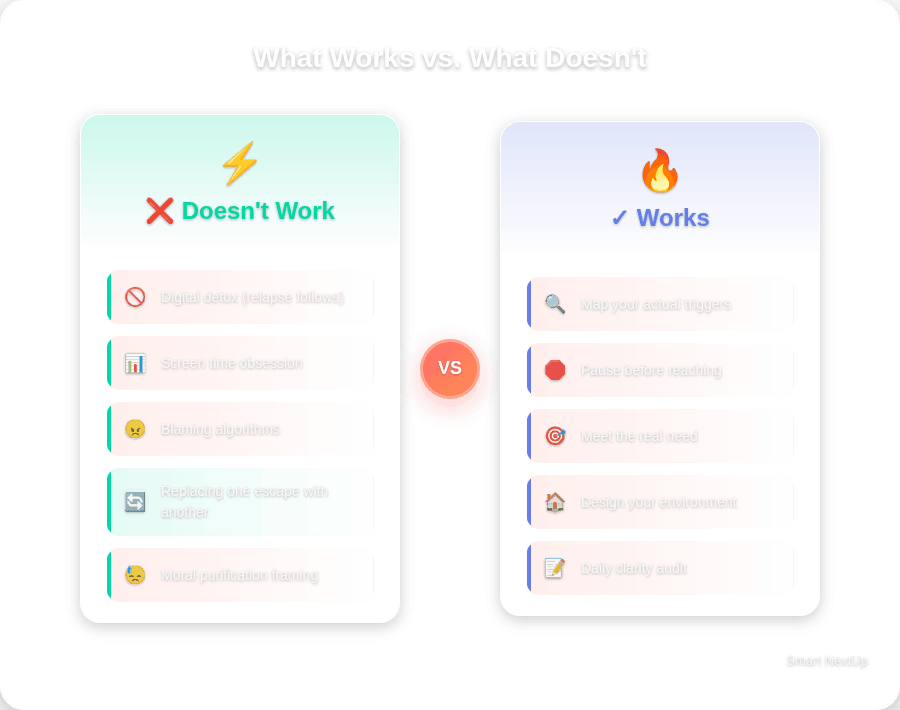
In the previous section, we left the phone sitting in your palm like a smoking gun—guilty by association, condemned by convenience. But if you’d pulled back the frame, if you’d looked at what was happening in the thirty seconds before your hand moved, you would have found something far more uncomfortable than any device: yourself. The ache, the avoidance, the small moment of emotional weather that you didn’t want to feel. The scroll was never about the scroll.
And yet, here we are, surrounded by solutions that treat your phone like the villain and your willpower like the hero. The detox industry has exploded into a multi-billion dollar marketplace of retreats, apps, books, and weekend workshops—all promising that if you just put the device down long enough, clarity will return. The messaging is seductive in its simplicity. Unplug. Disconnect. Reclaim your brain. The language borrows from recovery programs and spiritual awakening alike, wrapped in the clean aesthetic of people doing yoga on mountaintops.
But there’s a trap embedded in all of this, and it’s keeping you stuck far more effectively than any algorithm ever could. The trap isn’t your phone. The trap is believing that removing your phone will solve what your phone was never causing.
The Detox-and-Relapse Cycle
Mark had been planning his digital detox for three weeks. He’d read the articles, bought the paper journal, even scheduled “offline activities” into his Google Calendar before deleting the app. Friday at 6 PM, his phone went into a kitchen drawer. By Sunday afternoon, he felt like a different person. He’d read forty pages of a novel. He’d noticed birds. He’d had a conversation with his neighbor that lasted more than two minutes. When he finally retrieved his phone on Monday morning, he felt that familiar surge of righteous calm—the quiet confidence of someone who had proven he could live without the tether.
By Wednesday, he was back to four hours of daily screen time. By Friday, the journal was gathering dust and the novel had been replaced by a podcast played at 1.5x speed while scrolling through comments.
What happened? Mark would tell you he failed. That his willpower wasn’t strong enough. That the algorithms pulled him back in. But the truth is simpler and more uncomfortable: the detox worked exactly as designed. It gave him a temporary reprieve from his relationship with his phone without ever addressing his relationship with himself.
The detox industry has institutionalized a cycle that mirrors diet culture with uncomfortable precision. The structure is always the same: restriction, brief success, inevitable return to baseline, shame, renewed commitment to restriction. Each iteration reinforces the underlying belief that the problem is external and the solution is control. But control is not the same as understanding. You can force yourself to put the phone down for seventy-two hours. You cannot force yourself to become someone who doesn’t need to pick it up.
How do you see clearly when everything is loud? Not by silencing the noise temporarily, but by understanding why you reached for noise in the first place. The detox gives you quiet without giving you the capacity to be with quiet. It’s like taking painkillers for a broken bone and declaring yourself healed because the pain stopped. The bone is still broken. The next time stress arrives—and it will arrive—you’ll have no structural repair, only the memory of temporary relief.
The relapse isn’t a failure of the detox. The relapse is the detox working exactly as intended. It’s a pause button, not a solution. And for people like Mark, who’ve done five or six of these cycles, the detox itself becomes part of the addiction—a ritual of purification that feels like progress while perpetuating the underlying dynamic. He gets to feel virtuous on Sunday and victimized by Friday. Both feelings keep him focused on the phone rather than on the Mark who keeps reaching for it.
The Screen Time Obsession
Elena installed her first screen time tracker with genuine curiosity. She wanted to know where her hours were going. The number shocked her: six hours and forty-three minutes on an average Tuesday. She set a limit. Six hours. Then five. Then four. Each week, she watched the data accumulate, graphs rising and falling like a stock ticker of her own self-worth.
But something strange happened as the numbers went down. Elena didn’t feel more present. She felt more anxious. Every time she picked up her phone, she felt the weight of being measured. The notifications that told her she was “doing better” or “almost at your limit” created a running commentary in her head. She wasn’t using her phone less; she was using her phone while feeling worse about using her phone.
The screen time obsession is the detox trap quantified. It replaces the question “What am I seeking when I scroll?” with the question “How much am I scrolling?” The first question might lead somewhere uncomfortable. The second question leads only to numbers, and numbers can be managed without ever touching the deeper territory.
There’s also a peculiar blindness in the tracking approach. Elena noticed that her “social media” category was high, so she set limits on Instagram and TikTok. But her “productivity” category—email, Slack, news apps—remained untouched. She felt virtuous about the first while ignoring that the second had become its own form of avoidance. She could spend two hours answering emails she didn’t need to answer and the tracker would congratulate her. The app couldn’t see that she was still avoiding the difficult conversation with her mother, still procrastinating on the project that mattered, still filling every gap with something that felt like work but wasn’t.
Seeing through the numbers requires recognizing that not all screen time is created equal, and that the metrics tell you nothing about the internal state that preceded the swipe. You can hit every target and still be completely asleep. The tracker measures behavior, not the relationship to behavior. It tells you what you did, not why you did it, and certainly not what you were feeling in the thirty seconds before your hand moved.
The most insidious part? The tracking apps are often made by the same companies that profit from your attention. They’ve simply found a second revenue stream: selling you the illusion of control over the first one. It’s like a casino offering you a stopwatch to track how long you’ve been at the blackjack table. Useful information, perhaps, but it doesn’t change the game.
The Algorithm Scapegoat
David had done the reading. He knew about variable ratio reinforcement schedules, the infinite scroll architecture, the notification algorithms designed to maximize engagement. He could explain, with impressive technical detail, exactly how his phone was engineered to capture his attention. He’d even adjusted his settings—turned off notifications, switched his screen to grayscale, deleted the most predatory apps.
And he was still spending four hours a day on his phone.
The algorithm explanation has become the modern equivalent of “the devil made me do it”—technically accurate in its description of external forces, completely useless as a framework for change. David could tell you precisely how TikTok’s recommendation engine worked, but he couldn’t tell you what he was feeling in the moments he opened the app. He’d mapped the enemy’s territory without ever mapping his own.
There’s a comfort in the algorithm narrative. It positions you as the victim of sophisticated manipulation, which is partially true. The designers of these systems have billions of dollars and decades of research behind them. They are, in a very real sense, trying to capture your attention. But the narrative stops short of the only question that matters: given that these systems exist, given that they will continue to exist and evolve, what is your relationship to your own reaching?
David’s friend Priya had taken a different approach. She’d done the same reading, made the same settings changes, but she’d added one practice: every time she caught herself in an unconscious scroll, she asked herself what had happened in the minute before. Not to judge, just to notice. Over time, patterns emerged. The scroll happened after difficult emails. It happened when she was tired but not ready for bed. It happened when she felt excluded from social plans she’d seen on Instagram.
Priya still used her phone. But she used it differently. Not because the algorithms had changed—they hadn’t—but because she’d stopped using them as the sole explanation for her behavior. The algorithms were real. They were powerful. And they were interacting with a Priya who had her own patterns, her own avoidances, her own reasons for reaching.
This is seeing through the mechanism without dismissing it. The detox approach says: the algorithms are bad, remove them. The tracking approach says: the algorithms are powerful, measure them. The real work says: the algorithms exist, and so does my inner landscape. How do these two things interact?
The Moral Purification Frame
Perhaps the most damaging aspect of the detox trap is the moral language that surrounds it. We talk about “clean” breaks and “pure” attention. We describe scrolling as “mindless” or “wasteful,” and presence as “mindful” or “meaningful.” The phone becomes a corrupting influence, and putting it down becomes an act of virtue.
Jordan fell deep into this framing after a particularly inspiring podcast episode. He started describing his phone as a “toxic relationship” and his screen-free evenings as “detoxing.” He felt righteous when he declined to look at a notification during dinner. He felt superior when he watched his friends check their phones. The moral framing gave him a sense of progress and identity. He was becoming the kind of person who didn’t need the device.
But Jordan’s relationship with his phone had simply become more adversarial, not more conscious. He was now in a constant battle with himself—the part that wanted to check and the part that judged the checking. Every time he resisted an urge, he felt a small surge of victory. Every time he gave in, he felt a familiar shame. Neither feeling brought him any closer to understanding what the urge was actually about.
The moral frame also creates a strange blindness to legitimate uses of technology. Jordan started avoiding his phone even when it would have been genuinely useful—directions when he was lost, a text to a friend who was struggling, a quick note to capture an insight—because using the device felt like a moral failing. He’d replaced unconscious scrolling with unconscious avoidance, and called it growth.
What if this doesn’t apply to you? What if you’ve never done a detox, never tracked your screen time, never fallen for the moral language? The trap might still be operating in subtler forms. Every time you think “I should use my phone less” without asking what you’re using it for, you’re in the trap. Every time you feel a pang of guilt when you pick up your device, you’re in the trap. Every time you imagine that life would be better if you could just discipline yourself more effectively, you’re in the trap.
The detox trap isn’t just the formal programs and apps. It’s the entire framework that treats your phone as the problem and removal as the solution. It’s the belief that if you could just get enough distance, enough clarity, enough time away, you’d naturally become the person you want to be. But distance without examination is just distance. You can move three feet away from a mirror and still not see yourself more clearly.
Why These Approaches Fail
All of these approaches—the detox, the tracking, the algorithm blaming, the moral framework—share a common structure. They treat the symptom rather than the cause. They assume that if you can just modify the behavior, the underlying dynamic will resolve itself. But behavior is the output, not the input. It’s the final expression of a cascade that begins long before your hand moves toward the device.
Remember when we explored what your scroll is really about? We found that the hand movement, the app opening, the thumb swipe—these were responses to something internal. An ache. An avoidance. A weather pattern in the emotional atmosphere. The detox trap asks you to focus entirely on the response while ignoring the stimulus. It’s like trying to fix a cough without asking why you’re coughing.
The approaches fail because they operate at the wrong level. They try to solve a relationship problem with a behavior modification technique. They try to address an internal emptiness with an external restriction. They try to create consciousness through unconscious mechanisms—apps that track you, rules that bind you, moral frameworks that judge you.
How do you see clearly when everything is loud? Not by making the world quieter, but by developing the capacity to hear your own voice within the noise. Not by removing the device, but by understanding what you’re reaching for when you reach for it. Not by measuring your failure, but by getting curious about your pattern.
The detox trap keeps you focused on the phone because the phone is tangible. You can hold it, measure it, lock it in a drawer. The internal landscape is harder to access. It requires a different kind of attention—a willingness to sit with discomfort, to ask difficult questions, to notice what you’d rather not notice. The phone, for all its problems, can also be a magnificent hiding place from that work. Even the detox can be a hiding place, a way to feel like you’re addressing the problem while avoiding the territory where the real problem lives.
In the next section, we’ll begin the slower, more difficult, and ultimately more liberating work of actually seeing that territory. Not to judge it, not to fix it, but to understand it. Because the phone was never the problem. The problem was what the phone was helping you not feel. And the solution isn’t removal—it’s relationship.
The Clarity Protocol

In the previous section, we left the phone sitting in your palm like a smoking gun—guilty by association, condemned by convenience. But if you’d pulled back the frame, if you’d looked at what was happening in the thirty seconds before your hand moved, you would have found something far more uncomfortable than a device: you would have found yourself. The digital detox trap taught us that removing the phone without addressing what sent you reaching for it is like mopping the floor while the faucet still runs. The water will return. The reach will return. And you’ll find yourself, three days post-detox, standing in the same kitchen, holding the same black rectangle, wondering why nothing changed.
This is where we stop mopping. This is where we find the faucet.
Mapping the Real Trigger
Mark sat in his car after work, phone already in hand before he’d even turned off the engine. He’d done this five days a week for three years. Called it his “decompression time.” When I asked him what he was decompressing from, he paused. “Work,” he said. “Stress. You know.” But when we traced it backward—when we mapped the actual trigger—the phone wasn’t responding to work stress at all. The trigger occurred seventeen minutes earlier, during a meeting where his manager had dismissed his proposal without discussion. Mark had felt the sting, the familiar contraction in his chest, and he’d swallowed it. He’d said “no problem” and moved on. The phone was simply the anesthesia he applied to a wound he pretended didn’t exist.
How do you see clearly when everything is loud? You start by admitting that most of the noise isn’t coming from the device.
The mapping process requires a kind of archaeological patience. You’re not looking for the obvious answer—you’re looking for the layer beneath it. Here’s how it works in practice: the moment you notice yourself reaching for your phone, you freeze. Not in judgment, but in curiosity. You ask one question: “What happened in the thirty seconds before this reach?” Not “Why am I reaching?”—that question invites justification and defense. “What happened?” invites observation.
Priya discovered that her afternoon scrolling habit began not with boredom, but with a specific transition. She finished her lunch, returned to her desk, and immediately felt the weight of her inbox. The reach happened in that gap—the space between completing one task and facing the next. Her brain registered the inbox as threat, and the phone offered an escape route. The trigger wasn’t the phone. The trigger was the unacknowledged anxiety of facing seventy-three unread messages demanding her attention.
The mapping process reveals patterns that remain invisible when we focus only on the device. Elena tracked her reaches for two weeks and discovered that 70% of her phone use followed a specific emotional signature: a moment of feeling unseen. A comment ignored in a meeting. A text that went unanswered for hours. A partner absorbed in their own screen. Each reach was an attempt to find somewhere—anywhere—where she mattered.
This is the excavating work. This is seeing through the behavior to the need beneath it. And it requires a brutal honesty that most of us avoid, because the truth is often uncomfortable. It’s easier to blame the phone than to admit we feel lonely, dismissed, anxious, or overwhelmed. It’s easier to delete apps than to have difficult conversations. But the phone is not the problem. The phone is the solution you’ve been using to manage problems you haven’t yet named.
The Pause Practice
Once you’ve mapped the trigger—once you know what sent your hand moving—you need space to choose a different response. This is where the pause practice comes in. It’s deceptively simple, which means it’s deceptively difficult.
The practice works like this: when you notice the reach, you stop. Not forever. Just for three breaths. In that pause, you ask yourself what you’re actually feeling. Not what you’re avoiding—what you’re feeling. The distinction matters. Avoidance is about the escape; feeling is about the encounter. You’re not trying to fix anything in those three breaths. You’re simply creating enough space to see what’s actually there.
Jordan tried this for a week and reported that he’d failed completely. “I kept reaching anyway,” he said. “The pause didn’t work.” But when we examined what had actually happened, Jordan had turned the pause into another form of self-criticism. He’d pause, feel the urge, then berate himself for having the urge in the first place. Why do I always do this? What’s wrong with me? I should be past this by now. The pause had become a punishment, which meant his brain had learned to avoid it. The reach continued because the alternative—standing in the harsh light of his own judgment—was worse than the scrolling.
The pause practice only works when it’s neutral.
Pro tip: Don’t try to stop yourself from reaching. Just notice what happened 30 seconds before. That awareness alone will begin to shift the pattern—no willpower required.
You’re not trying to stop yourself from reaching. You’re not trying to be better. You’re simply creating a gap between stimulus and response, a gap where choice becomes possible.
Pro tip: Start with just three breaths before reaching for your phone. Notice what triggered the reach. That micro-pause is where choice becomes possible.
“Between stimulus and response there is a space. In that space is our power to choose our response. In our response lies our growth and our freedom.”
— Viktor Frankl, Man’s Search for Meaning (1946) Viktor Frankl, the psychiatrist and Holocaust survivor, described this as the last of the human freedoms: “to choose one’s attitude in any given set of circumstances, to choose one’s own way.” The pause is the space where that choice lives.
Maya developed a variation that worked for her particular patterns. She called it “the doorway practice.” Every time she passed through a doorway—entering a room, leaving a building, stepping into her car—she took one conscious breath. She wasn’t trying to change anything. She was simply practicing the act of noticing. After three weeks of doorway practice, she found that the pause had begun to appear elsewhere. The reach became slower. The gap became wider. She started seeing through her own patterns, not with judgment, but with recognition.
The pause practice isn’t about willpower. It’s about awareness. And awareness, once established, has a way of expanding on its own. You don’t have to force it. You simply have to create the conditions for it to grow.
“The first step toward change is awareness. The second step is acceptance.”
— Nathaniel Branden, The Psychology of Self-Esteem (1969)
Carlos had been a heavy phone user for over a decade. He’d tried every app blocker, every time limiter, every screen-time tracker. None of them worked, because none of them addressed what was actually driving his behavior. When he began the pause practice, nothing changed at first. He still reached. He still scrolled. But slowly—over weeks, not days—he started noticing something different. The scroll didn’t feel the same. The satisfaction had leaked out of it. He was seeing through the activity to the mechanism beneath it, and once seen, the mechanism couldn’t hold him the same way.
Meeting the Actual Need
Here’s where most approaches to phone usage fail: they focus on stopping the behavior without addressing the need the behavior was meeting. It’s like telling someone to stop eating without asking whether they’re hungry. The body doesn’t stop needing food just because you’ve decided eating is a problem. And the psyche doesn’t stop needing connection, distraction, validation, or rest just because you’ve decided your phone is the enemy.
The questions shift at this stage. Instead of asking “How do I stop reaching for my phone?” you ask “What am I actually reaching for?” The answers are specific to each person, but they tend to cluster around a few core needs: connection, stimulation, escape, validation, or rest. Your job isn’t to judge these needs—it’s to meet them more directly.
Aisha mapped her triggers for two weeks and discovered a clear pattern. Her evening scrolling—sometimes three hours or more—followed a predictable sequence. She’d finish dinner, feel a vague restlessness, and reach for her phone. The scroll would begin. Hours would disappear. When we traced it backward, the trigger appeared consistently: the moment her partner retreated into his own phone after dinner. The actual need wasn’t stimulation or distraction. The actual need was connection. She was lonely in the presence of someone she loved, and she was using her phone to manage the pain of that disconnection.
The solution wasn’t an app blocker. The solution was a conversation. Aisha told her partner what she’d discovered—not as an accusation, but as an observation. They established a new practice: thirty minutes after dinner, phones in another room, just the two of them. Her evening scrolling decreased by 80% within the first week. The phone had been a symptom, not the disease.
But what if this doesn’t apply to you? What if you’ve mapped your triggers, practiced the pause, identified the need—and the phone still pulls at you? This is where we have to be honest about the design of these devices. They’re engineered to create compulsion. The variable reward schedules, the infinite scroll, the notifications designed to trigger dopamine responses—all of this is intentional. Meeting your actual needs is necessary, but it may not be sufficient. The environment itself has to change.
Wei discovered this when he tried to address his late-night scrolling. He’d mapped the trigger: anxiety about the next day. He’d identified the need: reassurance and mental preparation. He’d even started journaling before bed to meet that need more directly. But the phone still called to him. The reach still happened. What Wei hadn’t addressed was the environment. His phone sat on his nightstand, within arm’s reach, glowing with notifications. He was trying to overcome compulsion through willpower while sleeping next to the very device that created it. When he moved the phone to the kitchen—when he required himself to physically get out of bed to check it—the behavior changed. The friction he’d introduced gave his prefrontal cortex time to engage. He could see through the urge before he acted on it.
There’s a counter-example worth examining here. Rachel tried all of this—the trigger mapping, the pause practice, the need identification, the environmental design—and nothing worked. Her phone use remained constant, her frustration mounted, and she began to believe that she was simply broken. But when we looked more closely, we discovered that Rachel had turned the entire protocol into another performance metric. She was tracking her successes, cataloging her failures, and using the process as evidence of her own inadequacy. The clarity protocol had become another way for her to judge herself, which meant it had become another thing she needed escape from. The phone offered that escape. The protocol, ironically, was feeding the very problem it was meant to solve.
The answer wasn’t more discipline. The answer was self-compassion. Rachel had to learn to approach her patterns with curiosity rather than criticism. When the reach happened—and it would happen—she had to meet it with gentleness. Oh, interesting. There I go again. I must be needing something. Let me see what it is. This shift from judgment to curiosity took months. But gradually, the stranglehold loosened. Not because she’d finally become disciplined enough, but because she’d stopped making the phone the enemy of her self-worth.
The Clarity Audit
All of this mapping, pausing, and need-meeting requires a way to see the patterns over time. The daily clarity audit is that way. It takes five minutes. It happens at the same time each day—usually evening, when the day’s events are still fresh. You ask yourself three questions:
First: “When did I reach today without thinking?” You’re not cataloging failures. You’re gathering data. Maybe you noticed three automatic reaches. Maybe you noticed thirty. The number doesn’t matter—the noticing matters.
Second: “What was happening before each reach?” This is where the mapping comes alive. You might see patterns you’d missed in the moment. The mid-morning reach that follows a difficult email. The afternoon reach that follows a conversation where you felt dismissed. The evening reach that follows the transition from work mode to home mode. The patterns emerge when you look at them collectively.
Third: “What did I actually need in those moments?” This question shifts you from observation to action. Maybe you needed a break. Maybe you needed acknowledgment. Maybe you needed to feel connected to someone. The need isn’t always easy to name, but the naming gets easier with practice.
Mark, the one who decompressed in his car after work, discovered through his daily audits that his phone use clustered around a specific emotional signature: feeling unheard. His manager dismissed his ideas. His partner asked about his day but didn’t really listen. His friends talked over him in group conversations. The phone offered something the world wasn’t giving: a space where his choices mattered, where his voice was the only one that counted. The scroll was a way of mattering to himself when he didn’t matter to others.
But here’s what happened when Mark began addressing the actual need—when he started advocating for himself in meetings, when he asked his partner for real attention, when he chose friends who could listen—his phone use didn’t disappear. It transformed. He still reached sometimes. He still scrolled occasionally. But the compulsive quality had dissolved. The phone had become a tool again, not a salve. He could pick it up and put it down without the desperate grip that had characterized his relationship with it for years.
The clarity audit isn’t about perfection. It’s about seeing clearly when everything is loud. And the world is loud. The phone is loud. The demands on your attention are loud. The voices telling you what you should do, who you should be, how you should perform—they’re all loud. But beneath that noise, something quieter is always operating. A need. A feeling. A truth you haven’t yet spoken. The clarity protocol is simply a way of hearing that quieter thing.
How do you see clearly when everything is loud? You stop trying to silence the noise. You start listening for what’s beneath it.
The daily audit builds a kind of internal ledger. Over weeks and months, you begin to recognize your patterns before they happen. You feel the reach coming before your hand moves. You notice the emotional weather before the storm hits. This isn’t about preventing the reach—sometimes you’ll still reach. It’s about knowing why you’re reaching, which changes everything. A reach you understand is a reach you can choose. A reach you don’t understand is a reach that controls you.
Elena kept her audit notes for six months. When she looked back at them, she saw a story she hadn’t recognized while living it. Her phone use had decreased dramatically, yes—but more importantly, her life had changed. She’d started speaking up in meetings. She’d ended a friendship that had become one-sided. She’d asked her partner for more support and received it. The phone had been the entry point, but the work had been about something larger. She’d been seeing through the device to the life she actually wanted.
This is what the clarity protocol offers: not a way to use your phone less, but a way to see what you’re actually hungry for. The phone is simply the delivery system you’ve been using to manage hungers you haven’t named. Name them, and the phone becomes less compelling. Meet them, and the phone becomes what it was always meant to be: a tool that serves you rather than a master that consumes you.
The work isn’t easy. It requires honesty that can feel uncomfortable. It requires attention that can feel exhausting. It requires facing feelings you’ve been avoiding—sometimes for years. But the alternative is worse. The alternative is continuing to believe that the phone is the problem, continuing to try solutions that address symptoms rather than causes, continuing to reach without knowing why. The alternative is staying lost in the noise.
In the next section, we’ll look at what happens when you’ve done this work—when you’ve mapped your triggers, practiced the pause, met your actual needs, and built the clarity audit into your daily life—but the phone still pulls at you. Because sometimes the problem isn’t just internal. Sometimes the environment itself is designed to keep you reaching. We’ll explore the architecture of attention and how to build a world that supports the clarity you’re cultivating.
When Nothing Changes

Remember when we explored the Clarity Protocol, how we left the phone sitting in your palm like a smoking gun—guilty by association, condemned by convenience? But if you’d pulled back the frame, if you’d looked at what was happening in the thirty seconds before your hand moved, you would have found something far more uncomfortable than any device could ever be. You would have found yourself. And sometimes, that’s the discovery that breaks everything open.
You’ve done the work. You’ve named the impulse, traced the wire, sat in the discomfort. You understand your patterns better than you ever have. You can see the mechanism clicking into place—the reach, the unlock, the scroll—like watching a slow-motion replay of your own hand. You have clarity. Real, hard-won clarity.
And yet.
Here you are, three weeks later, still reaching. Still scrolling. Still watching the days blur into one another while the insights you gathered gather dust in some forgotten notes app. The protocol made sense. The logic was sound. You could practically feel the truth of it settling into your bones. But somehow, nothing changed.
This is the moment we need to have a different conversation entirely.
The Protocol Worked—That’s the Problem
Here’s what nobody tells you about genuine insight: it doesn’t always produce the transformation you expect. Sometimes clarity doesn’t liberate you. Sometimes it just shows you, with devastating precision, exactly how trapped you actually are.
Mark spent six weeks working through the protocol with religious dedication. He tracked every impulse, mapped every trigger, sat with every uncomfortable feeling that surfaced when he didn’t reach for his phone. He discovered that his evening scroll sessions weren’t about entertainment or even distraction—they were about postponing the conversation he needed to have with his wife about their fading connection. Every night, somewhere between the dinner dishes and bedtime, a window would open. He could walk into the living room where she sat, could say the thing he’d been carrying for months. Instead, his hand found his pocket. The phone offered a bridge to nowhere, but at least it was a bridge that didn’t require him to speak.
The protocol gave Mark crystal clarity. He could see the choice point arrive each evening, could feel the weight of the unsaid words pressing against his chest, could watch his hand move toward the phone like watching someone else’s life unfold. He understood everything. And for three weeks, he changed nothing.
This isn’t failure. This isn’t weakness. This is what happens when the problem you’ve been trying to solve with tactics turns out to be something entirely different—a structural issue in the architecture of your life that no amount of impulse tracking will fix.
How do you see clearly when everything is loud? Sometimes the answer is: you see clearly, and you still can’t hear yourself think over the noise of a life that doesn’t fit anymore.
When the Phone Is a Symptom, Not a Disease
We’ve been operating under a certain assumption throughout this journey—that your phone use is a problem to be solved, a habit to be broken, a pattern to be interrupted. But what if we’ve been looking at this backwards? What if your phone use is actually functioning exactly as it should, doing precisely what it was designed to do?
Consider Elena. She’s a marketing director at a company she used to love, working under a new VP who micromanages her every decision. She spends her days in meetings that could have been emails, crafting presentations that will be rewritten by committee, watching her autonomy erode one “just one small change” request at a time. By 3 PM, her brain feels like it’s been put through a blender. She opens her phone and disappears into other people’s lives for twenty minutes.
The protocol helped Elena see that she was reaching for her phone when she felt powerless. The insight was accurate. But the solution wasn’t to sit with the feeling of powerlessness—it was to ask why she was spending forty hours a week in an environment that made her feel that way. Her phone wasn’t creating the problem. It was helping her survive it.
This is the uncomfortable truth that clarity sometimes reveals: your phone use might be the only thing keeping you functional in a dysfunctional situation. It might be the pressure valve that prevents you from exploding at your boss, or crying in the bathroom, or walking out without another job lined up. Removing the coping mechanism without addressing the underlying cause isn’t growth—it’s sabotage.
David’s story illustrates this differently. He did the protocol, found his patterns, and successfully reduced his screen time by 40% over two months. He felt proud. Controlled. But then came the anxiety attacks—out of nowhere, or so it seemed. Three months of barely touching his phone, and he was sleeping worse than ever, snapping at his kids, feeling constantly on edge. It wasn’t until his therapist asked what he’d been avoiding all those years that the connection clicked into place. The phone had been managing his anxiety. Not solving it, not healing it, but keeping it at a low hum so he could function. Remove the manager without treating the condition, and the whole system goes haywire.
Seeing through the phone to what lies beneath isn’t always liberating. Sometimes it’s terrifying. Sometimes it shows you work you didn’t sign up for.
The Deeper Work
So what do you do when the protocol reveals something you can’t fix with an article, a framework, or a thirty-day challenge?
First, you grieve. You grieve the version of yourself who could have solved this with willpower and app blockers. You grieve the fantasy that this was ever really about your phone. You grieve the time you spent treating symptoms while the cause went unaddressed. This grief is real, and it deserves space.
Priya discovered through the protocol that her phone use spiked dramatically on days when she had no human contact beyond transactional interactions at work. She could see the pattern clearly—hours of scrolling on evenings when she came home to an empty apartment, barely any phone use on the rare weekends when she managed to connect with friends. The protocol worked perfectly. It showed her exactly what she needed: community, connection, belonging.
But you can’t download community from an app store. You can’t hack your way into meaningful relationships with a twelve-step framework. Priya found herself sitting with a devastating clarity: she was profoundly lonely, and her phone was the only thing standing between her and the full weight of that loneliness. The protocol hadn’t given her a solution. It had given her a diagnosis that required a completely different kind of treatment.
For Priya, the deeper work meant joining a hiking group, which sounds simple but required her to show up week after week to events where she knew no one, to tolerate the excruciating vulnerability of being new, to keep returning even when it felt pointless and awkward. Six months in, she had three people she could call friends. Her phone use dropped by half without her trying. But the phone hadn’t been the problem. Her isolation had been the problem. The phone had just been the anesthesia.
Sometimes the deeper work is therapy—real therapy, with a skilled practitioner, not the self-help version where you read books about attachment theory and diagnose yourself and your ex. Sometimes it’s couples counseling, because the distance between you and your partner has grown so wide that your phone is just filling the space. Sometimes it’s a career change, because you cannot productivity-hack your way out of a job that makes you want to disappear. Sometimes it’s grief work, because you’ve been avoiding the loss that reshaped your world, and your phone has been holding back the tide.
How do you see clearly when everything is loud? Sometimes you don’t. Sometimes you find a therapist, or a support group, or a career counselor, and you let someone else help you navigate the noise.
When Nothing Changes, Everything Might Need To
Here is perhaps the hardest truth in this entire exploration: some of you reading this will do the work, see the patterns, understand everything, and still not change. Not because you’re broken. Not because the protocol failed. But because the cost of change is higher than you’re willing to pay right now.
That’s not failure. That’s choice. And it might be the right choice.
Jordan worked through the protocol and discovered that his phone use was directly tied to his marriage—a relationship that had been slowly dying for years. His late-night scrolling wasn’t about distraction; it was about not being present with a partner he’d fallen out of love with but couldn’t bear to leave. The phone created a kind of artificial separation, a way to be physically beside someone while emotionally miles away.
The clarity was excruciating. He could see, with absolute precision, that every time he picked up his phone in the evening, he was choosing not to address the growing distance between them. He was choosing not to have the conversation that might lead to counseling or separation or some unknown future. He was choosing the known misery over the unknown possibility.
Jordan hasn’t changed his phone use. It’s been eight months. He knows exactly what he’s doing and why. He’s decided, for now, that the cost of confronting his marriage is higher than the cost of his phone habit. Maybe that will change someday. Maybe it won’t. But he’s no longer confused. He’s no longer telling himself stories about addiction and dopamine and the evil tech companies. He’s making a choice, eyes open, seeing through the rationalizations to the truth underneath.
This is what clarity sometimes costs. It doesn’t always give you a path forward. Sometimes it just shows you the walls of the room you’re in.
The Recovery Mindset
If you’re reading this feeling like you’ve failed because you know your patterns but can’t seem to change them, I want to offer a different frame.
Key Insight
Progress looks like a spiral, not a line. Each time you fall back and try again, you’re not starting over—you’re continuing from a deeper place of understanding.
from confusion to clarity to transformation. Sometimes it’s a spiral—passing through the same territory again and again, each time with a little more awareness, a little more compassion, a little more understanding of what you’re actually dealing with.
Fiona has been working on her phone use for two years. She’s had months where she barely touched it, followed by months where she fell back into old patterns completely. In the beginning, each relapse felt like evidence of her fundamental brokenness. Now she sees it differently. Each return to the pattern tells her something. When she finds herself scrolling for hours, she knows to ask: what changed? What need went unmet? What feeling went unfelt?
The protocol isn’t a one-time fix. It’s a tool you return to, a lens you pick up again and again. Seeing through your patterns isn’t something you achieve once and then move on from. It’s a practice, a way of paying attention that deepens over time.
Maya went through the protocol three separate times over eighteen months before anything shifted. The first time, she couldn’t get past the impulse tracking—faced with the raw data of how often she reached for her phone, she felt so much shame that she abandoned the process entirely. The second time, she made it all the way through but couldn’t see how the patterns connected to her actual life; the insights felt intellectual, abstract, disconnected from her felt experience. The third time, something cracked open. She realized her phone was the only place she felt safe expressing her real opinions, in anonymous forums where no one knew her name. Her scrolling was a search for permission to be herself.
That insight didn’t come from nowhere. It came from two failed attempts and a lot of frustration and the slow accumulation of self-awareness. The protocol hadn’t failed the first two times. It had been preparing her.
What If the Real Problem Isn’t Solvable with Tactics?
This is the question we’ve been circling around, the one that’s been waiting in the wings since we began. What if your phone use isn’t a problem to be solved? What if it’s a message you’ve been sending yourself, in the only language you’d listen to?
Your phone has been telling you something. Maybe it’s been telling you that your job is draining the life from you. Maybe it’s been telling you that your relationship needs attention you’ve been too afraid to give it. Maybe it’s been telling you that you’re lonely, or bored, or grieving, or lost. Maybe it’s been telling you that you haven’t figured out how to be alone with yourself, that you never learned to sit in the quiet, that silence feels like a threat rather than a gift.
The protocol helped you hear the message. But hearing isn’t the same as heeding. Understanding isn’t the same as acting. And sometimes, the action required is so big, so life-altering, so far outside the scope of “phone habits” that it feels impossible to even begin.
That’s okay. That’s more than okay. That’s human.
But now you know. You can’t unsee it. The phone is no longer the villain in your story—it’s barely even a character anymore. It’s a mirror, reflecting back what you’ve been avoiding. And you can keep looking into that mirror, or you can look away, or you can finally turn around and face what’s been standing behind you this whole time.
How do you see clearly when everything is loud? Sometimes you stop trying to solve the noise, and start asking what it’s been drowning out.
This brings us to the next leg of our journey. We’ve stripped away the illusion that your phone is the problem. We’ve looked at what lies beneath. We’ve sat in the uncomfortable truth that some of what we find can’t be fixed with frameworks and good intentions. Now we need to talk about what happens when you’re ready to build something different—not by removing your phone, but by adding something your soul actually needs.
The phone, it turns out, was never really the point. It was just the thing you could see, the thing you could blame, the thing that was easier to confront than the vast and terrifying territory of your own unmet needs. We’ve been seeing through it all along. Now we have to decide what we’re looking at.
Three Screens, Three Stories
Remember when we explored the Clarity Protocol, how we left the phone sitting in your palm like a smoking gun—guilty by association, condemned by convenience? We established that the device was merely the final link in a chain of reactions, the visible symptom of an invisible cause. But understanding the mechanics of a concept is one thing; feeling the truth of it in your own life is another entirely. Abstraction is comfortable because it keeps the problem theoretical. Real stories, however, cut through abstraction. They force us to look at the specific, messy, human machinery operating behind the screen.
To truly understand why the phone is rarely the problem, we have to look at the people holding it. We have to see the moment the fog lifts. How do you see clearly when everything is loud? You start by listening to the silence underneath the noise. The following three stories act as mirrors. You may see yourself in one, or perhaps in the space between two of them. But in every case, the journey from confused phone-blame to clear root-cause recognition follows the same path: from the symptom to the source.
Mark and the Pacifier of Productivity
Mark was the kind of person who wore his exhaustion like a badge of honor. He was a senior project manager at a tech firm, a role that demanded constant availability and rewarded rapid response times. For two years, Mark had been locked in a battle with his screen time dashboard. Every Sunday night, he would watch the weekly report pop up: “Average of 5 hours and 22 minutes per day.” The number filled him with a specific kind of professional shame. He tried app blockers. He tried grayscale mode. He even bought a lockbox for his phone to keep it out of the bedroom. Nothing stuck.
He diagnosed himself as having a focus issue. He told friends he was “addicted to the dopamine hits.” He viewed his phone as a slot machine that had hijacked his brain. But when he really slowed down, when he applied the pause we discussed in the Clarity Protocol, the narrative began to fray.
The breakthrough didn’t come from a productivity hack; it came from a moment of exhaustion so profound it broke his filter. He was sitting in his car in the office parking lot, fifteen minutes before he had to go inside. He was doom-scrolling a rival company’s blog, looking for flaws in their strategy. He wasn’t enjoying it. He felt sick to his stomach. He asked himself the question: What am I getting from this?
The answer wasn’t dopamine. It wasn’t entertainment. It was safety. Mark was a high-performer who secretly feared he was a fraud. His phone was his shield. As long as he was “checking,” he was “working.” As long as he was “working,” he couldn’t be accused of slacking. His phone use wasn’t a focus problem; it was an unprocessed perfectionism problem. He was using the device to outrun his own insecurity.
Once Mark realized he was holding a pacifier, not a slot machine, the strategy changed. He couldn’t “block” his anxiety. He had to face it. He instituted a “parking lot pause.” Before picking up his phone, he had to ask, “What am I avoiding?” In the first week, the answers were terrifying: I’m avoiding the silence. I’m avoiding the feeling that I’m not doing enough. I’m avoiding the fact that I’m tired.
Within three months, his screen time dropped to under three hours a day—not because he forced it, but because he addressed the root cause. He wasn’t trying to stop looking at his phone; he was learning to look at himself. He was seeing through the illusion that his value was tied to his availability. The phone didn’t change; the story driving the hand did.
Elena and the Erasure of Self
If Mark’s phone was a shield, Elena’s felt like an escape hatch. Elena was a thirty-eight-year-old mother of two, working part-time as a graphic designer. She came to the realization about her phone use through a wave of guilt that crashed over her every evening. She felt she was ignoring her children. She felt she was “checking out” of her life.
She tried to be present. She put the phone in a drawer during dinner. She deleted Instagram. But by 9:00 PM, after the kids were asleep and the house was quiet, she would find herself back on the couch, the blue light illuminating her face, scrolling through home renovation accounts and parenting forums. She labeled this behavior “loneliness.” She thought she was seeking connection. She feared she was a bad mother.
But as we dug deeper, the Clarity Protocol revealed a different truth. Elena wasn’t lonely for other people; she was lonely for herself.
When we ask, “How do you see clearly when everything is loud?” for Elena, the noise wasn’t the notifications. The noise was the relentless demand of caregiving and the suppression of her own identity. She wasn’t addicted to her phone; she was starving for autonomy. In her real life, every inch of her time and space was claimed by others. The phone was the only square inch of territory that belonged solely to her. It was the only place where she could be someone who had choices, even if those choices were just looking at flights she’d never book.
Treating this as an “addiction” failed because it treated her need for selfhood as a glitch to be fixed. The shift happened when she stopped shaming the scroll and started asking what the scroll was trying to give her. It was trying to give her a room of her own.
Elena realized she didn’t need a digital detox; she needed a life infusion. She negotiated two hours on Saturday mornings that were strictly “Elena time”—no kids, no chores. She went to a coffee shop with a sketchbook. The first few weeks were agonizing. She felt guilty. She wanted to check her phone. But slowly, the itch faded. She had reclaimed her personhood in the real world, so she stopped seeking it in the digital one. Her screen time didn’t drop because she forced it; it dropped because she was no longer trying to escape a life that felt suffocating. She was seeing through the lie that she had to sacrifice her entire identity to be a good parent.
David and the Fear of the Blank Page
Then there was David. David was a twenty-seven-year-old aspiring novelist who worked a day job in data entry. He was the most vocal about his “phone addiction.” He referred to his device as a “neurotoxin” and a “parasite.” He was convinced that his phone had destroyed his attention span. He lamented that he could no longer read books. He spent hours researching “deep work” and “digital minimalism,” buying fancy journals and fountain pens to try to lure himself away from the screen.
David’s case is the one that often trips people up, because it looks so much like a genuine, chemical addiction. He would sit down to write, open his laptop, feel a wave of nausea, and immediately reach for his phone. Thirty minutes would vanish in a haze of Reddit threads and YouTube video essays. He hated himself for it.
But David was wrong about the mechanism. The phone wasn’t destroying his attention; his fear was destroying his attention. The phone was just the most efficient way to bypass the fear.
We have to look at the counter-example here to understand why this approach works, and when it doesn’t. Consider Fiona, a similar creative type who tried this introspective approach. Fiona asked, “Why am I scrolling?” and the answer came back: “Because I’m bored.” She accepted that answer. She decided she was just bored and needed more stimulation. She didn’t push past the first layer. As a result, nothing changed. She gave herself permission to scroll because she thought she was just “boring herself.” The introspection failed because she stopped at the surface.
David, however, didn’t stop at “boredom.” When he finally sat with the feeling, when he didn’t pick up the phone and instead let the silence of the blank page scream at him, he found the real culprit. He wasn’t addicted to Reddit; he was terrified of his own potential.
The phone was an anesthetic for the pain of the gap between who he was and who he wanted to be. It was easier to be a “phone addict” than a “failed writer.” The label of addiction protected him from the risk of trying.
Once David realized this—once he saw that his thumb was acting as a bodyguard for his ego—the phone lost its power. He didn’t stop using it entirely, but the “addiction” narrative collapsed. He started treating his writing sessions like exposure therapy. He allowed himself to feel the terror of the blank page. He saw that the phone was offering him a deal: Give me your dreams, and I will take away your fear. He stopped taking the deal.
The Limits of the Mirror
These three stories—Mark the achiever, Elena the parent, David the creative—illustrate the journey from confused self-blame to clear, actionable truth. But what if this doesn’t apply to you? What if you look in these mirrors and see nothing?
There is a variation we must address: the “Structural User.”
Caution: Sometimes high phone use is structural, not psychological. If your job requires constant connectivity, the solution isn’t introspection—it’s boundary setting or systemic change.
If your job requires you to be on Slack 12 hours a day, or if your social circle coordinates exclusively through Instagram DMs, your high screen time is a structural reality, not a psychological symptom. In these cases, seeing through the screen time numbers won’t help, because the problem isn’t internal confusion; it’s external demand. The solution here isn’t introspection; it’s boundary setting or systemic change. The Clarity Protocol works, but you have to apply it to the right variable.
However, for the vast majority of us, the phone remains the proxy. It stands in for the things we are afraid to name. In the previous section, we looked at the frustration of “When Nothing Changes.” We saw how willpower fails because it fights the symptom. Here, we see the alternative. Mark didn’t need willpower; he needed to admit he was scared of being seen as lazy. Elena didn’t need willpower; she needed to admit she was losing herself. David didn’t need willpower; he needed to admit he was afraid of his own talent.
Real stories cut through abstraction because they remind us that the data on the screen is actually data about the soul. The screen time is just a metric of displacement. When we stop blaming the device, we are left with the uncomfortable, liberating truth of our own humanity. We are left with the task of seeing through the glass, not to fix the image on the screen, but to find the person holding it.
As we move forward, we have to ask: once you see the root cause, what do you actually do about it? Understanding the “why” is half the battle, but winning the war requires a new set of tools. We have identified the stories. Now we must write new endings.
Remember when we explored the Clarity Protocol, how we left the phone sitting in your palm like a smoking gun—guilty by association, condemned by convenience? We established that the device was merely the final link in a chain of reactions, the visible symptom of an invisible cause. But understanding that chain and facing what lies at its source are two very different things. You can know the mechanism of your own escape without ever confronting what you’re escaping from.
This is the moment where we stop being polite.
The Moderate Use Trap
Here’s a truth that will make you uncomfortable: moderate phone use might not be the goal you actually want. It sounds reasonable, doesn’t it? Balanced. Mature. The kind of thing a reasonable person would strive for. But the pursuit of moderation often becomes its own form of avoidance—a way to feel like you’re addressing the problem without ever having to face what the problem actually is.
Consider Mark, a 34-year-old architect who spent eight months meticulously tracking his screen time. He set app limits, scheduled phone-free dinners, and proudly reported that he’d reduced his daily usage from four hours and twelve minutes to two hours and forty-three minutes. By every conventional metric, Mark had succeeded. His wife was pleased. His productivity had improved. He felt in control.
But when I asked Mark what he did with those reclaimed hours—what filled the space where scrolling used to live—he paused for a long moment.
“I started cooking more,” he said. “Started reading again. Going on walks.”
These all sounded like wins. They were wins, technically. But there was something hollow in how he listed them, like reading off a resume of accomplishments rather than describing experiences that mattered to him. When I pressed further, asking whether these new activities felt different than the scrolling had—whether they scratched the same itch or served a different purpose entirely—Mark’s face changed.
“Sometimes I catch myself cooking dinner,” he said slowly, “and I’m not really there. I’m thinking about the next thing, or replaying a conversation from work, or worrying about a project that’s due next week. The phone is gone, but I’m still not… I’m still somewhere else.”
This is what nobody tells you about the moderate use narrative: it assumes that the opposite of distraction is presence. But presence isn’t simply the absence of scrolling. Presence is the capacity to be where you are, when you’re there, without needing to be somewhere else. And that capacity cannot be hacked, optimized, or moderated into existence. It has to be built from materials that many people simply don’t have.
The phone was never the obstacle to presence. It was the bridge across an absence you hadn’t yet acknowledged.
Seeing through the illusion of moderate use requires confronting an uncomfortable possibility: what if the problem isn’t how much you use your phone, but what you’re using it to avoid? What if moderation is just a more socially acceptable form of the same escape—dressed up in productivity language and self-improvement rhetoric, but fundamentally serving the same function?
How do you see clearly when everything is loud? You start by admitting that the noise was never really coming from the screen.
The Uncomfortable Question
This is the part where we lose people. This is the moment where the fog starts to feel preferable, where the clarity you’ve been asking for suddenly seems like exactly what you didn’t want.
I want you to consider a question that has no comfortable answer: Is your life actually worth being present for?
Not the life you’re planning to have. Not the life you’re working toward. Not the idealized version you carry in your head like a promise you made to yourself years ago. The life you actually have, right now, in the hours between when you wake up and when you go to sleep. The conversations you have with your partner that feel like reruns of conversations you’ve had a thousand times before. The work that either exhausts you or leaves you hollow—or both. The weekends that blur into a sequence of errands and obligations and recovery from the week that preceded them.
Is that life worth showing up for?
Elena, a 29-year-old marketing manager, came to me after three failed attempts at a “digital detox.” Each time, she’d lasted about four days before caving, each time convinced that she simply lacked willpower, that she was addicted, that there was something wrong with her brain that craved the dopamine hit of scrolling.
But when we looked closer at what happened during those phone-free days, a different pattern emerged. Day one was uncomfortable but manageable—the novelty of the experiment carried her through. Day two brought a restlessness that she couldn’t name. By day three, she found herself sitting in her apartment with an overwhelming sense of… nothing. Not boredom exactly, but a kind of flatness. A grayness. An absence of anything that felt like it mattered.
“I kept waiting for the clarity to arrive,” Elena told me. “All the articles said that once I got past the initial withdrawal, I’d feel more present, more alive, more connected to what matters. But I just felt empty. And then I’d reach for my phone, and it was like… like coming up for air.”
What Elena was experiencing wasn’t a failure of willpower. It was a collision with the void that her phone had been filling. The scrolling, the checking, the endless swiping—these weren’t distractions from a meaningful life. They were the only things making an intolerable emptiness feel survivable.
This is what the anti-phone rhetoric gets wrong. It assumes that presence is the natural state, that if we could just remove the interference, we’d all naturally gravitate toward rich, fulfilling engagement with our lives. But what if that’s not true? What if, for many people, presence is the interference? What if the phone isn’t preventing you from living a meaningful life—what if it’s making it possible to live a life that would otherwise be unbearable?
Seeing through the phone means seeing through the fantasy that your life is secretly wonderful, just waiting for you to pay attention to it. Sometimes it is. Sometimes there’s genuine richness obscured by distraction. But sometimes there’s just… not. Sometimes the distraction was the only thing making the emptiness livable.
How do you see clearly when everything is loud? You start by admitting that some of what you’ve been calling noise was actually the only thing drowning out a silence you couldn’t bear.
What Your Phone Knows About You
Your phone is the most honest thing you own. Not because it tells you the truth—though it might—but because it shows you, with brutal precision, exactly what you’ve given up on.
Every app on your home screen is a map of your surrenders. The social media apps mark where you abandoned the project of genuine connection for the easier comfort of curated performance. The news apps mark where you gave up on the possibility of meaningful action and settled for the feeling of informed helplessness. The games mark where you stopped believing that leisure could be restorative and accepted that it could only be numbing.
This isn’t a judgment. It’s a diagnosis. And like any honest diagnosis, it offers both devastating clarity and the possibility of actual treatment.
Consider Priya, a 42-year-old physician who couldn’t understand why she spent every evening scrolling through Instagram despite having a rewarding career, a loving family, and a full social calendar. She’d tried deleting the app multiple times, always reinstalling it within days. She’d tried time limits, accountability partners, even a “dumb phone” experiment that lasted less than a week.
When we looked at her phone usage patterns, something interesting emerged. Her Instagram use spiked dramatically on days when she’d had particularly difficult patient interactions—deaths, difficult diagnoses, conversations with families who couldn’t accept what was happening. She wasn’t escaping from boredom or emptiness. She was escaping from grief.
“I can’t carry it all,” Priya said, when we finally named what was happening. “I see so much suffering every day, and I have to be present for all of it. I have to be the calm one, the competent one, the one who holds it together. And then I come home, and I scroll through pictures of people’s dinners and their vacations and their perfect moments, and for a few minutes, I can pretend that’s the only world that exists.”
Her phone wasn’t the problem. Her phone was the only thing allowing her to continue doing work that mattered without being destroyed by it. The scrolling was a pressure release valve—a way to metabolize cumulative grief that had nowhere else to go.
The counter-example here matters: not every phone habit masks a deeper truth. Sometimes a cigar is just a cigar, and sometimes scrolling is just scrolling. David, a 51-year-old accountant, spent months convinced that his nightly Reddit habit must represent some profound unmet need or suppressed trauma. He journaled about it. He meditated on it. He discussed it with his therapist. He was certain that if he could just identify the underlying cause, the behavior would resolve itself.
But after extensive exploration, a simpler truth emerged: David was just tired. He did work he found unfulfilling, came home to a house that required constant maintenance, and spent his evenings in a state of low-grade exhaustion that made meaningful engagement feel impossible. His Reddit habit wasn’t masking a deeper wound. It was a rational response to a life that had been drained of energy.
Sometimes the phone is revealing what you’ve given up on. Sometimes it’s just revealing that you’re depleted. Both truths matter. Both require something other than screen time limits to address.
Seeing through the phone means accepting what it’s been trying to show you all along: the shape of your absence from your own life.
The Most Honest Thing You Own
By now, you might be wondering whether this applies to you. Maybe you’re thinking: “My life isn’t empty. I have things I care about. My phone use isn’t about avoidance—it’s just habit, just convenience, just the way things are now.”
And maybe you’re right. Maybe your relationship with your phone is uncomplicated. Maybe you’re one of the people for whom the moderate use guidelines actually work—someone who can take it or leave it, who reaches for your device because it’s useful rather than because it’s necessary.
But if you’ve read this far, that’s probably not you.
The people who don’t need this message stopped reading pages ago. They skimmed the headline, decided it didn’t apply to them, and moved on with their unconsciously moderate relationship with technology. The fact that you’re still here suggests something. It suggests that something in these words has felt true, even if you wish it didn’t.
Your phone has been trying to tell you something for years. Every time you reach for it without knowing why. Every time you unlock it and stare at the home screen, unable to remember what app you meant to open. Every time you close one app only to immediately open another, as if the first one might have changed in the three seconds since you last checked it.
It’s telling you that you are hungry for something you cannot name.
It’s telling you that the life you’ve built does not have room for the person you actually are.
It’s telling you that you have been surviving rather than living, and that you are exhausted, and that you cannot remember the last time you felt genuinely present without also feeling anxious about all the ways you were falling behind.
The phone is not the problem. The phone is the most honest mirror you’ve ever held. It reflects back, with devastating accuracy, the shape of your needs and the absence of their satisfaction. It shows you exactly what you’ve been too tired, too busy, or too afraid to admit: that something essential is missing, and you have been using the device in your pocket to pretend otherwise.
Aisha, a 38-year-old professor, described it this way: “I used to think my phone was making me anxious. Then I left it at home for a whole weekend, and I felt… worse. Not better. The anxiety didn’t go away. It just had nowhere to go. And I realized that my phone had been absorbing all this ambient distress, giving it somewhere to land. Without it, I had to actually feel what I was feeling.”
How do you see clearly when everything is loud? You stop trying to silence the noise and start listening to what it’s been saying.
The Truth You’ve Been Avoiding
Here is the truth that changes everything if you let it:
Your phone use is not a problem to be solved. It is a message to be heard.
The scrolling, the checking, the endless reaching for something that never quite satisfies—these are not character flaws or moral failings. They are intelligent responses to unintelligent circumstances. They are your mind and body doing the best they can with what you’ve given them to work with.
The question is not “How do I use my phone less?” The question is “What am I using my phone to manage, and is there a better way to manage it?”
For some of you, the answer will involve genuine deprivation—lives that have been emptied of meaning by circumstances that feel beyond your control. Economic precarity, chronic illness, social isolation, work that drains you, relationships that deplete you. In these cases, the phone isn’t the problem. The problem is the problem. The phone is just the only affordable, accessible, reliable way to make the problem survivable.
For others, the answer will be more subtle—a slow drift from engagement to endurance, a life that looks fine from the outside but feels hollow on the inside. Not dramatic suffering, just quiet absence. A sense that you are going through the motions of a life that belongs to someone else.
And for a fortunate few, the answer will be genuinely simple: habit, convenience, the path of least resistance. If that’s you, count yourself lucky. Your path forward is straightforward. Put some boundaries in place, find some activities you enjoy, and trust that the phone will recede naturally as your engagement with life expands.
But don’t assume that everyone’s path is so simple. Don’t assume that what worked for you will work for others. And don’t assume that the people struggling with their phones are simply weaker, less disciplined, less committed to their own wellbeing.
They may be the ones who have been paying the closest attention.
They may be the ones who have been honest enough to admit that something is wrong, even if they’ve been blaming the wrong thing.
They may be further along the path to genuine clarity than you are—because they’ve already stopped believing the comfortable lies.
Your phone is not the problem. But it has been trying to show you what is.
The question is whether you’re finally ready to look.
Remember when we explored the Clarity Protocol, how we left the phone sitting in your palm like a smoking gun—guilty by association, condemned by convenience? We established that the device was merely the final destination in a long chain of decisions, each one pointing back to something far more uncomfortable: the absence underneath the scrolling, the void we kept trying to fill. But knowing the framework is different from living it. You’ve had time to sit with that truth, and questions have been accumulating. They always do. The real ones—the ones that keep you up at 2 AM, the ones you ask Google but never quite trust the answers to—those questions require more than frameworks. They require you to get honest about what you’re actually avoiding.
This is where we stop theorizing and start confronting. Every question you’ve been sitting on is a door you’ve been reluctant to open because you suspect, correctly, that what’s behind it will require something of you. But here’s what you need to understand: the confusion you feel isn’t coming from a lack of information. It’s coming from the gap between what you know and what you’re willing to see. How do you see clearly when everything is loud? You start by asking the questions that cut through the noise—and accepting that the answers were never really hidden, just inconvenient.
The Questions That Actually Matter
Let’s begin with the question underneath all other questions: How do I know if it’s the phone or something else? This is the diagnostic question, the one that determines whether you’re treating symptoms or disease. Mark asked himself this every night for three years. He’d catch himself scrolling at midnight, feel the familiar shame, and wonder if the device in his hand was the villain or just the weapon he kept picking up. The answer came to him not through analysis but through a simple experiment: he left his phone in the kitchen for one weekend. By Saturday afternoon, he wasn’t reaching for it anymore—he was pacing. By Sunday morning, he’d reorganized his entire garage and started an argument with his wife about nothing in particular.
The phone wasn’t Mark’s problem. The phone was his solution to a problem he refused to name: he couldn’t tolerate stillness. Without the device to fill the gaps, his anxiety had nowhere to hide. Seeing through the illusion of the phone as culprit revealed the actual culprit: his refusal to be alone with his own mind. The phone was simply the most efficient anesthetic he’d found. Take it away, and the pain didn’t disappear—it migrated.
Here’s the signal in the noise: if removing the phone creates a vacuum that fills with something equally compulsive—reorganizing, arguing, drinking, working—then the phone was never the problem. It was the symptom dressed in a convenient costume. But if removing the phone creates space that eventually settles into something resembling peace, then you’ve found a tool that overstepped its bounds. The difference matters more than any app timer or screen limit could ever measure.
The signal here requires seeing through our own projections first. What Elena actually wanted wasn’t for her daughter to use her phone less—she wanted her daughter to be okay. She wanted proof that her child was developing into someone who could tolerate boredom, who could sit with discomfort, who could look up from a screen and notice the world. But you cannot install those qualities through restrictions any more than you can install confidence through compliments. They develop through modeling, through the slow accumulation of witnessed behavior.
Elena’s daughter wasn’t addicted to her phone. She was apprenticing to her mother. Every time Elena reached for her device during dinner, every time she checked email while her daughter talked about school, every time she chose the dopamine hit over the present moment, she taught her daughter what adults do with discomfort. The parental controls were theater. The real intervention happened six months later when Elena started leaving her phone in another room during meals—not as a rule for the household, but as a practice for herself. Her daughter noticed. She didn’t say anything, but three weeks later, her phone started appearing less often at the table too.
Children are not problems to be solved. They are mirrors reflecting what we normalize. If you want to change your child’s relationship with technology, change your own first. Show them what it looks like to choose presence over distraction. Show them what it looks like to be wrong and course-correct. Show them what it looks like to see clearly when everything is loud. They’re watching. They’ve always been watching.
When the Stakes Feel Higher
But here’s what David was actually asking: Am I exempt from examining this because my circumstances are different? The answer is no, but not in the way he expected. The question isn’t whether your job requires phone use—it’s whether your relationship with that requirement is conscious or compulsive. David’s job did require him to be available. It did not require him to check his phone every six minutes during dinner with his family. It did not require him to sleep with his phone on his nightstand. It did not require him to respond to emails within three minutes or feel like a failure.
He decided to test what his job actually required versus what he’d assumed it required. He started with a simple boundary: no work phone in the bedroom. The first week, he woke up at 3 AM convinced he’d missed a crisis. He hadn’t. The second week, he added a thirty-minute buffer between waking and checking his phone. The world continued to spin. By the third month, he’d established a clear distinction between availability (which his job required) and hypervigilance (which his anxiety required). His clients didn’t leave. His boss didn’t fire him. His performance reviews remained unchanged. What changed was his nervous system.
The signal: professional obligations are real, but they have edges. If you cannot identify where those edges are—if you cannot point to the moment when work ends and life begins—then the problem isn’t your job. The problem is your inability to believe that boundaries won’t result in catastrophe. That’s not a phone problem. That’s a safety problem. And no amount of digital minimalism will fix what’s actually a core belief about your own fragility.
Screen time tracking operates on the same logic as a bathroom scale—useful if you understand what it’s measuring, harmful if you赋予 it moral weight it cannot carry. The number on the scale doesn’t tell you whether you’re healthy. The number on your screen time report doesn’t tell you whether you’re present. Priya was spending four hours daily on her phone, but two of those hours were language learning and meditation apps. The other two were scattered across social media and email. The aggregate number told her nothing useful. It just gave her something to judge herself against.
Here’s the signal: tracking is useful only if it reveals patterns you can work with, not if it provides ammunition for self-criticism. If checking your screen time makes you feel worse without giving you actionable insight, stop checking it. The goal isn’t less time on your phone—the goal is a relationship with your phone that serves your life rather than consuming it. Sometimes that relationship requires more phone time, not less. A three-hour video call with a friend who lives across the country is not the same as three hours of compulsive scrolling. Your screen time tracker cannot tell the difference. You can.
The Conversations We Keep Postponing
The signal in relationship conflict about phones is almost never about the phone. It’s about what the phone represents: the experience of not being chosen, the slow erosion of attention that was once freely given, the sense that something undefined but essential has shifted. Carlos wasn’t actually upset about the Instagram scrolling. He was upset because he couldn’t remember the last time Wei had looked at him the way she looked at her screen—with that quality of absorbed, effortless attention. Wei wasn’t actually upset about the morning doomscrolling. She was upset because Carlos’s attention had become something she had to earn rather than something she could count on.
The conversation they needed to have wasn’t about phones at all. It was about belonging. What does it mean to belong to each other in a world designed to fragment attention? How do we protect the sanctity of our connection when every app is competing for the very presence that makes connection possible? Carlos and Wei eventually found their way to this conversation, but not before months of circular arguments about screen time limits and phone-free zones. The limits and zones helped, but they were downstream of the real work: seeing through the phone to the loneliness underneath.
What they discovered was that they’d both been using their phones to manage the distance between them. When intimacy felt too scary, they scrolled. When vulnerability felt too risky, they checked notifications. The phones weren’t creating disconnection—they were medicating it. The conversation they finally had began with a different question: When do you feel most alone in our relationship? The phones came up, but they weren’t the answer. They were the symptom of the answer.
The signal here requires distinguishing between the question being asked and the question underneath. Aisha wasn’t really asking whether she should delete social media. She was asking whether she could survive the discomfort that social media had been managing for her. Every time she deleted her accounts, the discomfort returned—the boredom, the loneliness, the sense that she was missing out on something essential. She had no infrastructure for those feelings. Social media had become her infrastructure.
Her fourth attempt at deletion was different, not because she was more committed but because she was more prepared. She spent two weeks noticing what she reached for social media to accomplish. Boredom? Anxiety? Loneliness? Procrastination? She wrote down each instance, building a map of her internal landscape. When she finally deleted her accounts, she had alternatives ready: a book for boredom, a breathing practice for anxiety, a list of friends to call for loneliness, a timer for procrastination. The discomfort still arrived, but it wasn’t disorienting. She knew what it was. She had somewhere to put it.
Deleting social media is not a moral achievement. It’s a practical decision with practical consequences. For some people, those consequences are positive—they discover time, attention, and mental space they didn’t know they’d lost. For others, the consequences are neutral or negative—they lose connection with communities that matter, professional opportunities that sustain them, or information that enriches their lives. The question isn’t whether to delete. The question is what you’re deleting for, and whether you have the infrastructure to support what you’re choosing instead.
What happened when this approach didn’t work? Jordan tried the same method as Aisha—mapping his triggers, preparing alternatives, building infrastructure. He deleted his accounts for three months. He read more books. He called more friends. He felt… fine. Not transformed, not enlightened, just fine. The void he’d expected to confront never materialized. He eventually returned to social media, not because he couldn’t live without it but because he realized he didn’t need to. His relationship with the platforms had shifted. They were tools now, not crutches. The deletion had been useful not because it was permanent but because it proved something he’d needed to learn: he had a choice.
What If This Doesn’t Apply to Me?
The signal for Fiona is different. The question she needs to ask isn’t about her phone—it’s about what she’s avoiding by being so rigidly controlled. Sometimes the absence of a problem is its own kind of problem. Fiona’s relationship with her phone was pristine, but her relationship with spontaneity was almost non-existent. She’d optimized her life for efficiency and control, and her phone behavior was simply one expression of a broader pattern. She wasn’t avoiding her phone—she was avoiding anything that felt like loss of control. The phone wasn’t the problem, but it wasn’t the solution either. It was just another domain where her need for control played out.
Not everyone needs to examine their relationship with technology. But everyone benefits from examining their relationship with themselves. If your phone use feels neutral—if it serves your life without consuming it—then the question to ask is not How do I change this? but What is this revealing about how I move through the world? You might discover that your ease with technology comes from genuine integration. You might discover that it comes from something else entirely. Either way, the inquiry is worth making.
The Questions Beneath the Questions
But Maya wasn’t broken. She was exhausted. The phone was the only thing asking nothing of her. Every other part of her life demanded—her job, her children, her marriage, her aging parents, her household, her body, her mind. The phone was the one place where nothing was required. She could be passive. She could receive. She could disappear. The scrolling wasn’t a failure of will. It was a protest against the relentless demands of a life that had left no space for rest.
Seeing through the behavior to the need underneath changed everything for Maya. She stopped trying to fix her phone use and started addressing her exhaustion. She negotiated reduced hours at work. She asked her partner to take over one night of bedtime routines with the kids. She hired a housecleaner once a month—expensive, but cheaper than the therapy she’d been paying for to address her “phone addiction.” Her screen time didn’t drop to zero, but it stopped feeling like a compulsion. It became what it had always been capable of being: a choice among other choices.
Luis measured his progress by the quality of his mornings. For years, he’d reached for his phone within thirty seconds of waking—email first, then news, then social media, then a fog that lasted for hours. Progress, for him, was the gradual expansion of the space between waking and reaching. First it was two minutes. Then five. Then twenty. Now he makes coffee before he touches his phone. Some mornings he doesn’t touch it until after breakfast. The screen time numbers are roughly the same, but the experience is entirely different. He’s no longer starting his day in reaction mode. He’s starting it with a choice.
The signal in failure is not that you should stop trying. The signal is that you’re in relationship with something that has enormous power over your nervous system, and relationships take time to change. You didn’t develop your patterns overnight. You won’t undo them overnight either. But every time you notice—every time you see clearly what’s happening—you strengthen the part of yourself that is capable of choice. That part is already there, underneath the noise. Seeing through the confusion is how you find it.
The Final Question
All of these questions point in the same direction: back to yourself. The phone is a mirror. It shows you what you’re avoiding, what you’re seeking, what you’re too exhausted to face. It reveals the gaps in your life that you’ve been filling with digital noise. It illuminates the places where you haven’t yet learned to be with yourself.
How do you see clearly when everything is loud? You stop waiting for the noise to stop. You develop the capacity to see through it—to recognize that the phone in your hand is neither villain nor savior, but simply a tool that reflects whatever you bring to it. Bring exhaustion, and it will offer endless distraction. Bring loneliness, and it will offer the illusion of connection. Bring presence, and it will offer utility without demanding your soul.
The questions you’ve been avoiding are not obstacles to your progress. They are the path. Each one is a doorway into a deeper understanding of what you’re actually dealing with—not a phone problem, but a human problem. Not a technology issue, but an attention issue. Not a screen time crisis, but a meaning crisis. The phone is just the messenger.
And now, having asked the questions you’ve been avoiding, having seen through the confusion to the signals underneath, there’s only one thing left. You have to decide what to do with what you’ve seen. That’s where we’re going next—into the final choice that determines whether this understanding becomes transformation or just another article you read and forgot.
Frequently Asked Questions
How do I know if it’s the phone or something else?
The phone is never the root cause; it is the symptom. The distinction is simple: utility versus anesthesia. If you pick up your phone to accomplish a specific task—a map, a message, a transaction—and put it down immediately after, you are using a tool. If you pick up your phone without a conscious intention, or find yourself scrolling without remembering why you unlocked the screen, you are anesthetizing. You are numbing a specific discomfort.
To identify the “something else,” look at the moment immediately preceding the reach. Did you just finish a difficult work call? Are you procrastinating on a deadline? Are you sitting in a room with people you love but feel disconnected from? The phone is the exit door. The “something else” is the room you are trying to leave. If you feel relief when the screen lights up, you are escaping. If you feel neutral, you are likely just using a tool.
What about my kids?
If you take the phone away from a child without fixing their environment, you are not solving a problem; you are creating a new one. Children scroll for the same reasons adults do: boredom, loneliness, and a lack of autonomy. If your child is glued to a screen, ask yourself what they are escaping. Is their daily life over-scheduled and stressful? Do they have unstructured time that feels empty rather than spacious? Are they mirroring your own avoidance behaviors?
Pro tip: The tactical approach is substitution, not subtraction. You cannot simply delete the device and expect a child to sit quietly in a void. Fill that space with high-quality alternatives: face-to-face connection, physical play, or genuine responsibilities that make them feel capable.
If you remove the phone but leave the child in an emotionally sterile or chaotic environment, the child will not learn resilience; they will learn to find a different escape route. Fix the environment, and the fixation on the phone will naturally recede.
Is screen time tracking useful or harmful?
Screen time tracking is useful as a data point, but harmful as a metric for success. Most people look at the number—four hours, six hours—and feel a pang of shame. That shame is useless. In fact, shame often triggers the exact behavior you are trying to stop. You feel bad about your time use, so you reach for the phone to numb the feeling of failure. It is a self-licking ice cream cone of dysfunction.
Use the tracking feature for pattern recognition, not judgment. Look at the “pickups” metric. If you pick up your phone 80 times a day, you are not “addicted” in a chemical sense; you are avoidant. You are checking out 80 times a day. Look at the time of day. Are the hours spiking between 9:00 AM and 11:00 AM? That is likely work avoidance. Are they spiking after 10:00 PM? That is emotional exhaustion or anxiety about the next day. Use the data to ask: “What am I avoiding during those hours?” The number itself is noise; the pattern is the signal.
What if my job requires me to be on my phone?
This is the most common justification for unconscious scrolling, and it is usually a lie we tell ourselves. Very few jobs require constant, aimless scrolling through social feeds or news sites. If your job requires you to be on communication apps like Slack, Teams, or email, that is work. But the transition from “checking work email” to “scrolling Twitter for 20 minutes” happens in a split second, often unnoticed.
The solution is aggressive compartmentalization. If you must be on your phone for work, treat it like a workstation, not a companion. When you are done with the work task, physically put the phone down or close the app immediately. Do not let the “work” excuse grant you permission to blur the lines between professional utility and personal avoidance.
Should I delete social media?
Deleting social media is often a performative gesture that treats the symptom, not the disease. If you delete the apps but do not address the underlying void you were filling, one of two things will happen. First, you will simply switch your avoidance mechanism—you might start binge-eating, drinking, gambling, or doom-scrolling news sites instead. The brain’s desire to escape does not vanish just because the app does. Second, you will reinstall the app within 48 hours, feeling a sense of defeat that reinforces your belief that you have no self-control.
Delete the apps only if you have a clear plan for what replaces them. If you delete Instagram because you feel lonely, you must replace that time with actual, high-quality social connection. If you delete TikTok because you feel bored, you must have a hobby ready to fill that vacuum.
How do I talk to my partner about this?
Do not talk about the phone. Talking about the phone is a distraction that leads to arguments about screen time, hypocrisy, and “who is worse.” Instead, talk about the feeling of disconnection. When you say, “You’re always on your phone,” your partner hears criticism. When you say, “I miss you, and I feel lonely when we are in the same room but not connecting,” your partner hears a request for intimacy.
Shift the conversation from behavior management to emotional needs. Ask: “When we sit down in the evenings, what do we need from each other?” Frame it as a team problem: “We are both tired and escaping. How do we help each other stay present?”
What if I’ve tried everything and nothing works?
You have not tried everything; you have tried every surface-level intervention. You have tried app blockers, grayscale modes, strict time limits, and phone-free bedrooms. These are all friction mechanisms. They make the bad habit slightly harder to execute, but they do not change the motivation. If “nothing works,” you are likely dealing with a deeper emotional or psychological issue that the phone is masking. The phone is the solution to a pain you are not naming.
How long does this process take?
There is no standard timeline, but expect significant friction for the first two weeks. Breaking a dopamine loop requires a withdrawal period; if you are consistent, the urge to check constantly usually fades after 21 to 30 days. The timeline depends on what you are actually dealing with. If your phone use is driven by simple boredom, the fix is fast. If it is driven by unprocessed grief or relationship conflict, the phone will keep calling until you address what is underneath.
Is this just making excuses for bad behavior?
No. An explanation is not an excuse. Understanding the mechanical engineering behind addictive apps explains why you scroll, but it does not absolve you of the responsibility to stop. Acknowledging the trap is the first step to dismantling it; refusing to change because “the apps are addictive” is the actual excuse.
What about dopamine and addiction science?
Dopamine is the molecule of more, not pleasure. It drives the craving to check your phone, not the enjoyment of using it. Your brain is seeking a reward that the phone promises but rarely delivers. You are fighting a biological reward system hijacked by engineered stimuli. Slot machines and social feeds use the same psychological mechanism: variable reward schedules. The unpredictability is what keeps you pulling.
What if my partner or family doesn’t get it?
Stop trying to convert them and start setting boundaries. You cannot control their screen time, but you can control your environment. Establish phone-free zones or times for yourself, and stick to them regardless of their behavior. Lead by example. If their usage directly harms your relationship, have a specific conversation about that impact, not a general lecture about screen addiction.
How do I start when I feel overwhelmed?
Create friction. Do not rely on willpower; rely on obstacles. Move social media apps into a folder on the last page of your screen, or delete them entirely and force yourself to use the clunky browser versions. Turn your screen to grayscale. Put the phone in a drawer in another room. Make the bad habit annoying to perform.
Key Insight
Start with the Clarity Protocol’s first step: map your triggers. You do not need to change anything yet. Just notice what happens in the 30 seconds before you reach for your phone. Write it down. The act of observation itself begins to dissolve the automatic nature of the habit.
Now You See It
Remember when we explored the Clarity Protocol, how we left the phone sitting in your palm like a smoking gun—guilty by association, condemned by convenience? We established that the device was merely the final link in a chain that started somewhere else entirely. The questions that followed were uncomfortable. They were supposed to be.
Now you’re standing in a different place than when we started this journey together. The phone is still in your hand, or on your desk, or charging by your nightstand. But something has shifted. You’re no longer looking at it the same way. You’re no longer seeing a villain or a trap or a weakness. You’re seeing through the device to what’s actually underneath.
This is the moment where everything changes—or doesn’t. The clarity you’ve found isn’t a trophy to display. It’s a responsibility to carry. And that weight, while heavy, is also the first real freedom you’ve felt in a long time.
The View from Here
How do you see clearly when everything is loud? Not just the notifications, the pings, the endless scroll—but the internal noise that drove you to seek them out in the first place. The loneliness you didn’t want to name. The anxiety you couldn’t sit with. The questions you buried because answering them felt too heavy, too uncertain, too likely to require changes you weren’t ready to make.
Mark spent three years convinced his phone was his problem. Screen time reports confirmed it: six hours daily, sometimes more on weekends. He deleted apps, installed blockers, tried a dumb phone for two weeks. Each intervention worked briefly. Each time, he’d return to the same patterns within days. The cycle was exhausting, and the shame accumulated like compound interest—every failed attempt proof that he lacked discipline, lacked will, lacked something essential that other people seemed to have in abundance.
When he finally stopped asking “how do I use my phone less?” and started asking “what am I using it to avoid?”, the answer arrived like a punch to the chest. His marriage had been slowly dissolving for years. Not dramatically—no affairs, no explosions, no single event he could point to as the fracture point. Just the quiet erosion of two people who stopped really talking, stopped really seeing each other, stopped being curious about who the other person was becoming. The phone wasn’t causing his disconnection. It was documenting it, hour by hour, scroll by scroll.
“You’ve been out here for twenty minutes,” his wife Elena said when he finally came through the door. Not angry. Just tired in a way that made him tired too.
“I know,” he said. And for the first time in years, he told her the truth: “I don’t know how to be in there with you anymore.”
The phone didn’t create that distance. It just gave him a place to hide from it. And seeing that clearly—really seeing through the device to the relationship beneath—didn’t fix anything. But it gave him a choice he’d been pretending didn’t exist. He could keep hiding, or he could start the much harder work of figuring out whether his marriage was worth saving and what saving it would actually require.
When Clarity Doesn’t Fix Anything
Here’s what nobody tells you about seeing through the distraction: sometimes you wish you hadn’t. Sometimes the thing underneath is so painful, so overwhelming, that the phone was actually serving a purpose—numbing you just enough to function, just enough to get through the day without falling apart entirely.
Priya discovered this the hard way. After working through the questions we’ve been sitting with, after honestly facing what she’d been avoiding, she found herself confronted with grief she’d never fully processed. Her mother had died four years ago—quietly, expectedly, after a long illness. Priya had handled everything beautifully. She’d organized the memorial, sorted the belongings, supported her father through his own grief. She’d been strong. Capable. And she’d been scrolling past her loss ever since, filling every quiet moment with noise so she wouldn’t have to feel the full weight of absence.
The phone was her grief container, her portable way of diluting pain into manageable fragments. Without it, the grief arrived all at once, undiluted, devastating.
For two weeks after her clarity breakthrough, Priya barely touched her phone. But she also couldn’t get out of bed. The grief, no longer held at bay by constant distraction, was overwhelming. She missed work. She stopped eating properly. She lay on her couch and cried for hours at odd intervals, tears triggered by nothing and everything.
This wasn’t a clean resolution. The clarity didn’t fix her. In some ways, it broke her open in ways that felt unbearable. But it also gave her a choice she’d been denying herself for four years: the choice to grieve consciously rather than mourn in fragments between Instagram posts and email refreshes.
She called her sister for the first time in months. They talked for three hours, crying together, remembering together, sitting in the kind of silence that connects rather than separates. Six months later, Priya still struggles. She still picks up her phone more than she wants to. But she knows why now. And knowing why has changed everything about how she relates to both the device and her own pain. The grief is still there, but it’s no longer running the show from behind a screen.
The Trap of Intellectual Understanding
Not everyone who reaches this point actually changes. I’ve watched people have breakthrough moments of clarity—genuinely seeing through their patterns, naming the real issues with remarkable precision—and then deliberately choose to stay in confusion. Because confusion, for all its discomfort, has its own kind of safety. Confusion lets you stay stuck without having to admit you’re choosing it.
David is a perfect example. Smart, self-aware, articulate about his patterns. He could tell you exactly why he reached for his phone during difficult conversations with his teenage son. He knew he was avoiding conflict, avoiding the possibility of rejection, avoiding the vulnerability of really being seen by someone whose opinion mattered more than he wanted to admit. He’d done the work. He’d asked the questions. He had the insights.
“Knowing isn’t the same as doing,” he told me, almost proudly, during one conversation. “I see it clearly. I just don’t have the energy to change it.”
And there it was. The trap. Clarity is supposed to lead to action, but David had turned understanding into another form of avoidance. He’d replaced mindless scrolling with mindful resignation. Same paralysis, better vocabulary. He could now explain exactly why he was stuck, as if the explanation itself were a form of progress.
This approach—seeing clearly but refusing to act—doesn’t work because it keeps you in a state of chronic tension. You can’t unsee what you’ve seen. The phone will never feel the same, will never be the innocent tool it was before you understood its real function in your life. But you’re also not moving forward. You’re stuck in the doorway, one foot on each side, wondering why you’re exhausted when you haven’t actually gone anywhere.
David’s son, meanwhile, is sixteen now. In two years, he’ll be at college. In four years, he’ll have his own life, his own priorities, his own ways of filling time that don’t include his father. David sees all of this clearly. He just hasn’t decided whether seeing it is enough to make him do something about it.
What If This Doesn’t Apply to You?
There’s a question that comes up for some readers at this point, and it’s worth addressing directly before we close: What if your phone use isn’t hiding anything deeper? What if you genuinely just enjoy the device—the connection, the information, the entertainment—and your relationship with it is relatively uncomplicated?
Fair enough. Not every scroll is an escape. Not every notification check is emotional avoidance. Some people have genuinely manageable relationships with their devices—useful tools that occasionally become overused during stressful periods, but not symptoms of buried pain or unexamined lives.
Here’s how to tell the difference. When you reduce your phone use—really reduce it, not just perform a digital detox for a few days—what fills the space? Do you find yourself restless, anxious, reaching for something else to fill the void? Or do you naturally gravitate toward other activities, other connections, other ways of spending time that feel equally satisfying?
Wei ran this experiment on himself systematically. He tracked his phone use for two weeks, then replaced his usual two hours of evening scrolling with reading, calling friends, and learning to cook. After three weeks of this new routine, he noticed something interesting: he didn’t miss the phone. The activities he’d replaced it with were genuinely more satisfying, more aligned with the person he wanted to be. His phone use had been habitual, not compulsive—a matter of convenience and routine rather than emotional regulation.
But his friend Aisha tried the same experiment and found herself pacing her apartment, unable to focus on books, calling people and hanging up after two minutes because she didn’t actually want to talk. She just wanted the noise to stop. For Aisha, the phone had been serving a function Wei’s hadn’t. It was managing an underlying anxiety that became impossible to ignore when the distraction was removed. The experiment that was mildly inconvenient for Wei was genuinely destabilizing for Aisha—and that difference revealed everything about what their phones had actually been doing for them.
Both of them learned something valuable. Wei learned he could trust himself with technology—his relationship was genuinely manageable, and his phone use was a matter of habit rather than emotional necessity. Aisha learned she had work to do, and it wasn’t about the phone. The same experiment led to two completely different insights, which is exactly the point. The device isn’t the problem. But for some of us, it’s the flashlight that shows us where the problems are.
The Real Work Begins
So here you are. You’ve traveled the distance from blaming the device to seeing through it to what’s underneath. The questions you’ve been avoiding have been asked. The answers, however incomplete, however uncomfortable, are sitting with you now. You can’t unsee them.
How do you see clearly when everything is loud? You start by admitting that the loudest noise was never the phone. It was the voice inside you that you kept turning up the volume to drown out. The questions you didn’t want to ask. The feelings you didn’t want to feel. The life you were living parallel to, rather than inside of.
The clarity you’ve found isn’t a conclusion. It’s a beginning. The real work starts now—not the work of managing screen time or installing app blockers or imposing rules that treat symptoms rather than causes. The real work is addressing what you’ve been running from. The loneliness that needs tending. The relationships that need attention. The questions that need answering. The life that needs living, not just managing.
Your phone was never the problem. It was the mirror, reflecting back what you didn’t want to see. The scapegoat, carrying sins that belonged elsewhere. The accomplice, helping you hide from yourself.
Now you see. The device sits quietly, screen dark, no longer the villain you made it. And in that darkness, you might finally recognize what you’ve been looking at all along: not a phone, not a problem, not a character flaw—but yourself, waiting to be met.
What you do with that vision is the real work. The phone was just the beginning. Everything else—the hard part, the meaningful part, the part that actually matters—starts now.