The Morning After: Marcus’s Story
Marcus woke up at 5:30 AM out of habit, even though he no longer had a job to go to. For fourteen years, he’d been VP of Operations at a mid-sized logistics company. For fourteen years, he’d had purpose, status, and a clear answer to the question “what do you do?” Yesterday, in a twelve-minute video call, that identity had been deleted.
He lay in bed watching the ceiling fan rotate, counting the blades. The previous evening, he’d gone through the motions of informing his wife, sending awkward texts to former colleagues, and drinking two glasses of whiskey he didn’t taste. He’d fallen asleep out of exhaustion rather than peace. Now, in the hollow quiet of early morning, the reality arrived.
The company wasn’t failing. That was the part that disoriented him most. The company was being acquired, and his position was being “eliminated due to redundancy.” He was redundant. The word sat in his stomach like a stone. Fourteen years of early mornings, missed soccer games, strategic plans executed flawlessly, crises resolved at 2 AM—and he was redundant.
Marcus had built his identity brick by brick around that title. When he introduced himself at parties, the words “Vice President” came out with unconscious pride. When he looked in the mirror, he saw a competent man, a provider, someone who had figured out the game and was winning it. Now he saw someone who had been naive. Someone who had mistaken employment for security, performance for protection, loyalty for reciprocity.
“I’m 47 years old,” he thought, and the number felt like a verdict. “Who hires a 47-year-old VP who’s been made redundant?” His mind already racing toward financial calculations—mortgage, college fund for his youngest, the lifestyle his family was accustomed to. The severance would buy him six months, maybe eight if they cut back significantly. Then what?
He didn’t cry. Marcus wasn’t a crier. Instead, he felt something worse: the sensation of being underwater, looking up at a surface he couldn’t reach. The world continued above—his wife breathing in sleep beside him, the neighbor’s car starting, the newspaper delivery—while he descended into a silence that felt like it might be permanent.
This is what collapse feels like. Not drama. Not cinematic tragedy. Just the quiet dissolution of the story you’ve been telling yourself about who you are and where you’re going. The ground doesn’t shake. It simply vanishes, and you realize you’ve been walking on air.
Marcus’s story isn’t unique. It happens thousands of times every day. The specific circumstances vary—divorce, bankruptcy, career implosion, health crisis, creative failure—but the architecture of collapse is remarkably consistent. The identity built on stable ground. The sudden removal of that ground. The disorientation. The shame. The terrifying freedom of having no idea what comes next.
What follows is a guide for the aftermath. Not a promise that you’ll emerge stronger, better, transformed into some idealized version of yourself. Just a realistic map for navigating from the moment you wake up without the life you had to a point where you can build something you want. The path isn’t linear. It isn’t easy. But it is traversable. Thousands of people have walked it before you. This guide will show you how.
What Recovery Actually Means
Before we talk about how to recover, we need to be clear about what recovery is and isn’t. The pop psychology version suggests that recovery means “bouncing back”—returning to who you were before the failure, restoring your previous life, getting back to normal. This is wrong, and believing it will make your recovery harder.
Recovery is not about returning to who you were. The person you were existed in different circumstances. That person had the job, the relationship, the health, the momentum you no longer have. You cannot step back into that life any more than you can step into the same river twice. The current has moved on.
Recovery is about becoming someone new. Someone who carries the knowledge of collapse without being defined by it. Someone who has integrated the experience into their story without letting it dominate the narrative. It’s not about forgetting what happened. It’s about arriving at a place where the failure is a chapter rather than the whole book.
Recovery doesn’t mean you won’t feel pain about what happened. Years later, triggers will still catch you—a song, a location, a particular date. Recovery means those triggers hurt less and last shorter. It means the primary emotional tone of your life shifts from grief or shame to something more neutral, even hopeful. It means the failure becomes part of your history rather than the defining feature of your present.
Recovery is also not a destination you reach and inhabit permanently. It’s a practice you maintain. Some days you’ll feel fully integrated, solid, moved on. Other days—particularly around anniversaries, unexpected reminders, or new stressors—you’ll feel like you’re back at the beginning. This isn’t regression. It’s the nature of healing. The cycles get shorter and less intense, but they don’t stop entirely.
Most importantly, recovery is not about becoming “better” than you were. There’s no requirement that your post-failure life be more successful, more meaningful, or more enlightened than your pre-failure life. The goal isn’t triumph over adversity. The goal is integration—holding the complexity of what happened while continuing to live, choose, and build.
You don’t have to be grateful for the failure. You don’t have to find the silver lining. You don’t have to become a motivational speaker sharing how collapse made you who you are. You just have to reach a point where the failure no longer controls your daily choices, where you can imagine a future again, where you can function without performing wellness you don’t feel.
This kind of recovery is available to everyone. Not just the strong, the resilient, the naturally optimistic. Not just those with resources and support networks. The mechanics work for humans generally, even when the circumstances vary wildly. What follows are those mechanics, the stages you’ll move through, and the principles that help no matter what collapsed or why.
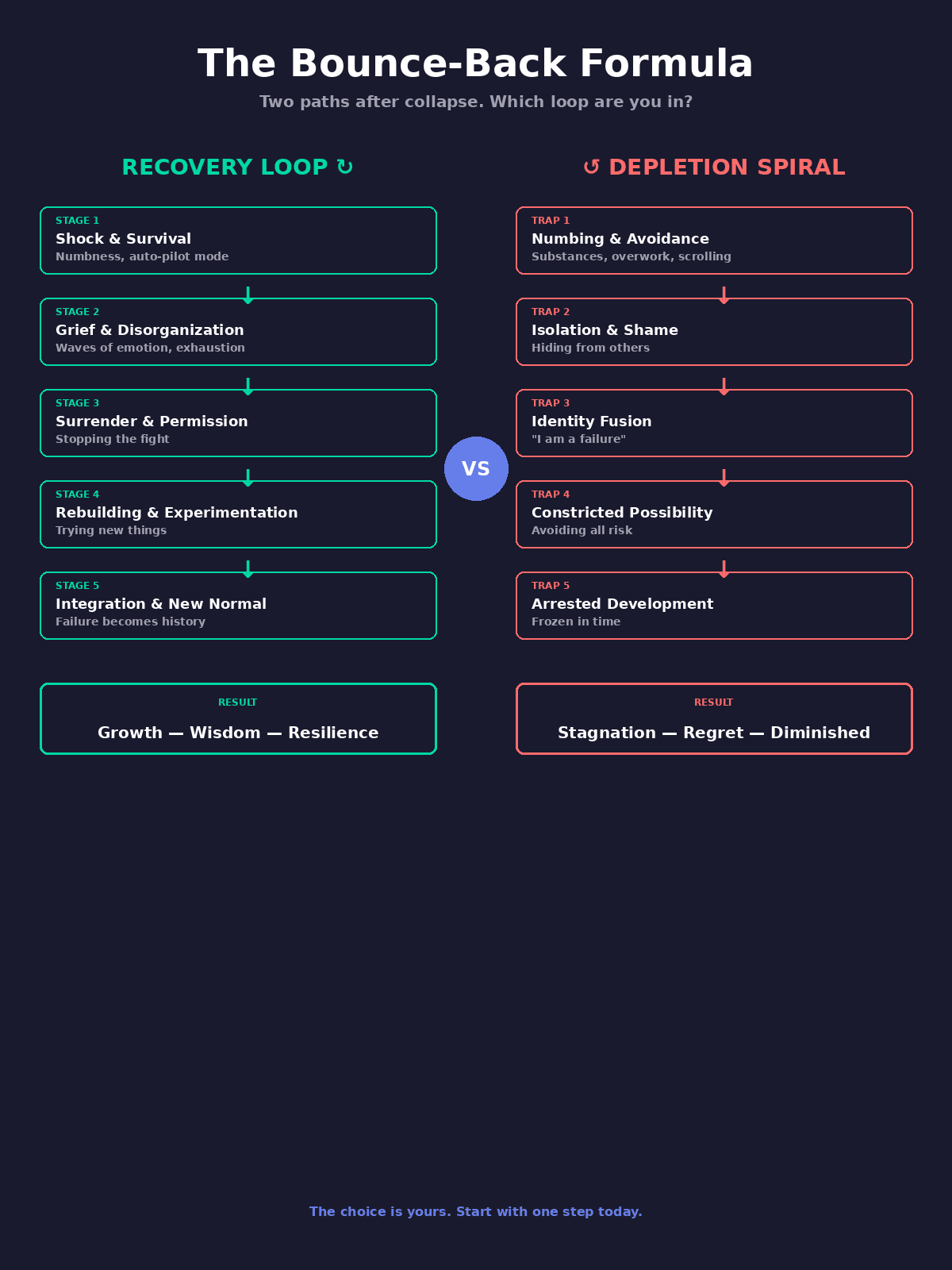
The Five Stages of Recovery
Recovery isn’t uniform, but it does follow recognizable patterns. Understanding the stages helps you recognize where you are, anticipate what’s coming, and avoid the trap of believing you’re failing at recovery when you’re actually progressing normally.
These stages aren’t strictly linear. You’ll circle back, skip ahead, get stuck, and suddenly leap forward. But the general trajectory holds: from chaos through grief through acceptance through rebuilding through integration. Each stage has its own challenges, its own traps, and its own requirements for moving through.
Stage One: Shock and Survival
The immediate aftermath of collapse is characterized by a strange combination of numbness and hyperactivity. Your body knows something catastrophic has happened even if your mind hasn’t fully processed it. You might find yourself making lists, handling logistics, returning emails with mechanical efficiency while feeling like you’re watching yourself from outside your body.
This dissociation is actually protective. Your nervous system is preventing you from being overwhelmed by the full weight of what just occurred. The danger is mistaking this functional capacity for okay-ness. Many people try to maintain normal performance during this stage, presenting calm exteriors while their interiors are in complete disarray.
What’s required in this stage is simply survival. Establish baseline safety: sleep, food, physical security. You don’t need to process everything yet. You don’t need to make meaning of what happened. You just need to keep breathing, keep functioning at the most basic level, and stop the immediate bleeding. (For practical crisis-level guidance while you’re in this stage, see What to Do If You Feel Like You’re Failing at Life—a companion piece with immediate, actionable strategies.) This stage typically lasts days to a few weeks.
Stage Two: Grief and Disorganization
When the protective numbness lifts, what’s underneath is often overwhelming. Grief arrives in waves that can knock you down without warning. You’ll be fine one moment—maybe even feeling optimistic—and sobbing in a parking lot the next. The triggers are unpredictable: a song you listened to while writing the business plan, a phrase your former partner used, the smell of the office building you no longer enter.
This stage brings a special kind of exhaustion. It’s not the tiredness of hard work; it’s the fatigue of holding intense emotion. Normal tasks feel impossibly heavy. You might sleep ten hours and wake up tired. Small decisions—what to eat, whether to shower—require enormous energy.
Shame often arrives with grief, and the two get tangled. You feel sad about what you lost, then ashamed that you’re sad, then ashamed that you feel ashamed. The shame tells you that your failure reveals something fundamentally wrong with you, that if you were better this wouldn’t have happened. (If you’re caught in this shame loop, The Self-Doubt Spiral: How Feeling Unworthy Blocks Success offers specific strategies for breaking free from internalized criticism.)
What’s required in this stage is witness and containment. You need people who can see you in your pain without trying to fix it. You need containers for your emotions—therapy, journaling, creating, movement. You need permission to feel exactly what you’re feeling without judging it. This stage is where most people want to rush through, but it can’t be rushed. It typically lasts weeks to months.
Stage Three: Surrender and Permission
There’s a distinct moment when you stop fighting what happened. It’s not happiness—it’s peace. The clenched fist you’ve been holding opens, and something releases. You stop asking “why did this happen to me?” and start asking “what now?” The energy that was going to resistance becomes available for forward movement.
This stage often feels less dramatic than the ones before and after. You’re not in crisis, but you’re not yet rebuilding. You’re in between, and that in-between-ness can feel uncomfortable. You’ve accepted that the past won’t change, but the future hasn’t formed yet.
What’s required here is patience with the liminal space. Self-compassion arrives, often slowly. You start treating yourself with the kindness you’d offer a friend. You acknowledge that you did your best with what you knew. The shame starts to lose its grip. This stage is shorter than grief—weeks rather than months—but essential for authentic rebuilding.
Stage Four: Rebuilding and Experimentation
This is where you start trying things again. New jobs, new relationships, new creative projects, new routines. Most of them won’t work out. You’ll face rejection. You’ll try directions that turn out to be wrong. You’ll have moments of excitement followed by crashes of disappointment.
The experiments feel disconnected from each other. One week you’re excited about a new direction, the next you’re convinced it was a mistake. Identity confusion is intense. You’re not who you were, but you’re not yet who you’re becoming. You might try on personas that don’t fit—being more ambitious than feels natural, or more laid-back.
This stage is where most people give up on recovery because it feels like making no progress. You’ll face rejection, and each one can feel like confirmation that you’re damaged goods. This is normal, even though it feels catastrophic.
What’s required is curiosity rather than certainty. Treating each “failure” as information rather than verdict. Support for the inevitable discouragement. Low-stakes experiments that let you try things without betting everything on them. This stage often takes much longer than you think it should—months to a year or more.
Stage Five: Integration and New Normal
You wake up one morning and realize you’re no longer thinking about the failure first thing. It’s still part of your story—you can still tell the narrative of what happened—but it doesn’t dominate your consciousness anymore. You’ve built new routines, new relationships, new ways of being that feel like yours.
There’s often gratitude in this stage, though it’s complicated. You’re grateful for the growth, but you wouldn’t choose to go through the collapse again. You’re grateful for the people who supported you, but you wish you hadn’t needed them so much. You’ve developed capacities you didn’t have before—perspective on challenges, tolerance for uncertainty, knowledge of your own resilience.
What’s required here is maintenance. Integration isn’t a destination you reach and stay at forever. You need to keep checking in. Also needed is generosity—sharing what you’ve learned with others who are struggling. Your failure becomes useful when it helps someone else navigate theirs. This stage is ongoing; it doesn’t end, it becomes part of how you live.
Stories from the Middle: Four Journeys Through Recovery
To understand how these stages work in practice, let’s follow four people through their recoveries. Each started at a different point, faced different challenges, and moved through the stages at different speeds. Their stories show what recovery actually looks like—not the polished version shared in keynote speeches, but the messy, nonlinear reality of rebuilding a life.
Marcus: From Corner Office to Kitchen Table
Marcus stayed in shock for nearly six weeks. He maintained his routine—up at 6 AM, dressed by 7, laptop open by 8—but he was operating on autopilot. He applied to jobs without reading the descriptions thoroughly, attended networking events where he couldn’t remember anyone’s name, and sat through interviews feeling like he was watching himself perform. His wife, sensing his distance, tried to offer comfort, but Marcus felt like a ghost in his own home.
“I remember sitting in a coffee shop for a ‘networking meeting’ with someone I’d contacted through LinkedIn,” Marcus recalls. “He was talking about his company’s ‘synergistic opportunities’ and I was nodding, smiling, asking follow-up questions. But inside, I was screaming. I didn’t care about his synergies. I didn’t care about anything. I was performing the role of ‘job seeker’ but I felt completely dead inside.”
The grief hit him suddenly, seven weeks after the layoff. He was scrolling through LinkedIn and saw his former company announce record profits. The dissonance broke something open. He went to the bathroom, locked the door, and sobbed for forty minutes—twelve years of loyalty, of sacrificed evenings and skipped vacations, of believing that his dedication meant something. The shame arrived with the grief. He’d been so proud of his title, his corner office, his place in the hierarchy. Who was he without those things?
“I couldn’t answer the phone when my college roommate called because I couldn’t say the words ‘I got laid off’ out loud. It felt like admitting I was nothing. I stopped going to my daughter’s soccer games because I couldn’t face the other parents—successful professionals who still had their jobs, their identities, their place in the world. I felt like I’d been exposed as a fraud, and everyone could see it.” (If Marcus’s story resonates with you, you might find The Self-Doubt Spiral: How Feeling Unworthy Blocks Success helpful—it explores the patterns of shame and identity collapse that follow major failures.)
Permission came slowly for Marcus. It started with a conversation with his brother, who’d been laid off twice in his career. “You’re acting like this is a moral failing,” his brother said. “It’s not. It’s weather. Economic weather. Happened to you, happens to thousands of people every day.” Something in that framing—weather, not character—helped Marcus soften toward himself. He started small: allowing himself to nap when he was exhausted, meeting friends for coffee without apologizing for being unemployed, admitting in interviews that he’d been laid off without hedging or making excuses.
“The moment that changed everything was stupid and small,” Marcus says. “I was in a grocery store, and I ran into someone from my old company. Former colleague. He asked how I was doing, and instead of saying ‘Great! Exploring new opportunities!’—my standard lie—I said, ‘You know what? I’m struggling. I got laid off and I’m figuring out what’s next.’ And he looked at me with such compassion, not pity, and said, ‘That happened to me five years ago. It was awful, and I’m sorry you’re in it. But you’ll get through.’ That was the first time I really believed I might.”
Rebuilding was the longest phase. Marcus spent eight months in an uncomfortable middle space—freelancing, consulting, taking a contract role that felt like a step backward. He questioned his identity constantly. Was he still a “senior executive” if he was doing project work? Was he failing if he earned less than before? The permission he’d found in stage three kept him moving, even when the path felt unclear.
He tried consulting and hated the constant pitching. He got certified to teach and realized he didn’t want to be in a classroom. He started a podcast about corporate culture that got fifty listeners. He felt lost, frustrated, and increasingly certain that he’d never find his way back to who he’d been.
“The irony is that I found my path by failing at other paths,” Marcus reflects. “Each thing I tried that didn’t work taught me something about what I actually wanted. (Success Through Failure: How Risks Teach Us Resilience explores this principle in depth—how each “failed” path can actually be gathering intelligence for the path that ultimately works.) I learned I needed autonomy more than status. I learned I cared about impact more than income. I learned I wanted to help people navigate the thing I’d just survived.”
Integration, when it came, surprised him. Eighteen months after the layoff, Marcus found himself in a new role—smaller company, less prestige, but more autonomy and better alignment with his values. He realized one morning that he no longer missed his old title. He’d become someone who valued different things: impact over status, sustainability over acceleration, relationships over networks. The collapse had stripped away layers of identity that weren’t truly his, revealing something more authentic underneath.
“I’m happier now than I was before the layoff,” Marcus says, and there’s wonder in his voice. “That’s not something I would have believed possible in those first months. But the collapse forced me to ask questions I’d been avoiding. Who am I without the titles? What do I actually care about? What would I do if I wasn’t trying to impress anyone? The answers surprised me.”
Elena: When the Dream Business Dies
Elena had opened her restaurant with every advantage: culinary school, five years working under a Michelin-starred chef, modest family investment, and a location she was sure would thrive. For three years, it worked. Not profitably, but sustainably—break-even, growing reputation, regular customers who felt like friends. Then the neighborhood changed. A major employer moved out. Foot traffic dried up. By year four, she was floating the business on personal credit cards and hope.
“I knew we were in trouble for months before I admitted it to anyone,” Elena recalls. “I’d sit in the back office after closing, looking at spreadsheets, trying to find a way to make the numbers work. The math was clear, but I couldn’t accept it. I kept thinking if I just worked harder, found one more catering client, cut costs a little more, we could turn it around.”
The shock of closing was brief because Elena had seen it coming. She’d been holding on for months, hoping for a miracle. When she finally made the decision—signing the papers, calling her investors, letting her staff go—she felt a strange relief mixed with devastation. The disorientation came after, when she realized she had no idea what to do with her days.
“Suddenly I had nowhere to be at 4 AM. No prep lists to check. No suppliers to call. No regulars to greet. I’d built my entire identity around being The Chef, The Owner, The Person Who Made This Place Happen. Without that, I was… I didn’t know what I was. I slept till noon and felt guilty about it. I watched terrible TV and felt guilty about that too. Everything felt wrong.”
Her grief was complicated by guilt. She felt responsible for her investors’ losses, for her employees’ sudden unemployment, for disappointing everyone who’d believed in her. The shame was intense—she’d staked her identity on being a chef, an entrepreneur, someone who created successful things. Now she was a cautionary tale, one of those restaurants people mention as “a shame, it used to be so good.”
“The worst part was running into former customers. They’d say, ‘Oh, I miss your place!’ and I’d have to smile and make small talk while inside I was screaming, ‘I failed! I lost everything! Don’t talk to me about your memories when I’m trying to forget mine!’ I started avoiding my own neighborhood because I couldn’t handle the questions and the sympathy.”
Permission emerged through therapy and a support group for failed entrepreneurs—her sister found it online and signed her up. Listening to others who’d lost businesses, who talked openly about their mistakes and their recoveries, Elena realized she wasn’t uniquely flawed. She’d taken a risk that didn’t pay off. That didn’t make her a failure; it made her someone who tried.
“The moment that shifted things was hearing a guy in my support group talk about his second bankruptcy. He said, ‘The first one nearly killed me. The second one was just business.’ I realized I’d been treating this like a death when it was really just… a thing that happened. A hard thing, a sad thing, but not a verdict on my worth.”
Gradually, she began to reframe: she’d learned five years of lessons in operations, leadership, and resilience. The restaurant had failed. She hadn’t.
Rebuilding took three years. Elena worked as a private chef, then as a consultant for new restaurants, then—slowly, carefully—started developing a concept for a smaller, more focused venture. She was terrified of failing again, and that fear made her conservative in ways she hadn’t been before. But it also made her wiser. She tested concepts before committing, built partnerships before signing leases, and kept her ego more separate from the business.
“The fear never really went away,” she admits. “Even when the food truck was doing well, I’d wake up at 3 AM convinced it was all about to collapse. But I learned to function with the fear instead of being paralyzed by it. (Elena’s experience of ongoing fear after failure is common; Facing Fear: How to Overcome Self-Doubt and Take the Leap provides practical tools for working with this residual anxiety.) I learned to ask for help instead of trying to do everything myself. I learned that a smaller, sustainable success is better than a big, spectacular failure—at least for where I am in my life now.”
Integration for Elena meant understanding that her first restaurant’s failure wasn’t a detour from her path—it was part of it. The skills she’d developed managing a crisis, the humility she’d gained, the clarity about what actually mattered to her in work—all of it informed who she became.
“My second venture is smaller and more sustainable, with a business model that reflects everything I learned. It’s not about proving the first failure wrong. It’s about building something that honors what that failure taught me. I don’t regret the restaurant—even though it failed, even though it hurt—because without it, I wouldn’t be who I am now. And I like who I am now better than who I was then.” (Elena’s transformation illustrates the central idea of The Gift of Struggle: Why Facing Adversity Is Key to Personal Growth—how our hardest experiences can become unexpected sources of wisdom and strength.)
David: The End of a Universe
David’s divorce arrived via text message while he was in a meeting. Twenty-three years of marriage, and his wife couldn’t wait until evening to tell him she’d filed papers. The shock was immediate and physical—he felt like he’d been punched, though no one had touched him. He left the meeting, sat in his car for an hour, and drove home to an empty house. She’d moved out that morning while he was at work.
“I remember walking through the house, room by room, realizing what was gone. The closet half-empty. The bathroom counter cleared of her things. The bed made in a way she never made it—tight, military corners. It felt like a crime scene, except the crime was the absence of everything familiar.”
The disorientation lasted months. David found himself reaching for routines that no longer existed—making coffee for two, calling out “I’m home” to an empty house, moving to share something funny before remembering there was no one there. His adult children navigated around him carefully, unsure how to process their parents’ split. His colleagues, unaware of his situation, commented on his distraction and weight loss.
“I kept buying food she liked, even though she wasn’t there to eat it. I’d find myself setting the table for two, then feeling like an idiot when I realized. It was like my body hadn’t gotten the message that my life had changed. The muscle memory of twenty-three years doesn’t just stop because the marriage ended.”
David’s grief was compounded by betrayal—his wife had been planning the exit for months, consulting lawyers, emptying accounts—and by the abrupt dissolution of his entire sense of self. He’d been a husband for longer than he’d been anything else. Who was he without that role? The shame was different from Elena’s or Marcus’s; it was the shame of not knowing, of having been blindsided, of realizing he’d been living in a story his partner had already exited.
“I felt like the world’s biggest fool. How did I not see it coming? How did I not notice she was checked out? How did I let twenty-three years end with a text message? The shame was worse than the grief. I felt like I should have known, should have done something, should have been somehow… more. More attentive? More successful? More something that would have made her stay?”
David’s shock phase was characterized by hyper-competence. He meticulously divided assets, handled all the logistics, and appeared to everyone as the person who was “handling it well.” He even started dating again within a few months, determined not to wallow.
“I was performing recovery. I’d read that the best way to get over someone is to get under someone else, so I went on dating apps before I was ready. (David’s premature dating was driven by fear of being alone; learn more about working with fear in Facing Fear: How to Overcome Self-Doubt and Take the Leap.) I’d meet women for drinks and talk about my divorce like it was a business transaction—efficient, resolved, no big deal. Then I’d go home and cry in my car. I wasn’t ready to date. I was ready to avoid feeling what I was feeling.”
But his grief phase was delayed, and when it hit, it hit hard. Nine months after the divorce was final, David found himself crying in his car after a first date that had actually gone well. The success of the date triggered a wave of grief—he realized how much he’d missed being truly seen, and how long he’d gone without it in his marriage.
Permission came through therapy, where he finally stopped using dates and work to numb himself. He spent three months intentionally single, which felt terrifying and liberating. He learned who he was without the mirror of a relationship reflecting him back.
“The anger came later than I expected. In therapy, I finally let myself feel furious about the text message, about the way she ended it, about the months of deception while she planned her exit. (For guidance on working with difficult emotions during collapse, What to Do If You Feel Like You’re Failing at Life offers specific tools for emotional regulation and crisis navigation.) I’d been raised to be nice, to avoid conflict, to smooth things over. But I was angry, and I needed to feel that anger to move through it.”
His rebuilding phase included moving to a new neighborhood, changing careers from finance to nonprofit development (he’d always wanted to), and slowly learning to trust his judgment again. At two years post-divorce, he’s in a healthy new relationship, but he’s different in it—slower to merge lives, clearer about his needs, more honest about his fears.
“The divorce didn’t just end my marriage; it forced a reckoning with how I’d shown up in it. (If you’re in the middle of collapse and need immediate strategies, What to Do If You Feel Like You’re Failing at Life provides practical crisis navigation for when nothing seems to be working.) I realized I’d spent years performing ‘good husband’ without actually being present. I checked boxes—anniversaries, vacations, holidays—without really being there. The collapse, as painful as it was, made me look at myself honestly for the first time in decades. I didn’t like everything I saw, but at least I could work with it.”
The integration David experienced wasn’t about becoming “over it” in the sense of being unaffected—he still felt sadness, still had moments of anger, still missed aspects of the marriage. But he’d constructed a meaningful life as a single person, and now as a partner in a new relationship that felt more authentic than the one he’d had for twenty-three years.
“I’m grateful for the divorce now,” he says, and there’s weight behind the words. “Not because the marriage was bad—parts of it were wonderful—but because the ending forced me to become someone I needed to be. Someone more honest, more present, more capable of real intimacy. I wouldn’t have chosen this path, but I’m glad I walked it.”
Kira: The Full Arc
Kira was thirty-four when her manuscript was rejected by the fifteenth publisher. She’d spent six years writing a novel she believed would be her breakout—the story that would finally justify all the years of adjunct teaching, the small apartments, the careful budgeting, the delayed life. Her agent had been optimistic. The early feedback had been promising. And then, one by one, the doors closed. Not “this needs work” rejections, but “this isn’t commercially viable” rejections. The kind that suggested the problem wasn’t execution but conception. The kind that made her question not just this book, but her entire understanding of what she was doing with her life.
“I still remember the fifteenth rejection because it came on my birthday. A form letter—couldn’t even be bothered to personalize it. I sat in my car in the campus parking lot where I taught freshman comp, read that email, and felt like the floor dropped out. Six years. Six years of thinking this was going to be my ticket out of adjunct hell, my proof that I was a real writer, my validation that all the sacrifice was worth it. And it was over in one paragraph.”
The immediate aftermath was numb efficiency. Kira taught her classes, graded papers, answered emails. She told herself she was being professional, handling disappointment with grace. What she was actually doing was dissociating, keeping herself busy enough that she couldn’t feel the full weight of what had happened.
“I was a zombie. I’d lecture about comma splines and thesis statements while inside I was screaming, ‘What am I doing with my life?” I couldn’t tell anyone about the rejections—not my family, not my friends, not even my writing group. I was too ashamed. I’d told everyone this book was going to be the one. Now I had nothing and I couldn’t face explaining why.”
Two months after the final rejection, Kira was driving home from campus when she heard a song on the radio that she’d listened to repeatedly while writing the book. She pulled over and sobbed for thirty minutes in a grocery store parking lot. That was the beginning of the grief phase.
The grief that followed was unlike anything she’d experienced. She felt betrayed by her own judgment—how could she have worked so hard on something no one wanted? She felt humiliated by the time she’d spent, the sacrifices she’d made, the way she’d answered “what do you do?” at parties with quiet pride. She felt terrified by the blankness of her future—without the book, what was she working toward?
“I stopped writing entirely. For two years, I didn’t write a single creative word. I couldn’t face the blank page—the thought of putting years into something that might meet the same fate felt unbearable. I took extra adjunct sections to fill the time. I taught during summers, which I’d always protected for writing. I filled every hour so I wouldn’t have to think about the fact that my dream was dead.”
She gained weight. She stopped calling her mother because she couldn’t stand the sympathy in her voice. She told herself she was taking a break, but the truth was she was drowning and didn’t know how to ask for help.
Permission came from an unlikely source: a podcast interview with a successful author who talked openly about querying for seven years, about trunking three complete novels that never sold, about the failure that preceded her success. Kira listened to that interview on repeat, especially the part where the author said, “I had to stop asking whether I was good enough and start asking whether I was willing to keep going. Those are different questions.”
“Something in that distinction helped me separate my worth from my outcomes. I’d been conflating ‘my book didn’t sell’ with ‘I’m not a real writer.’ But the author on that podcast had books that didn’t sell and she was still a real writer—still writing, still submitting, still creating. The failure of the product wasn’t the failure of the person. That seems obvious now, but it wasn’t then.”
She started small—journaling, morning pages, short essays she didn’t intend to publish. She wrote for herself, for the first time in years, without thinking about agents or markets or whether it was good enough. The work was private, humble, almost embarrassing in its sincerity. But it reminded her why she’d started writing in the first place: not to be published, but because she loved making sentences, loved the surprise of discovering what she thought through the act of writing.
“I wrote in my journal every morning for a year before I showed anyone a word. I wasn’t writing ‘real’ writing—I was just… processing. Writing about my day, my fears, my memories. But something was happening. The muscle was strengthening. The voice was coming back. I wasn’t writing for publication, and that made it safe again.”
Rebuilding took the form of a new novel—completely different from the first, written without any thought about marketability or commercial potential. Kira wrote it over three years, in early mornings and stolen lunch breaks, without telling anyone she was working on it. When it was finished, she hesitated for six months before querying again. The fear was visceral—she couldn’t survive another round of rejections like the first.
“But I was different now. The first book—I needed it to validate me. I needed it to prove I wasn’t wasting my life. I needed external success to feel internal worth. The second book was different. I wrote it because I had something to say, not because I needed it to save me. If it failed, I’d be disappointed, but I wouldn’t be destroyed. That difference changed everything.”
When it sold—quickly, to a small press that specialized in the kind of literary fiction she’d written—Kira felt a strange mix of triumph and relief, but not the ecstatic validation she’d expected. She was happy, but she was also… okay. The publication was wonderful, but it wasn’t saving her. She’d already done that work.
“The integration I experienced wasn’t about becoming a successful author. It was about becoming someone who could fail spectacularly, publicly, over years, and still choose to risk again. That capacity—to persist without guarantees—became part of who I was, applicable to everything from relationships to career changes to creative projects.”
The novel that was published wasn’t as good, in some technical sense, as the one that had been rejected a hundred times. But Kira was different. She’d weathered the collapse of her dream and discovered that she was more durable than she’d known. The bounce-back wasn’t about the external achievement. It was about the internal shift—from someone who needed success to validate her, to someone who could keep creating without requiring the world to affirm her worth.
“I still have the file of rejection letters from the first book. I don’t read them, but I keep them. They’re proof of what I survived. Not evidence of failure—evidence of persistence. Evidence that I kept going when everything suggested I should stop. That capacity, more than any publication, is what I’m proud of.”
Kira’s story illustrates something crucial about recovery: the external outcome doesn’t determine the internal transformation. She published her second book, but she would have been recovered—integrated, whole, changed—even if she hadn’t. The recovery was in the becoming, not in the achieving.
The Hidden Cost of Not Recovering
There’s a temptation, when you’re in the middle of failure, to imagine that the status quo is sustainable. You tell yourself you’re just taking time to figure things out. You promise you’ll start rebuilding next month, next season, next year. But not recovering has costs, and they compound in ways that make recovery harder the longer you wait.
The Cost of Arrested Development
When you don’t move through the stages of recovery, you become frozen in time. The person you were at the moment of collapse becomes the person you remain—defensive, cautious, defined by what you lost rather than what you might become. Marcus, if he hadn’t processed his layoff, might have taken the first job offered and spent his next decade resenting it, never taking risks, never discovering what truly mattered to him. Elena, stuck in shame, might have abandoned entrepreneurship entirely and spent her life wondering what would have happened if she’d tried again. David, refusing to grieve, might have rushed into another relationship that repeated the same patterns, dooming himself to the same outcome.
The cost here isn’t just the lost time—it’s the lost potential. Every month you spend in suspended animation is a month of growth you don’t get back. You’re not standing still; you’re falling behind. Your peers are moving forward, developing skills, building relationships, accumulating wisdom. You’re stuck in the emotional equivalent of a waiting room, watching life happen on the other side of the glass.
A former athlete who never processed a career-ending injury might spend decades avoiding physical activity, their identity forever linked to the body they used to have instead of the one they have now. A parent who never recovered from a child’s estrangement might become bitter and guarded, unable to fully show up for other relationships. The unprocessed loss casts a long shadow.
The Cost of Identity Calcification
The longer you stay in a state of post-collapse paralysis, the more your identity hardens around the failure. You become, in your own mind and often in others’, The Person Who Failed. The label sticks. The story solidifies. And identity has a way of creating reality—if you believe you’re someone who doesn’t succeed, you’ll unconsciously engineer situations that confirm that belief.
This calcification manifests in subtle ways. You stop applying for jobs that feel like stretches because “those aren’t for people like me.” You don’t initiate conversations with people you find attractive because “why would they want someone who failed?” You don’t pursue creative projects because “I already know how that ends.” The failure becomes a cage, and eventually you stop noticing that the door is unlocked. (These self-limiting beliefs are explored in detail in The Self-Doubt Spiral: How Feeling Unworthy Blocks Success—essential reading if you’re hearing this internal monologue.)
Years pass. You rationalize. “I’m being realistic.” “I’ve learned my lesson.” “Some people are cut out for success and I’m not one of them.” These aren’t insights; they’re coping mechanisms. The calcified identity protects you from the pain of trying again, but it exacts a heavy toll: your life becomes smaller than it needed to be, bounded by a failure that happened years ago but still governs your choices today.
The Cost of Constricted Possibility
Unprocessed failure narrows your world. You stop trying things that might lead to similar outcomes. You avoid relationships, opportunities, creative expressions that carry risk. Your life becomes a series of safe choices that protect you from the specific pain you experienced, while opening you to the slower pain of regret and unrealized potential.
This constriction happens so gradually you might not notice it. One day you realize you haven’t tried anything new in years. You haven’t put yourself in a position to fail because you haven’t put yourself in a position to try. Your life has become a fortress designed to prevent the specific collapse you experienced, but in doing so, it has prevented everything else as well.
The entrepreneur who never recovered from a failed business might spend decades working comfortable corporate jobs, always wondering what would have happened if they’d tried again. The artist who put away their paints after a harsh critique might find themselves at sixty realizing they’ve barely created anything in thirty years. The constriction feels protective, but it’s actually a slow drowning.
The Cost of Transmitted Trauma
If you have children, partners, or people who look up to you, your unhealed failure becomes part of their inheritance. They learn that setbacks are permanent, that dreams are dangerous, that it’s better to play small than to risk falling apart. Kira’s avoidance of writing for years wasn’t just her loss—it was a model for everyone watching her of how to respond to disappointment: shut down, protect yourself, let the dream die.
The people around you absorb your unspoken beliefs about failure through observation. When you don’t recover, you’re teaching that recovery isn’t possible. When you hide your struggles, you’re teaching that struggles should be hidden. When you give up on dreams, you’re teaching that dreams aren’t worth the risk. These lessons, absorbed unconsciously, shape the people you influence in ways you might never know.
A parent who models giving up after setback teaches their children to give up. A partner who never processes a career failure and becomes bitter teaches their spouse that ambition leads to pain. A leader who collapses under pressure without seeking help teaches their team that help-seeking is weakness. The transmission happens silently but effectively.
The Cost of Identity Foreclosure
Who you become after failure, if you don’t do the recovery work, is a diminished version of who you might have been. Not because failure diminishes you—it doesn’t—but because avoiding the work of integration means avoiding the growth that comes from it. You stay at the level of consciousness you had before the collapse, never upgrading your self-knowledge, your emotional capacity, your wisdom about how life actually works.
The person you could have been—the one who integrated the failure, learned from it, grew because of it—doesn’t exist. That person is a phantom, a possibility you declined. And while you can’t mourn what you never had, you can feel the absence of who you might have become if you’d done the work.
Consider the difference between these two versions of the same person: one who failed, learned, integrated, and built something meaningful despite (or because of) the failure; and one who failed, froze, and spent decades treading water. The gap between those versions widens over time. The cost of not recovering is the life lived in that gap.
The Cost of Time
Recovery takes time no matter what. But unprocessed failure takes more time because it keeps showing up. Years later, you’ll still be triggered by reminders. You’ll still be making decisions based on fear of repeating the collapse. The work you avoid today becomes the baggage you carry indefinitely.
Consider: Marcus could have spent ten years in jobs he hated, never understanding why he felt numb; instead, he spent eighteen months doing difficult emotional work and emerged with clarity. Elena could have spent five years avoiding the kitchen, nursing her shame; instead, she spent three years processing and rebuilding, and opened a successful second venture. David could have spent decades in a joyless marriage or a series of equally joyless relationships; instead, he faced the hard truths and built something better.
Time spent recovering is an investment. Time spent not recovering is a cost. The question isn’t whether you’ll spend time on this—it’s whether that time will move you forward or keep you stuck.
The Cost of Opportunity
While you’re not recovering, life is still happening. Jobs are being filled by people who applied. Relationships are forming between people who took the risk of meeting. Businesses are being started by people who were willing to fail again. Your window doesn’t stay open indefinitely, and every month spent in paralysis is a month of possibilities that close forever.
The opportunity cost of not recovering is invisible but real. You’ll never know about the job you didn’t apply for because you couldn’t get your resume together, the connection you didn’t make because you couldn’t bear to go to the party, the idea you didn’t pursue because you were still nursing the wounds of the last failure. These lost possibilities don’t announce themselves—they just don’t happen, and you carry on, unaware of what might have been.
There’s a particularly cruel irony here: the fear of failing again keeps you from trying, but not trying is its own failure—the failure to live fully, to risk, to find out what might be possible. The paralysis that feels like protection is actually a different kind of falling apart, slower and quieter but no less final.
The Cost to Your Future Self
The version of you five years from now is being shaped by the choices you’re making today. If you choose not to recover, you’re consigning that future self to a smaller, dimmer life than they could have had. You’re making their story one of ongoing aftermath rather than new beginnings. They will look back at this moment and either thank you for what you did or mourn what you didn’t.
Future-you deserves better than current-you’s avoidance. They deserve the version of you that did the work, that moved through the grief, that rebuilt even when it was hard. They deserve a life that isn’t defined by a collapse that happened years ago. They deserve you at your full capacity, not you at your diminished, stuck capacity.
This isn’t meant to pressure you. Recovery can’t be rushed; doing the work superficially to check a box isn’t recovery at all. But it also can’t be postponed indefinitely. The question isn’t whether you’ll recover—it’s whether you’ll start the process while you still have the resources, relationships, and runway to do it well.
The costs of not recovering accumulate silently, invisibly, until one day you look back and realize years have passed and you’re still standing in the same spot. Don’t let that happen. The work is hard, but the cost of not doing it is harder.
How To Actually Recover: The Practical Path
All the theory in the world won’t help if you don’t know what to do on Tuesday at 3 PM when grief hits unexpectedly. This section is a step-by-step guide for the daily work of recovery. These aren’t abstract principles; they’re actions you can take, habits you can build, and choices you can make even when you feel like you have no choices left.
Five Foundations Before You Start
Before diving into specific actions, establish these five foundations. Without them, the steps that follow won’t work as well—or at all.
- Create containment. You need a space where you can fall apart without consequences. This might be therapy, a trusted friend, a journal, or a private creative practice. The container holds your grief so it doesn’t leak into every area of your life. Without containment, you’ll either suppress everything (and it will explode later) or express everything everywhere (and damage relationships and opportunities you need).
- Establish baseline survival. Sleep, food, movement, and basic hygiene aren’t optional. They seem trivial compared to the existential crisis you’re facing, but your nervous system can’t process grief while also coping with sleep deprivation and malnutrition. You don’t need to optimize this—just achieve minimum viable functioning. Eight hours in bed (even if not all sleeping). Three meals. A walk around the block. A shower every two days. These basics create the physical platform that makes psychological work possible.
- Secure your resources. Whatever you need to survive—money, housing, healthcare, childcare—address these first. Panic about eviction will derail grief work. Financial survival terror will override healing. Make the hard practical decisions: apply for assistance, move to a cheaper place, ask for help from people you usually wouldn’t ask. Stability, even at a lower standard of living, creates the safety needed to do the emotional work.
- Identify your witnesses. You need people who see you without trying to fix you. Not everyone can do this. Some friends will try to cheer you up, offer solutions, or subtly communicate that your pain makes them uncomfortable. Find the ones who can simply be present. It might be one person. It might be a therapist. It might be a support group. But you need at least one witness who can hold your experience without rushing to change it.
- Set intentions, not goals. Goals—”get a new job by March,” “be dating again by summer”—create pressure that can interfere with recovery. Intentions—”be present with my grief,” “try one new thing each week,” “practice self-kindness daily”—create direction without rigidity. You’re not racing toward a finish line. You’re tending to a process that unfolds on its own timeline.

The 10-Step Practical Path
- Step 1: Name What Happened (Week 1-2)
The first step is the simplest and hardest: say out loud what occurred. Not the sanitized version, not the version that makes you look better, but the truth. “I was laid off because the company was acquired.” “My partner left me.” “My business failed.” “I didn’t get into any of the schools I applied to.”
This sounds trivial, but most people avoid it. They euphemize (“I’m exploring new opportunities”). They blame (“the market was impossible”). They obscure (“things didn’t work out”). Naming requires facing reality without the protective stories that soften the blow.
Exercise: Write the sentence. “What happened is…” No qualifiers, no explanations, no mitigating circumstances. Just the fact. Read it out loud to yourself, alone, until you can say it without your voice catching. Then practice saying it to one person who can hold the truth with you. Notice how naming changes the experience—it moves the failure from an overwhelming cloud into a specific event that happened.
The power of naming is in the specificity. “I failed” is amorphous and crushing. “I submitted my novel to fifteen publishers and all of them rejected it” is specific and manageable. You can work with specifics. You can grieve specifics. You can make meaning from specifics. The vague, general sense of having failed is just a weight you carry.
- Step 2: Feel What You Feel (Week 2-8)
After naming comes feeling. This is the stage most people want to skip. We live in a culture that pathologizes unpleasant emotion, offering quick fixes for anything uncomfortable. But grief, anger, shame, and fear are not problems to be solved. They’re experiences to be had.
This doesn’t mean you should wallow or perform your feelings. It means allowing them when they arise and finding appropriate containers for them. Cry when you need to cry. Hit pillows when you’re angry. Write rage letters you don’t send. Go to therapy and say the things you’re ashamed to say anywhere else.
Exercise: Create a daily 10-minute container. Set a timer. During those 10 minutes, feel whatever you’re feeling without judgment, without trying to change it, without reframing it positively. If you’re sad, be sad. If you’re angry, be angry. If you’re numb, be numb. When the timer goes off, go about your day. This practice teaches your nervous system that emotion is safe, that it can arise and pass through without destroying you.
You’ll notice that feelings come in waves. There are moments of intense grief followed by moments of normal functioning. This doesn’t mean you’re “over it” when you feel okay, or that you’re “backsliding” when grief returns. It means you’re human, with a nervous system that oscillates between processing and functioning. Both states are normal.
The danger in this phase is either suppressing (which stores the feelings for later explosion) or indulging (which makes feelings into an identity). The middle way is acknowledgment: “I’m experiencing grief right now. It’s strong. It’s heavy. It won’t last forever.”
- Step 3: Find Your Witnesses (Week 2-4)
You cannot recover in isolation. The shame of failure convinces us to hide, but isolation amplifies shame. Finding the right witnesses—people who can see you without trying to fix you—creates the relational context that makes healing possible.
Not everyone in your life can fill this role. Some people simply can’t handle pain without trying to solve it. Others get uncomfortable and change the subject. Some offer platitudes that make you feel worse. Don’t blame them for these limitations—most people haven’t learned to hold space for difficulty.
Exercise: Make a list of five people you might trust. Test them with small disclosures: “I’ve been having a hard time since the layoff.” Watch how they respond. Do they ask questions? Do they offer immediate solutions? Do they tell you it’ll be okay? The good witnesses hold eye contact, ask what you need, and offer presence rather than platitudes. When you find one, give them more. Eventually, tell them the full truth.
Consider professional witnesses as well. Therapists are trained specifically for this role. Support groups provide multiple witnesses who understand your experience intimately. Spiritual directors, coaches, mentors—depending on your needs, different professionals offer different kinds of witnessing.
The quality of witnessing matters more than the quantity. One person who truly sees you is worth more than a dozen well-meaning friends who offer superficial comfort. Invest in finding and maintaining relationships with your true witnesses.
- Step 4: Separate Identity from Outcome (Week 4-12)
One of the hardest aspects of failure is the way it conflates with identity. “I failed” becomes “I am a failure.” “The business collapsed” becomes “I’m not cut out for entrepreneurship.” “The relationship ended” becomes “I’m unlovable.” This conflation isn’t true, but it feels true, and it creates the shame that paralyzes recovery.
Separating identity from outcome requires a specific practice: notice when you make global statements about yourself based on specific events, and correct them. Not in a Pollyanna way—”the failure was actually good!”—but in a factual way: “The business failed. That doesn’t define my worth or capacity.”
Exercise: Keep a log for one week. Every time you notice yourself thinking in global terms about your failure—”I’m terrible at everything,” “I always fail,” “I’m not good enough”—write it down. Then write the specific, factual correction: “One business failed under difficult circumstances. I’ve succeeded at other things. My worth isn’t determined by this outcome.”
This practice feels artificial at first, like you’re arguing with yourself. But over time, it rebuilds the boundary between specific events and general identity. You start to believe the corrections. The shame loses its grip.
A crucial distinction here: separating identity from outcome isn’t the same as avoiding responsibility. If you made mistakes, own them specifically. “I didn’t manage cash flow well in Q3” is different from “I’m terrible at business.” The first points to something you can change. The second is a global condemnation.
- Step 5: Process with Your Body (Week 4-16)
Trauma and grief live in the body, not just the mind. You can talk about failure for years without releasing the held tension, the startle responses, the physical symptoms of stress. Somatic processing is often the missing piece in recovery that seems stuck.
Your body is responding to the failure as a threat, whether or not your mind has intellectually processed it. The racing heart, the tight shoulders, the shallow breathing, the disrupted sleep—these are somatic expressions of emotional states. Addressing them directly speeds psychological healing.
Exercise: Three times daily, do a 30-second body scan. Close your eyes. Start at your feet and move upward, noticing tension, temperature, sensation. Don’t try to change anything, just notice. Then, add gentle movement—shaking out your limbs, stretching, walking. Movement discharges stored stress hormones in a way thinking cannot.
More intensive somatic practices include: yoga (especially restorative or yin), tai chi or qigong, somatic experiencing therapy, EMDR, massage, floating in salt water, dancing, hitting a punching bag, or screaming into a pillow. The key is finding practices that let your body express what it’s holding rather than just managing symptoms.
Pay attention to when you feel “activated”—heart racing, stomach clenched, breath shallow. In those moments, you can’t think your way out. You have to body your way out: feet on the floor, deep breaths, physical grounding. The body leads, and the mind follows.
- Step 6: Make Meaning, Eventually (Week 8-20)
There’s a difference between making meaning and rushing to positivity. “Everything happens for a reason” is usually a way to bypass grief. Meaning-making comes later, when the initial intensity has passed, when you can look back with some distance and ask: “What does this mean? What have I learned? How am I different?”
This step cannot be rushed. Trying to make meaning too early is like trying to analyze a movie while you’re still watching it. You need the full experience before you can understand its significance. Forcing meaning in the middle of grief just creates shallow narratives that don’t hold up over time.
Exercise: When you’re ready—and only when you’re ready—write the story of what happened. Not the factual account, but the meaning. “I learned that…” “I discovered I could…” “This failure taught me about…” If you can’t write these sentences without feeling like you’re lying, you’re not ready yet. Wait. Try again in a month.
The meaning you make might not be what you expect. It might not be “this made me stronger” or “I wouldn’t change anything.” It might be “I learned I can survive things I thought would kill me” or “I discovered some people I thought were friends weren’t” or “I understand now that luck matters more than I wanted to believe.” Meaning doesn’t have to be positive. It just has to be true.
Meaning is also not static. The meaning you make at six months might differ from the meaning at two years. That’s okay. You’re allowed to revise your understanding as you gain perspective.
- Step 7: Experiment with New Identity (Week 12-30)
After the initial grief has passed, you’re in the liminal space—not who you were, not yet who you’ll become. This is when experimentation becomes possible and necessary. Try things. Take small risks. Put yourself in unfamiliar situations and notice who you are there.
Some experiments will fail. That’s the point. You need to discover what doesn’t fit as much as what does. The person who emerges from failure isn’t predetermined. You’re actively creating them through these experiments.
Exercise: Once a week, do something that would have been out of character for pre-failure you. If you were cautious, try something spontaneous. If you were a workaholic, take a full day off. If you were all about achievement, do something purely for pleasure with no productive outcome. Notice what feels authentic and what feels like a costume.
The experimentation phase can be disorienting. You might feel like you’re playing roles, trying on personalities that don’t quite fit. This is normal. You’re in the fitting room of identity, and it takes time to find what feels like yours.
Keep experiments low-stakes when possible. You’re testing, not committing. The goal is information, not achievement. Each experiment that doesn’t work teaches you something about what you actually want.
- Step 8: Build New Structures (Week 16-40)
After experimenting comes building. You start to formalize the new identity, new routines, new life that emerged from your experiments. This is where you commit to directions that feel right and begin constructing the scaffolding that will support your next chapter.
Structures include: routines that support your well-being, relationships that nourish you, work that aligns with your values, environments that feel like home, practices that ground you. These aren’t accidental anymore; they’re chosen and maintained intentionally.
Exercise: Identify the three structures that would most support your recovery. A morning routine? A weekly social commitment? A creative practice? A financial safety net? Pick one and build it deliberately over a month. Then add the second. Then the third. Sustainable change happens through accumulated structure, not willpower.
Building structures requires saying no to things that don’t serve the new life you’re creating. This might mean ending relationships, leaving opportunities, disappointing people’s expectations. The structures you build are boundaries that protect the life you’re constructing.
Notice the difference between structure that supports you and structure that confines you. Good structure feels like a trellis that lets you climb—present but not restrictive. Bad structure feels like a cage. Adjust as needed.
- Step 9: Integrate the Story (Week 30-60)
Integration means the failure becomes part of your story without being the whole story. You can talk about what happened without being triggered. You can see the gifts and the losses with equal clarity. The failure has its proper place in your history—not erased, not dominant, just there.
This doesn’t mean you’re “over it.” You might still feel sad, angry, or scared when you think about what happened. But these feelings are proportionate, passing, part of the texture of your history rather than its defining feature.
Exercise: Write the story of your failure as you would tell it to someone you trust. Not the dramatic version, not the sanitized version, but the true version. Practice telling it—first to yourself, then to safe people, then gradually to less safe people as you feel ready. Notice how the story changes as your relationship to it changes.
Integration also means the failure informs your present without controlling it. You carry the lessons—about your resilience, about what matters, about the nature of risk—without carrying the fear that prevents new risks. You remember without reliving.
This is the stage where your failure can become useful to others. When you’re integrated, your story helps people in the middle of their own collapse feel less alone, less strange, less hopeless. Integration allows you to be a witness for others the way witnesses helped you.
- Step 10: Maintain and Return (Ongoing)
Recovery isn’t a destination you reach and stay at. It’s a practice you maintain. Some days you’ll feel fully integrated. Other days—anniversaries, triggers, new stressors—you’ll find yourself back in earlier stages. This doesn’t mean you failed at recovery. It means you’re human.
Maintenance means keeping the practices that support you even when you feel fine. It means having a plan for when grief unexpectedly returns. It means knowing your warning signs and responding to them before you spiral.
Exercise: Create your “return protocol”—the specific steps you take when you notice yourself slipping back toward old grief. Who do you call? What do you do? Where do you go? Write it down when you’re well, so you have it when you’re not. Keep your witness relationships active even when you don’t need them, so they’re there when you do.
The goal of maintenance isn’t to prevent setbacks—it’s to handle them skillfully when they come. You’ll have hard days. The question isn’t whether but when, and what you do when they arrive.
Over time, the returns to grief become shorter and less intense. A trigger that would have derailed you for a week early in recovery might derail you for an hour at two years. The work compounds, and recovery becomes self-sustaining.
Finally, maintenance includes generosity. As you recover, help others. Be the witness you needed. Share what you learned. Your failure becomes a gift when it lightens someone else’s burden. This is the final transformation: from victim to survivor to guide.
Unconventional Paths to Recovery
Not everyone recovers through therapy and journaling. Some people need different routes back to themselves—approaches that might look strange to observers but work for the individuals who take them. Here are some less conventional but valid paths to recovery.
Physical Extremes
For some people, the way through psychological pain is through physical challenge. Ultrarunning, mountaineering, long-distance hiking, cold water swimming—pursuits that push the body to its limits can create conditions where the mind can’t hold onto its usual patterns. The sheer demands of physical survival override ruminative loops.
There’s science behind this. Extreme physical exertion changes brain chemistry significantly. The release of endorphins, the activation of the mammalian dive reflex in cold water, the meditative state induced by repetitive movement—these alter consciousness in ways that can interrupt grief patterns. The body, pushed to its limits, demands full attention, which provides relief from obsessive thought.
A software engineer who lost his startup described running a hundred-mile race through the mountains as his therapy: “I couldn’t think about the failure while I was navigating technical terrain at mile eighty in a snowstorm. My body was so fully occupied that my mind had to quiet. And when I finished—when I proved I could do something that hard—I started to believe I could survive the business failure too.”
Caveats: Physical extremes aren’t for everyone. They require baseline fitness and carry injury risk. They also don’t replace psychological processing—they just create conditions where processing becomes possible. Use them as adjuncts, not replacements, for the core recovery work.
Creative Destruction
Some people need to break things before they can build again. Not metaphorically—literally. Smashing objects, burning symbols, destroying representations of what was lost. This appears in many cultures: the burning of letters after a divorce, the tearing of garments in mourning, the destruction of effigies.
There’s therapeutic value in destruction as a physical act of release. Keeping physical reminders of what you’ve lost maintains a connection that can prevent moving on. Ritually destroying those objects externalizes the internal decision to let go.
An artist whose gallery show had flopped described her recovery process: “I kept the terrible review pinned above my desk. Told myself it was ‘motivation.’ Really, it was self-flagellation. My sister convinced me to burn it on New Year’s Eve. We made a ceremony of it—read it one last time, acknowledged everything it triggered, then lit the fire. I cried harder than I had in months. But the next day, something had shifted. I could finally start new work without that voice hanging over me.”
Caveats: Destruction should be symbolic and safe, not actual harm to relationships, financial stability, or legal standing. Burn representations, not bridges you might need later. Make it ritual, not rage.
Service and Submersion
For some, the path out of self-absorption induced by failure is through absorption in others’ needs. Volunteering, caregiving, service work—these create contexts where your problems aren’t the center of the universe. This isn’t avoidance; it’s perspective.
Service work reminds you that your suffering exists alongside others’ suffering, that your story is one of millions, that you have something to offer even in brokenness. The nurse who volunteers at a homeless shelter after losing her job, the divorced father who coaches his son’s team, the failed entrepreneur who mentors new business owners—these acts of service rebuild identity through contribution rather than achievement.
“I was drowning in my own failure,” a former executive recalled. “Then I started tutoring kids in math at the community center. Their struggles—real, immediate, not theoretical—made mine feel different. I wasn’t ‘the guy who lost his job.’ I was ‘the guy who helps with algebra.’ That shift, however small, mattered.”
Caveats: Service should come from genuine desire to help, not from escaping your own pain. Don’t use others’ suffering to make yourself feel better. Be honest about your motivations with yourself.
Radical Restructuring
Sometimes recovery requires changing everything. Moving to a new city. Changing careers entirely. Ending all existing relationships and starting fresh. This looks like running away, and sometimes it is—but sometimes it’s the necessary creation of a context where new identity can form without the triggers and expectations of the old context.
A teacher who’d been fired after a scandal moved across the country, changed her name (not legally, just in daily use), and started working in a completely different field. “I couldn’t be the person I was trying to become while everyone around me expected me to be the person I’d been. I needed a context without those associations. It wasn’t about escaping consequences—it was about creating space for growth that wasn’t possible where I was.”
This path is controversial because it can look like avoidance, and sometimes it is. The difference is in whether you’re running toward something new or away from something old. If you’re building a new life somewhere else, that’s valid. If you’re just trying to outrun pain that will follow you anywhere, that’s not recovery.
Caveats: Radical restructuring should be done deliberately, not impulsively. Don’t burn bridges you might need. Consider whether you’ll just recreate the same patterns in a new location. Sometimes the problem is internal, not external.
The Slow Fade
Not everyone needs dramatic intervention. Some people recover through the simple passage of time, continued functioning, and gradual adjustment. They don’t process intensively—they just keep living, and eventually the pain fades to background noise, then to memory, then to history.
This path looks like doing nothing special: going to work, raising children, maintaining routines, not talking much about what happened. It can seem like avoidance or suppression, but for some personalities, it’s the right approach. They don’t need to dive into the grief. They need to walk around it, over time, until it’s far enough behind them.
A corporate lawyer after a divorce: “Everyone told me I needed therapy, needed to process, needed to ‘do the work.’ I tried it and felt worse. What worked for me was just… going to the office every day, seeing my kids on weekends, letting time pass. Two years later, I realized I was okay. Not ‘healed’ in some dramatic sense. Just okay. The pain had faded without me having to wallow in it.”
Caveats: The slow fade works for some, but for others it’s just avoidance that will explode later. Be honest about which you are. If you’re numbing with substances or activity, that’s not the slow fade—that’s suppression.
Spiritual and Contemplative Approaches
For those with spiritual inclinations, recovery might happen through prayer, meditation, retreats, pilgrimage, or religious community. The traditional wisdom of spiritual traditions offers frameworks for understanding suffering that secular approaches sometimes lack.
The Buddhist concept of impermanence helps some people hold their failure more lightly. The Christian practice of confession and absolution offers some a structured way to separate identity from action. The Jewish tradition of sitting shiva creates a container for grief. Indigenous healing circles use community and ritual in ways talk therapy can’t replicate.
A musician whose band had broken up found his recovery through a three-month meditation retreat: “I sat with my grief every day for twelve hours. Not analyzing it, not telling stories about it—just feeling the pure sensations in my body. By the end, something had loosened. The failure didn’t feel like an attack on my being anymore. It felt like… weather. Something that passed through.”
Caveats: Spiritual approaches should be chosen thoughtfully, not as escapism. Beware of spiritual bypassing—using spiritual concepts to avoid emotional work. “Everything happens for a reason” can be used to suppress grief just as surely as denial can.
Paradoxical Recovery
Recovery contains paradoxes—truths that seem contradictory but are simultaneously real. Understanding these paradoxes prevents the frustration of trying to resolve them. You don’t have to choose one side. Both are true.
Acceptance and Change
You must fully accept what happened—this is the reality, this is what occurred, this cannot be changed—while simultaneously committing to changing your situation. These seem opposed: if you accept, why change? If you want to change, how can you accept?
But they’re complementary. Acceptance is about the past and present—acknowledging what is. Change is about the future—shaping what will be. You can’t change effectively while denying reality, because your efforts will be aimed at a false target. And you can’t accept fully without intending change, because acceptance without growth becomes resignation.
Marcus accepted that he’d been laid off and that his old life was gone. Full stop. That was the reality. But he also committed to building a new life that aligned with his actual values rather than his previous ambition. The acceptance freed him from fighting the past; the change gave him direction for the future.
Surrender and Agency
Recovery requires both surrender—letting go of control, accepting what’s beyond your power—and fierce agency—taking full responsibility for what you can control. You surrender to the reality of what happened. You take agency over your response.
The surrender piece acknowledges that some things are truly beyond your control: market conditions, other people’s choices, luck, timing. The agency piece recognizes that within those constraints, you have choices: how you respond, what you try next, how you treat yourself and others.
Elena surrendered to the fact that her restaurant had failed and that no amount of regret could change that. But she took agency over her next venture, refusing to let the failure define her future. “I couldn’t control the economy or my landlord’s decisions. But I could control whether I tried again. That was mine.”
Integration and Separation
You must integrate the failure—make it part of your story, learn from it, let it change you—while also separating from it—recognizing it as an event, not your essence, as something that happened to you, not who you are.
Integration without separation becomes being defined by failure. Separation without integration becomes amnesia and repetition of the same mistakes. Healthy recovery holds both: the failure is part of your history, your lessons, your story. But it’s not your identity. It’s something you experienced, not the definition of your being.
Kira integrated her publishing failure by writing about it, learning from it, letting it shape her creative practice. But she also separated from it: “The book’s failure was information about that book, in that market, at that time. It wasn’t information about my worth as a writer or a person. Both are true: it mattered, and it didn’t define me.”
Patience and Urgency
Recovery requires patience—this takes time, you can’t rush stages, healing has its own timeline—and urgency—every day matters, time is passing, you need to do the work now.
The patience prevents rushing through necessary stages, forcing yourself to “be over it” prematurely, setting unrealistic timelines that create shame when you miss them. The urgency prevents wallowing, avoidance, and the tempting comfort of staying safely stuck.
David balanced these by setting process goals rather than outcome goals. “I didn’t tell myself ‘be recovered by next year.’ I told myself ‘do the grief work daily.’ The timeline was out of my control. The daily practice was in my control. That let me be patient with the outcome while being urgent about the process.”
Community and Solitude
You need others—witnesses, supporters, people who won’t let you isolate—and you need solitude—time alone to process, to feel, to discover who you are without the reflections of other people’s expectations.
Too much community gives you other people’s answers instead of your own. Too much solitude lets shame and distortion grow unchecked. Recovery requires navigating between these poles: connection that supports but doesn’t consume, solitude that clarifies but doesn’t isolate.
The right balance varies by person and by stage. Early in shock, you might need more community to maintain baseline functioning. In deep grief, you might need more solitude to feel without performing. In rebuilding, you need both—witnesses to support your experiments, and alone time to integrate what you’re learning.
Remembering and Forgetting
You must remember what happened—hold the lessons, honor the experience, carry the wisdom forward—while also forgetting—holding it lightly enough that it doesn’t dominate, giving yourself permission not to think about it sometimes, allowing new experiences to take up space in your consciousness.
Remembering without forgetting is obsessing. Forgetting without remembering is not learning. Healthy recovery means the failure is available to you when relevant—you can access the lessons, tell the story, use the wisdom—but it doesn’t demand attention constantly. You remember when you choose to, and forget when you choose to.
“I keep a journal from the worst months,” Elena says. “I don’t read it often. But when I’m facing a new challenge and feeling like I can’t handle it, I look back at what I survived. Then I close it and go about my day. The remembering is there when I need it. But most days, I don’t think about it at all.”
Gratitude and Grief
You can be grateful for what the failure taught you while still grieving what you lost. Gratitude for growth doesn’t cancel grief for loss. Grief for loss doesn’t negate gratitude for growth. They coexist.
The trap is “gratitude that erases”—being grateful for the lesson as a way to avoid feeling the pain. The other trap is “grief that resists”—refusing to acknowledge any positive outcome as a way of honoring the loss. Both are incomplete.
True recovery holds both truths: “I wouldn’t choose to go through that again, and I learned things I needed to learn. I lost things I loved, and I gained capacities I needed. Both are real. Neither cancels the other.”
David captured this: “I’m grateful for who I became through the divorce. That doesn’t mean I’m grateful for the divorce. I’m not. It was hell. But if I pretend it taught me nothing, I waste the suffering. And if I pretend the lessons make the loss okay, I betray how much it hurt. Both. Always both.”
The One Thing You Must Truly Do
Everything else in this guide is secondary to this single commitment: you must face what happened. Not analyze it. Not reframe it. Not learn from it. Not grow from it. Just face it. Look directly at the collapse without flinching, without hedging, without the protective stories that soften the blow.
This sounds simple. It is not. Facing what happened means letting the reality land fully in your body, not just your mind. It means admitting, to yourself first and eventually to others, the unvarnished truth of where you are. It means dropping the performance of “handling it well” and acknowledging that you are, in fact, not okay.
Every other recovery strategy depends on this foundation. You cannot grieve what you won’t admit happened. You cannot rebuild while pretending the ground didn’t shift. You cannot integrate an experience you haven’t actually allowed yourself to have.
How to do it:
- Write the sentence. “What happened is…” Fill in the blank without qualifiers. Not “I experienced a transition” but “I was fired.” Not “we grew apart” but “she left me.” Not “the venture didn’t work out” but “my business failed and I lost everything I invested.”
- Say it out loud. To yourself first, in the mirror. Then to one person who can hear it without trying to fix it. Notice how your voice sounds. Notice what happens in your body. Keep saying it until it stops feeling like a foreign language.
- Stop performing okay-ness. For a defined period—a day, a weekend, a week—drop the mask. Don’t answer “how are you?” with “fine.” Don’t post inspiring quotes. Don’t maintain the illusion that you’re handling this well. Performances cost energy you need for actual recovery.
- Feel what you’ve been avoiding. If you’ve been intellectualizing, find the feeling underneath. If you’ve been staying busy, sit still. If you’ve been comforting yourself with future plans, stay in the present moment of loss. This is the work that everything else builds upon.
What gets in the way:
The urge to immediately start fixing, reframing, or finding the lesson. The fear that if you truly face the failure, you’ll be overwhelmed and never recover. The shame that says acknowledging defeat makes you a defeated person. The cultural conditioning that says you must stay strong and positive.
All of this is understandable. None of it helps. The facing must come first. Only after you’ve truly looked at what happened—standing eye to eye with the reality of your collapse—can the rest of the work begin. Everything before that is preparation. Everything after that builds on it.
Eight Hard Truths About Recovery
Recovery is wrapped in myths and pleasant lies. Here are the hard truths that, once accepted, actually make recovery possible.
- No One Is Coming to Save You.
Support helps. Community matters. But ultimately, you walk this path alone. No one can feel your feelings for you. No one can make meaning of your experience for you. No one can do the internal work that recovery requires. People can walk beside you, but they can’t carry you.
This sounds bleak, but it’s actually empowering. It means you’re not waiting for rescue that might never come. You’re doing what needs to be done. You’re building your own capacity, not outsourcing your healing to someone else who might disappoint you.
- Some People Won’t Understand, and That’s Okay.
Not everyone will get it. Some people will offer platitudes that sting. Some will change the subject. Some will distance themselves because your pain makes them uncomfortable. This isn’t because you’re failing at communicating or because they don’t care. It’s because they haven’t been where you are, and empathy has limits.
Stop trying to make people understand. Find the ones who do, accept the ones who don’t, and stop wasting energy on converting the unconcerned. It’s not your job to educate everyone about your pain.
- You Will Make New Mistakes.
Recovery doesn’t make you infallible. Rebuilding means risking again, and risk means potential failure. You might take a new job and hate it. You might start a new relationship and have it end. You might try something creative and produce something mediocre.
The point isn’t to never fail again. It’s to fail differently, fail better, fail while knowing you can survive it. New failures don’t mean you didn’t learn from the old one. They mean you’re still living, still trying, still risking.
- The Pain Might Not Fully Go Away.
For some losses—certain kinds of grief, particular betrayals, specific failures—the pain doesn’t disappear completely. It becomes manageable, less central, less frequent. But it doesn’t vanish. Years later, something might trigger it, and you’ll feel the old weight again, however briefly.
This isn’t failure at recovery. It’s the nature of some wounds. Accept that you might always carry this, in some form, and that carrying it is different from being controlled by it.
- You Might Not Become “Better.”
The growth narrative—”what doesn’t kill you makes you stronger”—holds sometimes, but not always. Some people don’t become wiser or more resilient after failure. They just become people who failed and recovered, period. Nothing special, no silver lining, just survival and continuation.
That’s okay. Recovery is enough. You don’t have to emerge transformed into some idealized version of yourself. You can just be you, scarred and surviving, and that’s sufficient.
- Your New Life Might Not Look Impressive.
There’s pressure to show that failure was worth it by succeeding spectacularly afterward. But your recovered life might be smaller, simpler, less outwardly impressive than what you had before. You might value different things: time over money, relationships over status, peace over achievement.
Don’t chase the big comeback if that’s not what you actually want. Build a life that feels good to live, not just good to post about.
- Some Relationships Won’t Survive.
Recovery changes you, and some people won’t like who you become. They preferred the pre-failure version of you—more accommodating, more invested in the same things they were, more available to their needs. As you change, some relationships will naturally end.
This is loss on top of loss, and it hurts. But trying to stay small to maintain relationships that require you to be small isn’t recovery. It’s capitulation. Let the relationships that can’t grow with you fade. They were built for a version of you that no longer exists.
- Sometimes Things Don’t Work Out for a Reason (and the Reason Sucks).
Sometimes the “reason” for your failure is that you weren’t good enough, that you made avoidable mistakes, that you got unlucky in a way that feels cosmically unfair. The universe isn’t always sending lessons. Sometimes things just happen, randomly, stupidly, without meaning.
The insistence on meaningfulness is itself a defense against the terror of randomness. But accepting that some suffering is pointless, that some failures teach nothing useful, that sometimes you just got the short straw—this acceptance, while painful, liberates you from the burden of having to make something good out of everything bad.
Sometimes recovery means accepting that what happened sucked and there was no good reason for it, and building a life anyway.
Ten Enemies of Recovery
Recovery has obstacles—internal and external forces that push you backward when you’re trying to move forward. Knowing these enemies helps you recognize them and defend against them.
- The Comparison Trap.
Comparing your recovery to others’—whether people who “got over it faster” or people whose failures “weren’t as bad”—creates shame and rushes you through necessary stages. Recovery isn’t a race. Your path is yours.
Also dangerous: comparing your inside to others’ outside. You see polished social media versions of people who seem to have bounced back effortlessly, and you feel broken because you’re still struggling. You don’t see their 3 AM moments, their therapy sessions, their setbacks. Don’t let other people’s highlight reels shame your real life.
- The Tyranny of “Should.”
“I should be over this by now.” “I should be happier.” “I should have figured this out.” Shoulds are other people’s expectations, internalized. They don’t account for your specific circumstances, your history, your sensitivity, your actual experience.
Notice when you use the word. It’s a red flag that you’re judging yourself against an external standard that might not apply. Replace “should” with “am” or “choose” or “want” and see what changes.
- The Fixers.
People who can’t tolerate your pain and constantly offer solutions, distractions, or insistence that you “look on the bright side.” They mean well, but they teach you that your feelings are problems to be solved rather than experiences to be had.
Limit time with fixers when you’re in vulnerable stages. You need witnesses, not project managers. Be direct: “I don’t need solutions right now. I need you to listen.” If they can’t do that, find others who can.
- The Seduction of Numbness.
Alcohol, drugs, excessive work, compulsive scrolling, emotional eating, adrenaline-seeking behaviors—numbing strategies work in the short term and backfire in the long term. They postpone pain rather than processing it, and the postponed pain grows larger while you avoid it.
Numbness is tempting because pain is hard. But recovery requires feeling. Notice your numbing patterns and gently interrupt them. Not with shame—”I’m so weak for drinking too much”—but with care: “I see I’m trying to avoid feeling, and I wonder what’s underneath that I need to face.”
- The Identity Trap.
When failure becomes who you are rather than what happened to you. “I’m a failure” rather than “I failed.” “I’m broken” rather than “I got broken and am healing.” Language shapes reality, and identity statements shape it most powerfully.
Catch yourself in identity language and practice shifting to event language. It’s not fake positivity—it’s accurate description. The failure was an event. You are a person who had that experience. Those are separable facts.
- The Rush to Rebuild.
Starting over before you’ve processed the ending. Dating immediately after a breakup. Starting a business before grieving the failed one. Taking a new job in the same field that burned you out. The rush creates repetition rather than growth.
There’s a difference between moving forward and running away. If you’re rebuilding to escape pain rather than having processed pain enough to choose differently, you’re likely to recreate the same patterns. Slow down. Grieve first. Then build intentionally.
- The Perfectionism Trap.
Believing your recovery must be done “right”—optimally, completely, without stumbles. This perfectionism is a recycled version of the achievement orientation that might have contributed to your collapse. You’re recovering perfectly in order to prove you’re not a failure, which means the failure still controls you.
Let your recovery be messy. Let there be days you don’t do the work. Let there be backslides. Let there be imperfection. If you’re trying to be the best at recovering, you’re missing the point.
- The Shame Spiral.
Shame tells you the failure reveals your essential unworthiness. It’s different from guilt (“I did something bad”)—shame is global (“I am bad”). Shame isolates you, prevents you from seeking help, and convinces you that you deserve your pain.
Combat shame with exposure. The more you hide, the stronger shame grows. Tell someone. Write it out. Get it outside your head where it can be seen clearly rather than felt murkily. Shame can’t survive being spoken.
- The Waiting Game.
Waiting for time to heal you without doing the active work. Time only heals if you’re using it to process, learn, grow, and build. Passive waiting just keeps you stuck longer. You wake up five years later in the same place, just older.
Time is a necessary ingredient, not a sufficient one. You need time plus active engagement with the work of recovery. Don’t let “it takes time” become an excuse for “I’m not doing anything.”
- The Isolation Curse.
Withdrawing from everyone and everything, convinced that no one understands, that you’re alone in your experience, that connection would burden others. Isolation feels like protection but functions as imprisonment. It amplifies shame, distorts thinking, and prevents the witnessing that makes recovery possible.
Even one connection can break the isolation curse. One person who sees you. One community that understands. One witness who holds space. You don’t need a crowd; you need presence. Reach out, even if you don’t want to.
Letting Go and Burning Bridges
Sometimes recovery demands that you release what you cannot change, and that release requires ending things. Not everything can be salvaged. Not every relationship can be repaired. Not every situation can be improved. Knowing when to let go, and when to actively burn bridges, is part of recovery.
Letting go is surrender: accepting what is, stopping the fight against reality, releasing the grip on outcomes you cannot control. It’s the internal work of accepting that this happened, that you cannot undo it, that your future is different than planned.
Burning bridges is action: deliberately ending connections, opportunities, or possibilities that no longer serve you. It’s the external work of removing options that keep you stuck, of making certain paths impossible so you must find new ones.
Both are necessary at different times. Letting go without burning bridges creates suffering—you accept internally but keep the door open externally, constantly tempted by what you’ve supposedly released. Burning bridges without letting go creates bitterness—you end things but keep fighting internally, resentful about what you were forced to give up.
You’ll know you need to let go when you’re exhausted from fighting reality, when continuing to resist takes more energy than accepting would, when you realize you’ve been trying to change something that cannot be changed. The moment of letting go often feels like grief but brings relief.
You’ll know you need to burn bridges when a connection is actively preventing your growth, when keeping a door open keeps you from committing to new paths, when someone’s presence in your life diminishes you, when the possibility you’re holding onto is actually a trap.
There’s a cultural narrative that says you should never burn bridges, that you might need that connection someday, that professional networks are sacred. This is nonsense. Some bridges lead back to places you should never return to. Some bridges are built on foundations that have rotted. Some bridges are the only thing preventing you from swimming to shore.
Burn bridges deliberately, not in anger. Make the decision when you’re clear, execute it when you’re ready, and let the burning be final. Don’t burn bridges just to watch them burn—burn them because standing on the other side is necessary for your life.
Regrets, Courage, and the Resilience to Continue
Living without regret is a fantasy. If you risk, you will sometimes fail, and you will sometimes regret the risks taken, the choices made, the paths followed. The question isn’t whether you’ll have regrets but what you’ll do with them.
There are two kinds of regrets: the ones you must integrate, and the ones you must release. Integration regrets teach you something true about yourself, your values, how you want to move through the world. They’re the regrets that guide better choices in the future. Release regrets are just pain without lesson—circumstances you couldn’t control, outcomes you couldn’t predict, results that don’t contain useful guidance for next time.
Distinguishing between them requires honesty. Ask: “Is there a genuine lesson here, or am I just punishing myself?” If the regret just makes you feel bad without informing future choices, it’s probably a release regret masquerading as an integration regret.
Courage isn’t the absence of regret. It’s the capacity to act despite knowing that regret is possible. Marcus was courageous not because he didn’t fear making mistakes, but because he applied for jobs despite that fear. Elena was courageous not because she was sure her food truck would succeed, but because she opened it anyway. David was courageous not because he knew his next relationship would last, but because he risked intimacy again.
Resilience is the muscle that develops from using courage repeatedly. Each time you act despite fear of failure, you prove to yourself that you can survive failure. Each time you get back up, you make getting up easier next time. Resilience isn’t a trait you have or lack; it’s a capacity you build through practice.
The relationship between failure and resilience is paradoxical: you develop resilience by needing it. People who’ve never faced significant setbacks often crumble when they finally do. People who’ve weathered storms know they can weather storms because they have. Your current collapse, terrible as it is, is building the resilience that will serve you in ways you can’t yet see.
Make It Yours: Adapting the Formula
Everything in this guide is a suggestion, not a requirement. Recovery is not one-size-fits-all. You must adapt these principles to your personality, circumstances, culture, and specific failure.
If you’re an introvert, you might need more solitude and fewer support groups. If you’re in precarious financial circumstances, you might need to prioritize income over emotional processing. If you have children depending on you, you might need to maintain more functionality than someone without that responsibility. If your culture has specific rituals around loss or failure, incorporate those.
The five stages might look different for you. You might skip stages, repeat them, or experience them simultaneously rather than sequentially. The timeline is yours. Some people move through shock quickly and stay in grief for years. Others seem to skip grief entirely and wake up to it months later. There’s no “right” way.
What matters is that you’re moving, however slowly, toward integration. That you’re not stuck indefinitely in any one stage. That you’re doing the work your specific circumstances require, on your specific timeline.
Trust yourself. You know more about your recovery than any guide, including this one. Use what’s useful. Discard what isn’t. Build a recovery path that fits your life, your values, your constraints, your goals.
Myths vs Facts About Recovery
| Myth | Fact |
|---|---|
| “Time heals all wounds” | Time plus active work heals wounds. Time alone just may not be enough at times. |
| “You need to be strong” | You need to be real. Strength is not the same as suppression. |
| “Everything happens for a reason” | Some things happen randomly. Meaning is made, not given. |
| “You should be over it by now” | Recovery has its own timeline. “Should” is shame in disguise. |
| “Staying busy helps” | Staying busy delays processing. Grief requires attention. |
| “You’ll bounce back stronger” | You might. You might not. Recovery isn’t about becoming better. |
| “Positive thinking is key” | Realistic thinking is key. Toxic positivity blocks grief. |
| “You need closure” | Some things don’t close. Living with open questions is its own skill. |
| “Forgiveness means forgetting” | Forgiveness means releasing the grip, not erasing the memory. |
| “Talking about it makes it worse” | Talking about it with the right person makes it bearable. |
Evaluating Your Progress
Recovery isn’t linear, and it’s not always obvious whether you’re moving forward or standing still. Without some form of tracking, you might not notice the gradual improvements that indicate progress—or the warning signs that indicate you’re stuck. Evaluation isn’t about judging your performance; it’s about gathering data to support your recovery.
What to measure (and what to ignore):
Don’t measure how you feel—feelings fluctuate wildly and don’t reliably indicate progress. Do measure what you do—behaviors are concrete indicators of where you are in the process.
| Sign of Progress | Sign of Being Stuck |
|---|---|
| You can talk about the failure without crying (most days) | You still can’t say what happened out loud |
| You’re trying new things, even small ones | You haven’t tried anything new in months |
| You have moments of genuine laughter | Everything feels flat and joyless |
| You’re reaching out to others for connection | You’re isolating more than usual |
| You can imagine a future that feels okay | The future feels like a blank or a threat |
| Setbacks feel like setbacks, not confirmations | Every minor failure proves you can’t recover |
The monthly review practice:
Once a month, take 30 minutes to answer these questions in writing:
- What did I do this month that was hard? (List specific actions, conversations, or experiences you faced)
- What triggered me unexpectedly? (Note any situations that caused disproportionate emotional reactions)
- What can I do now that I couldn’t do a month ago? (Look for small functional improvements)
- What am I still avoiding? (Be honest about what you’re not facing)
- What pattern do I notice? (Look for themes across your answers)
Warning signs that you need additional support:
- You’re stuck in the same stage for more than 6 months without any movement
- You’re using substances or behaviors to numb daily
- You’ve withdrawn from all social contact
- You have persistent thoughts of self-harm
- You can’t perform basic self-care (eating, sleeping, hygiene)
If you recognize these patterns, consider seeking professional help. Therapy, support groups, or crisis resources aren’t signs of failure—they’re tools for recovery.
The timeline reality check:
Use these rough guidelines to set expectations, not to judge yourself:
- Months 1-3: Establishing baseline survival, naming what happened
- Months 3-6: Processing grief, building support systems
- Months 6-12: Experimentation, rebuilding identity
- Year 1-2: Integration, new normal becoming stable
- Year 2+: Maintenance, occasional returns to grief that pass quickly
Remember: these are rough averages, not requirements. Your timeline is your own. The goal of evaluation isn’t to hit specific benchmarks by specific dates—it’s to ensure you’re moving, however slowly, toward integration rather than staying stuck in avoidance.
Common Mistakes People Make
- Comparing timelines. Assuming your recovery should follow the same timeline as someone else’s. Recovery is individual. Your history, support system, resources, and the nature of your failure all affect speed. Comparing creates shame and rushes stages that can’t be rushed.
- Fake positivity. Performing wellness you don’t feel, telling everyone you’re “great!” when you’re not, posting inspiring quotes while falling apart. This prevents authentic connection and delays real processing.
- Premature rebuilding. Starting the next thing before grieving the last thing. New relationships, jobs, projects launched from unprocessed failure often recreate the same patterns.
- Isolation. Believing no one understands, that you’re alone in your experience, that connection would burden others. Isolation amplifies shame and distorts thinking.
- Numbing. Using substances, work, or distractions to avoid feeling. Numbness postpones pain; it doesn’t process it.
- Perfectionism in recovery. Trying to recover “right” or optimally, measuring your progress, criticizing yourself for backslides. If you’re trying to win at recovering, failure still controls you.
- Identity fusion. Believing that the failure defines you, that you are what happened rather than that you experienced what happened. Language matters: “I failed” vs “I am a failure.”
- Ignoring somatic experience. Focusing only on thoughts and emotions while ignoring what your body is holding. Trauma lives in the body; recovery must include it.
- Waiting for rescue. Expecting someone else to fix this, to make it better, to show you the way. Support helps, but you must walk the path.
- Refusing help. The opposite of waiting for rescue—believing you must do this alone, that needing help is weakness, that you should be able to handle it. Both extremes prevent recovery.

Challenges and Next Steps
As you move through recovery, challenges will arise that test your commitment and skills. Here are four levels of challenge, from immediate to ongoing.
Level 1: The Daily Check-In
Each day, ask yourself: “What do I need today?” Not “what should I do?” or “what would a productive person do?” but “what do I actually need?” Some days you need rest. Some days you need action. Some days you need connection; others, solitude. Stop defaulting to what you “should” do and start asking what you need.
Challenge: Commit to asking and answering this question honestly for one week. Follow the answer, even if it inconveniences others or violates your productivity programming.
Level 2: The Weekly Experiment
Once a week, try something that feels slightly uncomfortable—reaching out to someone you’ve been avoiding, trying an activity you’ve been afraid to attempt, visiting a place that holds difficult memories. The goal isn’t success; it’s exposure. You’re training yourself to function in the presence of discomfort.
Challenge: Schedule one uncomfortable action each week for a month. Beforehand, write what you’re afraid will happen. Afterward, write what actually happened. Notice the gap between fear and reality.
Level 3: The Monthly Review
Once a month, sit down with your journal and review the month. What triggered you unexpectedly? What progress did you make, however small? What do you understand now that you didn’t before? What do you need to focus on next month?
Challenge: Schedule a two-hour block monthly for this review. Protect it like any other important appointment. Use it to recalibrate your recovery, noting patterns you might miss day-to-day.
Level 4: The Annual Reckoning
Once a year—perhaps on the anniversary of your collapse, or on your birthday, or on a meaningful date—do a deeper review. Where were you a year ago? Where are you now? What has changed? What hasn’t? What do you want the next year to hold?
Challenge: Schedule this annual review and commit to it. It’s easy to let the years pass without intentional reflection. This practice prevents that drift.
Affirmations for Different Phases
Affirmations aren’t magic—they don’t manifest outcomes through positive thinking. What they do is gently reorient your self-talk from habitual criticism toward something more supportive. Use these, adapt them, or create your own. The goal isn’t belief (you won’t believe them at first); it’s practice.
For Pre-Action (When You Need Courage)
- I can do hard things, even when I’m scared.
- This risk is worth taking, even if it doesn’t work out.
- I’m allowed to try without knowing the outcome.
- My fear is real, but it doesn’t get to make my decisions.
- I survived the last collapse, and I can survive what comes.
For Post-Action (When You Need Perspective)
- I did what I could with what I knew at the time.
- This outcome doesn’t define my worth.
- I tried, and that’s more than many people do.
- One result isn’t the final verdict on my abilities.
- I’m learning, and learning includes failing.
For Recovery (When You Need Patience)
- I’m healing at my own pace, and that’s exactly right.
- Some days are harder than others, and both are part of the process.
- I don’t need to be over this yet. I need to be with it.
- My feelings are valid, whatever they are.
- I’m doing the work, even when I can’t see the results yet.
For Maintenance (When You Need Grounding)
- I’ve survived hard things before, and that capacity is still in me.
- I can ask for help without it meaning I’m weak.
- My past is part of me, but it doesn’t control me.
- I’m allowed to have good days without waiting for the other shoe to drop.
- I keep showing up, and that’s enough.
Frequently Asked Questions About Recovery
1. How long does recovery actually take?
There’s no universal timeline. Some people move through the stages in months; others need years. The variables include: the magnitude of the loss, your history with previous failures, your support system, your financial resources, your physical health, and the complexity of what you’re recovering from. A job loss in a strong economy with savings and family support is different from a bankruptcy in a recession with isolation and health problems.
What matters more than speed is movement. Are you progressing through the stages, even slowly? Are you having more good days than bad over time? Are you building new structures even when you’re still grieving? If yes, you’re recovering, regardless of the timeline. If you’re stuck in one stage for an extended period—especially if you’re stuck in shock, grief, or numbing behavior—consider additional support like therapy or support groups. Don’t measure your recovery against anyone else’s clock. Your path is yours.
2. Is it normal to still feel this way months later?
Yes. Absolutely. The cultural expectation that we should “move on” quickly is pathological and unrealistic. Significant failures—divorce, career collapse, business closure, creative rejection—are major life events. They deserve major life processing. Feeling grief six months, twelve months, even two years later isn’t a sign you’re doing something wrong. It’s a sign that what happened mattered.
What’s important is the trend, not the timeline. Are the intense episodes getting shorter? Are you functioning better than you were three months ago? Can you occasionally imagine a future that feels okay? These signs matter more than the calendar. The question isn’t “should I be over this by now?” but “am I moving through it, however slowly?” If you are, you’re recovering normally. If you’re stuck in exactly the same place you were six months ago, that’s when additional intervention might help. But feeling pain months later? That’s human.
3. How do I know if I’m processing or just wallowing?
Processing moves; wallowing circles. When you’re processing, you notice shifts over time—you understand something new, you feel a little lighter, you have moments that feel different. When you’re wallowing, you tell the same stories in the same way without new insight, and you feel stuck in the same emotional loop. Processing leads to change; wallowing reinforces stasis.
However, be careful not to pathologize necessary grief. Early in recovery, you’ll feel intense emotion repeatedly. You’re not wallowing; you’re feeling what you need to feel. The distinction matters more in later stages. If you’re six months out and having the same breakdowns without any new understanding, you might be stuck. If you’re six weeks out and crying daily, you’re probably right on schedule. When in doubt, ask a trusted witness: “Do you see me moving through this, or am I stuck?” They often see patterns you can’t.
4. What if I can’t afford therapy?
Therapy is valuable but not the only path. Many communities offer sliding-scale or free counseling through community mental health centers. Support groups—both in-person and online—provide witnessing and understanding at no cost. Group therapy is often cheaper than individual. Some therapists offer pro bono hours. Don’t let cost be the reason you get no help, but also don’t believe that recovery requires resources you don’t have.
Beyond formal therapy, build your own support system. Find witnesses—friends, family, mentors, clergy, coaches—who can hold space for you. Use journaling as a therapeutic practice. Read books about recovery and grief; they’re not therapy but they provide frameworks and normalization. Exercise, sleep, and nutrition affect mental health significantly and are free. If you’re in crisis and truly have no resources, call crisis hotlines—they’re free and staffed by trained listeners. Recovery has happened for millennia without modern therapy. You can recover too, even with limited resources.
5. Should I tell people what happened, or keep it private?
Tell people who can support you; protect yourself from people who can’t. There’s no virtue in broadcasting your failure to everyone, nor is there virtue in complete secrecy. Strategic disclosure serves your recovery. Tell the people who love you and can hold space for your pain. Tell professional contacts when relevant to job searching or networking. Don’t tell people who will judge you, use the information against you, or make you feel worse.
The middle path is: don’t hide out of shame, but don’t expose yourself unnecessarily. The people who need to know for practical reasons (potential employers, close family) should know. The people who need to know for emotional support (friends, partners, chosen family) should know. Everyone else gets the edited version or no version at all. Recovery requires community, but it doesn’t require that you be vulnerable with everyone. Choose your witnesses wisely.
6. I’m terrified of failing again. How do I take another risk?
The fear of failing again is natural and intelligent—you’ve learned that failure hurts, and your nervous system is trying to protect you. The goal isn’t to eliminate the fear; it’s to act despite it. Courage isn’t the absence of fear; it’s moving forward with fear present.
Start with smaller risks. Don’t bet everything on your next move. Marcus applied for jobs before he was emotionally ready, but he didn’t take the first one offered. Elena tested her food truck concept before fully committing. David dated casually before getting serious. Small risks build the confidence for larger ones. Also, remember that not taking risks is its own failure—the failure to live fully, the slow death of a too-small life. The question isn’t whether to risk, but how to risk wisely. Build safety nets. Start small. Learn from what happened. But don’t let fear of failing again prevent you from living.
7. How do I handle the financial stress while recovering emotionally?
Financial survival terror and emotional processing cannot happen simultaneously at full intensity. You must secure baseline stability before deep grief work is possible. This might mean taking a job you don’t love, moving to cheaper housing, asking for help you don’t want to need, or using resources you’d prefer to save. Do what you must to stop the immediate bleeding.
Once you have baseline security—a roof, food, basic healthcare—you can do the emotional work. But don’t expect yourself to fully process a career collapse while also facing eviction. The hierarchy of needs is real. Address survival first, then growth. This may feel like a step backward or a compromise, but it’s actually strategic. You’re creating the conditions that make recovery possible. The job you take to pay bills isn’t your forever job; it’s your right-now job. The apartment you downsize to isn’t your dream home; it’s your recovery base. Secure the platform, then build.
8. What if the people around me don’t understand?
They probably don’t, and that’s okay. Most people haven’t experienced your specific failure, and even if they have, their recovery path was different. The lack of understanding isn’t a sign you should hide; it’s a sign you should find your people. Support groups—online or in-person—connect you with people who absolutely understand because they’re living it too. Consider a group for job seekers if you’re unemployed, divorce recovery if you’re separated, entrepreneurs if your business failed.
For the people who don’t understand but love you anyway, teach them what you need. Tell them explicitly: “I don’t need solutions right now. I need you to listen.” Or: “I need to talk about this even if you’ve heard it before.” Most people want to help; they just don’t know how. Give them instructions. For the people who actively make it worse—the minimizers, the fixers, the judgmental—limit contact. You don’t need everyone to understand. You need enough people to witness. Find those people and invest there.
9. Is it okay to be angry at the people or circumstances that caused this?
Yes. Anger is a natural stage of grief, and it’s often the most avoided because it feels dangerous or unattractive. But anger has important functions: it energizes you when depression drains you, it establishes boundaries that shock weakened, and it signals that something violated your sense of justice. Don’t rush to forgive or find compassion for people who harmed you. Let yourself be angry first.
The goal with anger isn’t to eliminate it but to channel it. Express it safely—through writing, physical exercise, therapy, or honest conversations. Don’t act on it impulsively in ways that harm your long-term interests (burning bridges you’ll later need, lashing out in ways that create legal problems). But don’t suppress it either. David’s anger at his ex-wife’s methods eventually helped him see the problems in the marriage he’d ignored. The anger didn’t make him bitter; it made him honest. Let yourself feel it, express it, and eventually it will transform into something else—though that something else doesn’t have to be forgiveness.
10. How do I rebuild my confidence after such a hit?
Confidence isn’t a feeling; it’s a memory of capability. You rebuild it by accumulating evidence that you can do hard things. Start small. Set micro-goals and achieve them. Not grand achievements—daily practices that prove you’re functional. Make your bed. Take a walk. Send three job applications. Write one paragraph. Each small success is a data point for your brain: “I can do things.”
Over time, these compound. You’ll take slightly bigger risks, succeed or survive the failure, and add that to your evidence pile. The confidence doesn’t come from believing you’re great; it comes from knowing you’ve survived hard things before and can again. Keep a “survival log”—a list of things you did that were hard, scary, or uncertain that you got through anyway. Read it when you doubt yourself. Confidence is built, not found. Start building with small bricks.
11. What if I made real mistakes that contributed to this failure?
Then you made mistakes. Welcome to being human. The question isn’t whether you were perfect—no one is—but what you do with the knowledge of your imperfections. Own the mistakes specifically: “I didn’t manage cash flow well in Q3” or “I wasn’t present in my marriage” or “I submitted prematurely without adequate editing.” Specific ownership allows specific correction. Global self-condemnation—”I’m terrible at business” or “I’m a bad spouse” or “I’m not a real writer”—just creates shame without learning.
Ask yourself: “What would I do differently if I could do it again?” Then ask: “How can I apply those lessons going forward?” This is how mistakes become education. Also consider: even with perfect execution, some failures happen anyway. Markets shift. Partners leave. Tastes change. Don’t take 100% of the blame; distribute it accurately between your choices and circumstances beyond your control. Learn from your part. Accept the rest as weather.
12. Everyone says I should see this as an opportunity. Why does that make me want to scream?
Because it bypasses your grief. The “opportunity” framing is true eventually—many people do build better lives after collapse—but it’s not true immediately. Hearing it too early feels like someone is erasing your pain, telling you to skip the hard part and get to the growth. You’re allowed to hate the platitude. You’re allowed to say “this isn’t an opportunity; it’s a loss, and I’m grieving it.”
Eventually, you might see opportunities in the collapse. Kira wouldn’t have written her memoir without the novel’s failure. Marcus wouldn’t have found meaningful work without the layoff. But that perspective comes with time and processing, not because someone told you to have it. Let the grief happen first. The opportunities will reveal themselves when you’re ready. Until then, feel free to tell people offering premature positivity to kindly back off.
13. How do I handle holidays and anniversaries that trigger memories?
Plan for them. Triggers are predictable if you know your calendar. The anniversary of the layoff. The birthday of the business you closed. The wedding anniversary after divorce. These dates will sting; you can’t prevent that. But you can prepare.
Options: Mark the day intentionally with ritual—visit the old neighborhood, write a letter you’ll burn, meet with a witness who understands. Or distract through it—plan a completely different activity, travel, be with people who don’t know the significance of the date. Or treat it like any other day—acknowledge it briefly and move on. There’s no right approach; there’s only what works for you.
Over time, the charge on these dates lessens. Five years later, the anniversary might merit a moment of acknowledgment and nothing more. But early in recovery, plan for the trigger. Don’t let it surprise you into a backslide.
14. Should I delete social media or block my ex/former colleagues?
If seeing their updates triggers you, yes. Protect your recovery environment aggressively. Unfollow, mute, block—whatever creates the digital space you need. This isn’t pettiness; it’s self-preservation. You don’t need to see your ex’s vacation photos or your former company’s celebration posts while you’re rebuilding.
Digital boundaries are real boundaries. Just as you’d avoid a physical location that triggers you, avoid digital spaces that do the same. You can reconnect later, when you’re stronger. Or never, if that’s better for you. Your social media feed is an environment you curate. Curate it for recovery, not for information about people who are no longer central to your life.
15. I feel like I’ve lost my identity. How do I find myself again?
You don’t find yourself—you build yourself. The identity you had was constructed over years, and it can be reconstructed. Start with questions: What do I believe in? What do I enjoy when no one is watching? What would I do if money and status didn’t matter? These questions point toward your authentic interests, stripped of the external validation that may have defined your previous identity.
Then experiment. Try things. Notice what feels like “you” and what feels like costume. Over time, patterns emerge. You’ll discover you’re someone who likes small gatherings more than big parties, or creative work more than analytical work, or nature more than cities. These discoveries don’t come from thinking; they come from doing. Build the new identity action by action, choice by choice. A year from now, you’ll look back and realize you’re someone new—not the person you were, but the person you needed to become.
16. When will I feel like myself again?
You won’t—not the old self, anyway. That person existed in a context that no longer exists. They had the job, the relationship, the momentum that you’ve lost. Trying to feel like them is trying to return to a country that’s closed its borders. Instead, you’ll gradually feel like a new self—the post-failure you, the integrated you, the person who survived this and kept going.
That feeling arrives unpredictably. One day you’ll realize you’ve gone a whole morning without thinking about the failure. Or you’ll catch yourself laughing without it feeling forced. Or you’ll plan for a future that feels possible. These moments start as brief flashes and gradually expand into your default state. You won’t feel like your old self. You’ll feel like your current self, and eventually, that will feel like home.
17. How do I support someone else going through this?
Be a witness, not a fixer. Listen more than you speak. Let them tell their story as many times as they need to. Don’t rush them to the growth narrative. Ask what they need rather than assuming. Sometimes they need solutions; sometimes they just need presence. Check in consistently—”how are you today?”—over months, not just days. The long tail of grief lasts longer than most people’s attention spans.
Also, take care of yourself. Supporting someone in recovery is draining. Set boundaries so you don’t burn out. You can’t be their only witness; encourage them to build a network. And remember that you can’t recover for them. You can walk beside them, but they have to walk. Your presence matters, even when you can’t make it better.
18. Is full recovery actually possible, or do you just learn to live with it?
Both. Full recovery means the failure no longer dominates your consciousness, controls your choices, or defines your identity. You can talk about it without being triggered, take risks without being paralyzed by fear, and imagine a future that feels open. That’s possible and happens for most people who do the work.
But you’ll also always live with it—in the sense that it happened, it matters, and it changed you. Integration means the failure is part of your history, not erased. You’ll carry the lessons, the scars, the altered perspective. That’s not incomplete recovery; that’s what recovery looks like. The goal isn’t to return to a pre-failure state—that’s impossible. The goal is to become someone who carries the failure with grace and continues living fully. That’s not just possible. It’s available to everyone willing to do the work.
Your Next Step
Stop reading. Start doing. Not everything—just one thing. Choose one action from this guide that you can take today. Not tomorrow, not when you feel ready, not when circumstances are ideal. Today.
Maybe it’s naming what happened out loud to another human being. Maybe it’s journaling for ten minutes without editing. Maybe it’s reaching out to someone you’ve been avoiding because you’re ashamed. Maybe it’s taking a walk, making a call, updating a resume, or simply sitting still and breathing through the discomfort for five minutes without reaching for your phone.
Recovery doesn’t begin with a massive overhaul of your life. It begins with a single step that interrupts the pattern of avoidance, denial, or paralysis. That step won’t solve everything. It won’t immediately make you feel better. But it will prove to you that movement is possible, that you have agency even when you feel powerless, that the story isn’t over just because one chapter ended badly.
The people in this guide—all of them, Marcus and Elena and David and Kira—started with a single step. They didn’t see the full path when they began. They didn’t know they’d eventually integrate their failures into meaningful lives. They just kept moving, one day at a time, through the stages, through the pain, through the uncertainty.
You will too, if you choose to. The capacity is in you already. You survived the collapse. You woke up this morning. You’re reading this sentence. Those are data points proving you have what it takes to continue.
What happens next is up to you. Not entirely—circumstances matter, luck matters, help from others matters. But within the constraints of your reality, you have choices. Will you reach out for support? Will you feel what you feel instead of numbing it? Will you take one risk today, however small? Will you treat yourself with the kindness you’d offer a friend in the same situation?
These are the choices that accumulate into recovery. Not dramatic transformations. Just the next right thing, repeated until the path becomes clear.
The collapse was not the end of your story. It was a plot twist—a hard one, an unfair one perhaps, but just one chapter in a longer narrative you are still writing. The next chapter hasn’t been written yet. Pick up the pen. Start with one sentence. Today.
Related Articles
If you’re working through recovery, these related guides may offer additional support:
- Facing Fear: How to Overcome Self-Doubt and Take the Leap — For when you’re ready to risk again but terror is holding you back
- The Self-Doubt Spiral: How Feeling Unworthy Blocks Success — For understanding the inner critic that failure amplifies
- Success Through Failure: How Risks Teach Us Resilience — For reframing failure as education rather than verdict
- The Gift of Struggle: Why Facing Adversity Is Key to Personal Growth — For understanding the growth that comes through difficulty
- What to Do If You Feel Like You’re Failing at Life — For immediate strategies when you’re in the depths
Remember: You are not alone in this. Thousands have walked this path before you. Thousands are walking it beside you now. And thousands more will need your witness when their time comes. Keep going.