
The discomfort arrives first as a whisper. A vague restlessness on a Tuesday afternoon. A nagging sense that something is off, even when everything looks fine on paper. You try to ignore it, but it grows louder. The life you built no longer fits. The skin that once protected you now feels suffocating. This is the ache of becoming—and it hurts because it matters.
Growth is supposed to feel good. That’s what the self-help industry tells us. Visualize success. Manifest your dreams. Think positive thoughts. But the reality of transformation is messier, darker, more disorienting. Real growth begins with loss—the shedding of an old identity, the death of who you used to be. If you’re recovering from a major setback, see our guide on how to recover when everything falls apart.
The only way to make sense out of change is to plunge into it, move with it, and join the dance. — Alan Watts
This is not a crisis. This is an invitation.
The Edge of Becoming
The edge is a strange place to stand. Behind you lies the comfortable territory of the familiar—your routines, your relationships, your carefully constructed sense of self. Ahead stretches the unknown, a landscape without maps or guarantees. The temptation to retreat is overwhelming. At least the old life is known. At least the pain is predictable.
But something has shifted. The old strategies no longer work. The habits that once served you have become constraints. The identity that felt like home now feels like a costume that no longer fits.
The Growth Edge Paradox
- Disruption precedes transformation. The old must destabilize before the new can emerge.
- Competence becomes a cage. The skills that got you here become the ceiling that keeps you from expanding.
- Identity gaps create energy. The distance between who you are and who you’re becoming fuels the journey.
Not becoming someone else. Not adopting a new personality like a new outfit. But becoming more fully who you were always meant to be—peeling back the layers of conditioning, expectation, and fear that have obscured your essential nature.
The process is neither linear nor predictable. It spirals and loops, doubles back and surges forward. Some days you feel expansive, alive with possibility. Other days you feel contracted, certain you’ve made a terrible mistake. Both are part of the journey.
| Stage | Internal Experience | External Signs | Common Mistake |
|---|---|---|---|
| Discomfort | Restlessness, nagging dissatisfaction | Boredom, irritability | Ignoring the signals |
| Recognition | Awareness of misalignment | Questioning choices, relationships | Rushing to fix immediately |
| Transition | Disorientation, grief | Life feels unfamiliar | Clinging to old identity |
| Integration | Emerging clarity, new energy | Synchronicities, opportunities | Expecting perfection |
The Courage to Let Go
Before you can become, you must release. This is the hardest truth of transformation. The old self does not go quietly. It fights for survival, marshaling every argument, every fear, every comfortable rationalization.
This question haunts anyone standing at the edge. Your story—your struggles, your wounds, your hard-won wisdom—has become inseparable from your identity. To release it feels like a betrayal. Like erasing yourself.
The Paradox of Release
You don’t let go to become someone new. You let go to become who you’ve always been.
But the story is not the person. The wounds are not the identity. The patterns are not the permanent truth of who you are. They are adaptations—brilliant, necessary adaptations to circumstances that no longer exist. You needed them then. You don’t need them now.
The process of release is not a single event but a practice. Each day, each moment, offers a choice: grip tighter to the familiar or open your hands to the unknown.
The Release Protocol
- Name the pattern. Bring unconscious habits into conscious awareness.
- Honor the function. Acknowledge how this pattern once served you.
- Recognize the cost. Understand what holding on costs you now.
- Choose consciously. Decide, moment by moment, whether this pattern still serves.
Consider Elena, a corporate attorney who spent twenty years building a career she no longer wanted. The prestige, the income, the identity of “successful lawyer”—all of it felt like a trap. But every time she considered leaving, fear paralyzed her. Who would she be? What would people think? How would she survive?
The breakthrough came not from forcing a dramatic exit but from small, daily releases. She started taking painting classes on weekends. She began saying no to cases that didn’t align with her values. She had honest conversations with her partner about her dreams. Each small release created space for something new to emerge.
| Release Practice | Time Required | Difficulty | Impact |
|---|---|---|---|
| Daily reflection | 10 minutes | Low | High |
| Pattern journaling | 15 minutes | Medium | High |
| Honest conversation | 30-60 minutes | High | Very High |
| Values audit | 2 hours | Medium | Very High |
| Identity excavation | Ongoing | High | Transformative |
The Shape of the New
What does it mean to become? Not to achieve or accomplish or acquire, but to become—to unfold, to emerge, to grow into a fuller expression of yourself?
The language of becoming is different from the language of achieving. Achievement has metrics, milestones, clear definitions of success. Becoming is messier, more organic. It’s less like building a house and more like tending a garden. You create conditions for growth, but you cannot force the outcome.
Pro tip: Instead of setting goals for what you want to achieve, set intentions for who you want to become. “I want to publish a book” is an achievement goal. “I want to become someone who writes daily” is a becoming intention.
The shape of the new self emerges gradually, often imperceptibly. You notice it first in small moments—a choice that surprises you, a reaction that feels different, a desire that doesn’t match your old patterns. These are the shoots of becoming, breaking through the soil of your old identity.
The temptation is to rush, to force clarity before it’s ready, to grasp at the first glimpses of the new self and declare the journey complete. But premature certainty is another form of hiding. The new self needs time to grow strong before it can bear the weight of full expression.
Caution: Don’t mistake the first glimpse of the new self for the destination. Early clarity is often partial, distorted by old patterns of thinking. Give yourself time to test, adjust, and deepen into the new identity.
The Practice of Becoming
Transformation is not a single decision but a thousand small choices. Each moment offers an opportunity to reinforce the old or nurture the new. The practice of becoming is the discipline of choosing, again and again, in the direction of growth.
We are what we repeatedly do. Excellence, then, is not an act, but a habit. — Will Durant
Step 1 of 3: Building the foundation
Step One: Clarify the Direction
Before you can move toward the new, you need to understand where you’re going. This doesn’t mean having a perfect vision—becoming who is inherently uncertain. But it does mean having a sense of direction, a compass heading that guides your choices.
The Becoming Compass
- What feels alive? Notice what energizes you, what makes time disappear, what calls you forward.
- What feels aligned? Identify what matches your deepest values, what resonates as true.
- What feels expansive? Look for what makes you feel bigger, more capable, more yourself.
- What feels inevitable? Recognize what keeps returning, what won’t let you go.
| Old Question | Becoming Question | Shift in Focus |
|---|---|---|
| What should I do? | Who am I becoming? | External to internal |
| What will succeed? | What feels meaningful? | Outcome to process |
| What do others expect? | What do I desire? | Other to self |
| What’s realistic? | What’s possible? | Constraint to possibility |
| What’s safe? | What’s true? | Comfort to authenticity |
For help clarifying your values during this process, see our guide on living what you say you believe.
Step 2 of 3: Taking action
Step Two: Experiment with Action
Clarity comes through action, not before it. You cannot think your way into a new identity; you must act your way into it. This means trying things, failing, learning, adjusting. It means treating your life as a laboratory for becoming.
Start small. Choose one action that aligns with the direction you’ve identified. It doesn’t have to be dramatic—it just has to be different. If you’re becoming someone who is creative, paint for ten minutes. If you’re becoming someone who is healthy, take a walk. If you’re becoming someone who is connected, call a friend.
1
Choose
Select one small action aligned with your becoming direction.
2
Commit
Decide when and where you will take this action.
3
Complete
Follow through, regardless of how you feel.
4
Reflect
Notice what the action taught you about who you’re becoming.
5
Iterate
Adjust based on what you learned.
Step 3 of 3: Deepening the practice
Step Three: Surround Yourself with Support
Becoming who is not a solo journey. The old identity has powerful momentum, and it takes more than willpower to overcome it. You need people who see the new self before you can see it yourself. You need environments that reinforce the new rather than the old.
The Mirror Effect
You become like the people around you. Choose your companions consciously—they are shaping who you are becoming.
This may mean changing relationships. Not necessarily ending them, but perhaps redefining them. It may mean seeking new communities—people who are also in the process of becoming, who understand the disorientation of the edge, who can offer support without judgment.
| Support Type | Function | Example |
|---|---|---|
| Witnesses | See your new self emerging | Friends who reflect your growth |
| Companions | Walk the path alongside you | Peers in transformation |
| Guides | Offer wisdom and direction | Mentors, coaches, teachers |
| Challengers | Push you beyond comfort | Those who question your assumptions |
| Anchors | Remind you of your progress | Those who knew the old you |
The Integration of Self
The final stage of becoming is integration—not the rejection of the old self but its transformation. The person you were is not an enemy to be defeated but a foundation to be built upon. Every wound, every struggle, every hard-won lesson has contributed to who you are becoming.
This is the paradox at the heart of transformation: the more fully you accept who you were, the more freely you become who you are. The old self, honored and released, becomes a resource rather than a constraint. The patterns that once limited you become the raw material for new creation.
Old Approach
- Fight the past
- Reject old identity
- See patterns as enemies
- Force change
Integration Approach
- Honor the past
- Transform old identity
- See patterns as teachers
- Allow emergence
Integration is not a single moment but an ongoing practice. Each day offers opportunities to bring more of yourself into alignment—to act from your deepest values, to express your truest self, to choose in the direction of your becoming. If self-doubt is holding you back, see our guide on recovering from imposter syndrome.
“The moment I stopped trying to become someone better and started becoming more fully myself, everything shifted.”
— Derek, Entrepreneur
The Continuous Journey
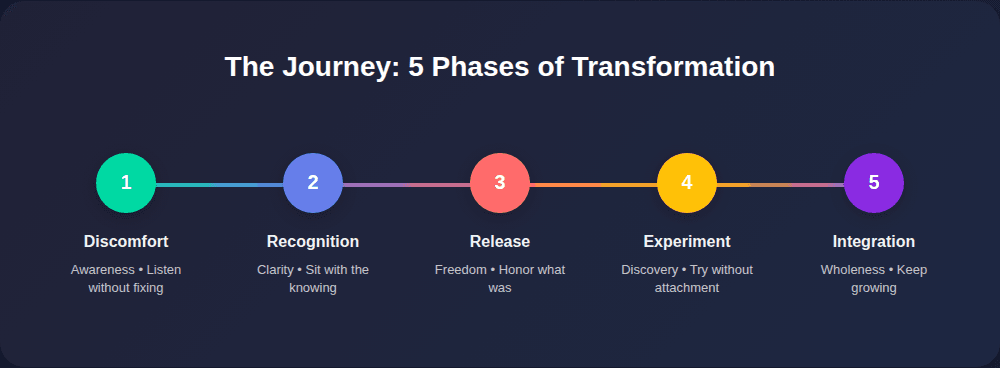
There is no arrival. The edge of the known keeps moving. Each transformation reveals new horizons, new possibilities, new versions of yourself waiting to emerge. This is not a failure of the process but its very nature.
Life is not a problem to be solved, but a reality to be experienced. — Søren Kierkegaard
The person standing at the edge today is not the same person who will stand at the next edge. And that’s the point. Growth is not something you achieve once and then rest. It’s a orientation toward life—a willingness to keep questioning, keep releasing, keep expanding.
Pro tip: Create a “becoming journal” where you regularly reflect on who you are becoming. Review it monthly to notice patterns, celebrate progress, and adjust your direction.
The discomfort of growth—the restlessness, the ache, the sense that something is missing—is not a problem to be solved. It’s a signal to be honored. It means you’re alive. It means you’re paying attention. It means you’re standing at the edge of the known, ready to expand into something more.
Not once. Not finally. But continuously, courageously, with all the messy beauty that real transformation requires.
| Phase | Gift | Challenge | Practice |
|---|---|---|---|
| Discomfort | Awareness | Resistance | Listen without fixing |
| Recognition | Clarity | Impatience | Sit with the knowing |
| Release | Freedom | Grief | Honor what was |
| Experiment | Discovery | Uncertainty | Try without attachment |
| Integration | Wholeness | Complacency | Keep growing |
The Promise Fulfilled
You don’t transform from comfortable to expanded once. You transform again and again, each time becoming more fully who you are meant to be.
The calendar turns, and suddenly everyone is talking about fresh starts. New Year’s resolutions. Birthday goals. Monday morning commitments. We stand at the edge of transformation, convinced this time will be different. But here’s what nobody tells you: most fresh starts fail because they’re built on a fundamental misunderstanding of what growth actually means.
We’ve been sold a seductive lie about personal development. The lie says growth is about accumulating—more skills, more achievements, more credentials, more comfortable circumstances. We chase promotions, certifications, and accolades, believing each one marks our evolution. But accumulation isn’t transformation. A larger pile of accomplishments doesn’t mean you’ve become someone different.
The False Architecture of Self-Improvement
The self-improvement industry thrives on addition. Read more books. Learn more languages. Build more habits. Optimize more systems. It treats identity like a building under permanent construction—always adding floors, never questioning the foundation.
This additive model feels productive because it produces measurable results. You can count books read and certifications earned. But these metrics measure expansion, not transformation. They answer “what do you have?” rather than “who have you become?”
The Accumulation Fallacy
- Growth equals addition. We believe becoming more means having more—skills, achievements, possessions.
- Identity is static. We assume the “you” seeking improvement is the same “you” who will enjoy the results.
- External markers indicate internal change. We mistake visible progress for invisible transformation.
Consider James, a software developer who spent five years accumulating credentials. Three new certifications. Two promotions. A corner office. By every conventional metric, he had grown tremendously. But when asked whether he had become who he was meant to be, he paused for an uncomfortably long time.
| Metric Type | What We Measure | What It Actually Indicates |
|---|---|---|
| Achievement | Promotions, awards, recognition | External validation |
| Accumulation | Skills, possessions, experiences | Added capacity |
| Comfort | Ease, stability, predictability | Risk avoidance |
| **Becoming** | Identity shifts, value changes, perspective evolution | **True transformation** |
What Growth Actually Is
Growth isn’t comfort. It isn’t achievement. Growth is becoming who you’re meant to be—and that person is often unrecognizable to your current self.
Identity formation isn’t about improving who you are. It’s about allowing who you are to die so something truer can emerge. This sounds dramatic because it is. The caterpillar doesn’t become a better caterpillar on its way to becoming a butterfly. It dissolves entirely before reconstruction begins.
Growth Requires Identity Death
The person you’re becoming cannot coexist peacefully with who you’ve been. One must give way.
This is why fresh starts feel so precarious. We sense, correctly, that we’re not just adopting new habits—we’re gestating new selves. The discomfort isn’t a bug in the system. It’s the whole point.
The Identity Formation Process
Identity formation happens in phases, though we rarely recognize them while living through them. Understanding these phases can help you navigate the terrain without panicking when things feel uncertain.
The Identity Transition Model
- Recognition. You realize your current identity no longer fits—often triggered by crisis, dissatisfaction, or quiet accumulation of misalignment.
- Disintegration. The old identity begins to crumble. This phase feels like failure but is actually progress.
- Reconstruction. New values, beliefs, and behaviors emerge from the wreckage of the old self.
- Consolidation. The new identity stabilizes and becomes your default operating system.
The disintegration phase is where most people abandon their fresh starts. They interpret the discomfort as evidence they’re failing, when it’s actually evidence they’re succeeding. The old you is protesting its own obsolescence.
| Phase | What It Feels Like | Common Misinterpretation | Actual Meaning |
|---|---|---|---|
| Recognition | Restlessness, dissatisfaction | Something is wrong with my life | Something is ready to change |
| Disintegration | Anxiety, loss, confusion | I’m failing at improvement | Old identity is releasing |
| Reconstruction | Experimentation, uncertainty | I’m lost without direction | New self is taking shape |
| Consolidation | Stability, clarity, ease | Finally, I’m “fixed” | Integration is complete |
Caution: Do not mistake the disintegration phase for failure. The urge to abandon your fresh start is strongest when transformation is actually working. The old identity fights hardest when it’s losing ground.
Why Comfort and Achievement Are Traps
Comfort is seductive because it feels like arrival. You’ve worked hard, faced challenges, and now you can relax. But comfort is actually a signal that growth has stopped. The moment you feel entirely comfortable in your identity, you’ve likely stopped becoming.
This doesn’t mean comfort is bad. It means comfort is a resting place, not a destination. The problem arises when we mistake temporary respite for permanent home.
Achievement is equally tricky. External accomplishments can mask internal stagnation. You can achieve impressive things while remaining fundamentally unchanged. In fact, high achievers often resist growth most stubbornly because their accomplishments provide convincing evidence that nothing needs to change.
Achievement Focus
- External validation
- Measurable outcomes
- Adding to resume
- Proving worth
Becoming Focus
- Internal alignment
- Felt transformation
- Evolving identity
- Discovering self
Elena built a successful career in finance, achieving everything she thought she wanted. The corner office. The impressive title. The salary that exceeded her early dreams. But when she imagined ten more years on the same trajectory, she felt something between boredom and despair. She had achieved the life she thought she wanted without becoming the person she actually was.
The realization was devastating and liberating in equal measure. Her achievements weren’t wrong—they just weren’t the point. They had prepared her for a life that no longer fit.
The Process of Becoming Who
If growth is becoming rather than achieving, how do you actually do it? The process is less linear than additive self-improvement but more profound in its results.
Step 1 of 3: Recognition Phase
→1. Acknowledge Misalignment
Stop pretending everything is fine when it isn’t. Name the gap between who you are and who you sense you could be.
The recognition phase requires brutal honesty with yourself. This isn’t about finding problems to fix—it’s about acknowledging the truth that your current identity has become too small for your emerging self.
Pro tip: Pay attention to envy. The qualities you envy in others often point toward undeveloped aspects of yourself seeking expression. Who do you wish you could be, and what does that tell you about who you’re becoming?
Step 2 of 3: Disintegration Phase
→2. Allow the Old Self to Dissolve
Stop propping up identities that no longer serve you. Let old beliefs, behaviors, and self-concepts fall away without rushing to replace them.
This is the most uncomfortable phase because it involves uncertainty. You’re no longer who you were, but you’re not yet who you’re becoming. The space between identities feels like freefall.
The Void Is Necessary
The empty space between identities isn’t a problem to solve—it’s the fertile ground where becoming happens. Rushing to fill it with new achievements or identities prevents genuine transformation.
Step 3 of 3: Reconstruction Phase
→3. Experiment with New Ways of Being
Try on different values, behaviors, and perspectives. Some will fit; others won’t. The experimentation itself is the work.
| Experimentation Area | Old Identity Approach | Emerging Identity Approach |
|---|---|---|
| Decision-making | Maximize security | Maximize learning |
| Relationships | Maintain comfort | Seek challenge |
| Work | Achieve externally | Express authentically |
| Failure | Avoid at all costs | Embrace as information |
| Success | Accumulate recognition | Experience alignment |
When the Old You Can’t Solve New Problems
Here’s how you know you’re in the process of becoming: you encounter problems your old self is unequipped to solve. This isn’t a sign of inadequacy—it’s evidence of growth.
The problems that arise at each level of identity require a different version of you to address them. The skills, strategies, and perspectives that worked for your previous self become insufficient for your emerging challenges.
The Problem-Identity Mismatch
- New level, new devil. Each identity upgrade brings challenges the old you cannot meet.
- Old solutions fail. Strategies that worked before now produce diminishing or negative returns.
- Identity leap required. The solution isn’t better tactics—it’s a different self.
Derek spent years developing his technical skills as an engineer. He could solve any problem that came across his desk. But when he was promoted to lead a team, his technical expertise became insufficient. The problems were now about people, communication, and leadership—territory where his old identity had no traction.
He had two choices: develop a new identity capable of meeting these challenges, or retreat to a role where his old identity could still succeed. Many people choose retreat because it feels safer. But retreat is its own kind of death—the slow suffocation of who you’re meant to become.
Caution: When familiar strategies stop working, don’t double down on them. This is a signal that you’ve outgrown your current identity, not that you need to try harder at being your old self.
Identity Formation in Practice
Becoming who isn’t a passive process—it requires active participation. But the participation looks different from traditional self-improvement. Instead of adding more, you’re allowing different. Instead of conquering obstacles, you’re letting go of what no longer fits.
| Traditional Self-Improvement | Identity Formation |
|---|---|
| Set specific goals | Clarify emerging values |
| Track measurable progress | Notice internal shifts |
| Build new habits | Allow old patterns to dissolve |
| Seek external accountability | Develop internal alignment |
| Optimize current systems | Question whether systems serve you |
| Achieve and maintain | Become and continue becoming |
Pro tip: Create an “identity journal” where you track not what you did each day, but who you noticed yourself becoming. Record moments when you surprised yourself, reacted differently than expected, or felt a shift in your core values.
The practice involves regular self-inquiry. Ask yourself:
What emerging qualities am I resisting?
These questions don’t have quick answers. They’re meant to be lived with, returned to, and deepened over time.
The Freedom of Becoming
When you release the pressure to achieve and embrace the process of becoming, something shifts. The frantic energy of self-improvement—the constant feeling that you’re not enough, not there yet, not doing enough—begins to ease.
In its place emerges a quieter confidence. Not the confidence of having arrived, but the confidence of being on the right path. The path of becoming who you were meant to be.
Growth Is Directional, Not Destination
You don’t become who you’re meant to be and then stop. The becoming is the point. Each identity is a temporary home, eventually outgrown as you continue evolving.
Fresh starts aren’t about becoming a better version of your current self. They’re about allowing space for something new to emerge. The old you served its purpose. The challenges you face now require a different person entirely.
What This Means for Your Fresh Start
When you stand at the edge of a new beginning, you’re not just adopting new habits or setting new goals. You’re participating in the ancient, ongoing process of identity formation. You’re allowing who you’ve been to give way to who you’re becoming.
This perspective changes everything. The discomfort isn’t evidence of failure—it’s evidence of transformation. The uncertainty isn’t a problem to solve—it’s the space where growth happens. The old problems that feel unsolvable aren’t signs that you’re inadequate—they’re invitations to become someone capable of meeting them.
| Old Perspective | New Perspective |
|---|---|
| Discomfort means I’m failing | Discomfort means I’m growing |
| I need to achieve more | I need to become different |
| Problems are obstacles | Problems are identity invitations |
| Success is arrival | Success is continued becoming |
| I’m broken and need fixing | I’m evolving and need space |
Pro tip: When you feel stuck in your fresh start, ask: “What identity would make this challenge easy?” Then stop trying to solve the problem with your current identity and focus on becoming the person for whom the problem doesn’t exist.
The fresh start you’re seeking isn’t found in new habits or better strategies. It’s found in the courage to let go of who you’ve been, sit in the uncertainty of who you’re becoming, and trust that the process will produce someone truer than before.
And who you’re meant to be is already emerging—quietly, steadily, beneath the noise of your striving. Your only job is to stop getting in the way.
Everyone talks about turning over a new leaf. Few understand what actually makes it stick. The difference between those who transform and those who cycle through the same resolutions year after year isn’t willpower or circumstance. It’s architecture. They lack a framework for understanding where growth actually happens—and the sequence required to make it permanent.
Most people start at the surface. They learn new skills, chase credentials, and accumulate achievements. This is good. This is necessary. But it’s also where most people stop, wondering why they feel like imposters wearing someone else’s clothes.
Each level builds on the one before it. Skip a level, and the structure collapses. Rush through, and you’ll find yourself back where you started, only more frustrated. But move through them with intention, and something remarkable happens: you stop performing the person you want to become and start actually becoming them.
The Pyramid of Permanent Change
The Fresh Start Pyramid
- External Growth forms the base. Visible skills, knowledge, and behaviors that others can observe and measure.
- Internal Growth forms the middle. Character development, mindset shifts, and the essential work of becoming who you aspire to be.
- Integration forms the apex. The moment when the new identity stabilizes and growth becomes your natural state.
This isn’t just theoretical. It’s the hidden pattern behind every lasting transformation—whether it’s someone recovering from addiction, an executive evolving their leadership style, or an artist finding their authentic voice. The pyramid reveals why some changes stick while others fade.
Level 1: External Growth
The Visible Layer
External growth is what everyone sees. It’s the promotion, the certification, the new habit tracked in your app. It’s the language you’re learning and the marathon you’re training for. This level matters—not because it’s sufficient, but because it’s foundational.
The skills you build become the vocabulary of your future self. The knowledge you acquire creates options you didn’t have before. The behaviors you practice lay neural pathways that make excellence repeatable.
| External Growth Element | What It Looks Like | Why It Matters |
|---|---|---|
| Skills | Coding, public speaking, financial literacy | Expands capability and marketability |
| Knowledge | Books read, courses completed, expertise developed | Informs better decisions |
| Behaviors | Exercise routines, sleep schedules, productivity systems | Creates reliable structures for success |
| Status | Credentials, titles, recognition | Opens doors and opportunities |
| Network | Professional connections, mentors, community | Accelerates growth through relationships |
The Trap of the First Level
Here’s where most people get stuck. They accumulate skills, stack achievements, and wonder why they still feel like the same person underneath. They have the résumé of someone successful but the internal experience of someone pretending.
Caution: External growth without internal development creates the “imposter complex”—you have the skills but not the sense of self that matches them. This is why high achievers often feel like frauds despite objective evidence of their competence.
The external layer is necessary but insufficient. You can’t become who you’re meant to be without developing new capabilities. But capabilities alone don’t create transformation.
Think of it this way: External growth is like buying new furniture for a house. It changes how things look. It can even change how you function day-to-day. But it doesn’t change the foundation. It doesn’t change the structure. It doesn’t change what kind of house you’re living in.
The Proper Role of Level 1
This isn’t to diminish external growth. It’s to properly locate it. When you understand that Level 1 is the foundation—not the entire structure—you can engage with it differently.
Pro tip: Treat external growth as evidence-gathering for your emerging identity. Each new skill isn’t just something you can do—it’s proof of who you’re becoming. A certification isn’t just a credential—it’s a milestone on your journey.
This reframing is the bridge to Level 2. It’s where external growth stops being an end in itself and starts serving a deeper purpose.
Level 2: Internal Growth
Where Becoming Who Happens
If Level 1 is the visible layer, Level 2 is the essential work that makes the visible meaningful. This is where character develops. Where mindset shifts. Where the fundamental question of identity gets answered.
The transition from external to internal growth requires a difficult admission: you can have all the skills and still not be the person you want to be. You can have the body, the career, the relationship—and still feel hollow. Still feel like an actor in your own life.
The Internal Pivot
Lasting transformation requires shifting from “What do I want to have?” to “Who do I want to be?” This is the essential question of Level 2.
The Character Laboratory
Internal growth is character development in real-time. It happens in the gap between stimulus and response—those moments when you choose who you want to be instead of defaulting to who you’ve been.
| Situation | External Response | Internal Growth Opportunity |
|---|---|---|
| Conflict at work | Win the argument | Practice patience and curiosity |
| Financial pressure | Make more money | Develop trust and creativity |
| Relationship struggle | Change partners | Cultivate communication skills |
| Health setback | Find quick fix | Build resilience and discipline |
| Career disappointment | Blame circumstances | Strengthen adaptability |
Each of these moments is a choice point. The external response addresses the immediate situation. The internal growth opportunity addresses who you’re becoming.
The Becoming Who Framework
This is the heart of Level 2. The phrase “becoming who” isn’t just language—it’s a framework for understanding how identity actually evolves.
The Becoming Who Framework
- Recognition. You identify the gap between your current self and your aspirational self—seeing clearly who you are and who you want to become.
- Practice. You begin acting as your future self would act, even when it feels inauthentic at first. This is the “fake it until you become it” phase.
- Internalization. The practiced behaviors stop feeling foreign and start feeling natural. The gap between performance and identity closes.
Becoming who isn’t about discovering your true self. It’s about constructing it. The self isn’t something you find—it’s something you create through repeated choices aligned with your values.
The Discomfort of Level 2
Here’s what nobody tells you: internal growth often feels like regression. As you become more aware of your patterns, you notice more of your flaws. As you reach for higher character, you become more conscious of where you fall short.
This is normal. This is actually a sign of progress.
Caution: The “growth dip” is real. You will feel worse before you feel better. Increased self-awareness often brings increased self-criticism. This isn’t failure—it’s the necessary discomfort of transformation.
The person who doesn’t notice their impatience isn’t more patient than you. They’re just less aware. Your awareness is the first sign that you’re becoming someone new.
Level 3: Integration
When the New Self Stabilizes
Integration is the moment everything clicks. The skills from Level 1 combine with the character from Level 2, and suddenly you’re not practicing being someone new—you simply are.
Integration doesn’t mean perfection. It means congruence. Your external actions align with your internal values. Your skills serve your character. Your behavior expresses your identity rather than contradicting it.
| Before Integration | After Integration |
|---|---|
| Effortful practice | Natural expression |
| Internal conflict | Internal alignment |
| Performing the new self | Being the new self |
| Willpower required | Automatic behavior |
| Identity feels fragile | Identity feels stable |
The Embodied Self
At Level 3, growth stops being something you do and starts being something you are. The person who exercises daily doesn’t debate whether to go to the gym. The person who values honesty doesn’t struggle to tell the truth. The person who has integrated confidence doesn’t perform confidence—they simply operate from it.
The Integration Test
You know you’ve reached Level 3 when the new behavior requires no more mental energy than the old behavior did. Integration means your nervous system has caught up with your intentions.
This is why the pyramid matters. You can’t jump to integration. You can’t shortcut the process. The skills from Level 1 provide the hardware. The character from Level 2 provides the software. Integration is when the system runs smoothly.
The Paradox of Permanent Change
Here’s the final paradox: once you reach integration, you’re no longer the same person who started the journey. The “you” who wanted to change has been replaced by the “you” who has changed.
This is why fresh starts are both liberating and disorienting. You get what you wanted—but you’re different enough that what you wanted has also transformed.
The Old Self
- Changes through force
- Sets goals from lack
- Fights against old patterns
- Measures progress by achievement
The Integrated Self
- Changes through flow
- Sets goals from abundance
- Builds on new foundations
- Measures progress by identity
Putting It All Together
The Complete Journey
The pyramid gives you a map. Every lasting transformation moves through these three levels. Understanding where you are—and what’s required at each stage—prevents the frustration of misaligned expectations.
The Transformation Sequence
- Level 1 demands discipline. Focus on skill acquisition, habit formation, and measurable progress. Expect visible results and external validation.
- Level 2 demands courage. Focus on character development, mindset shifts, and identity work. Expect internal resistance and the discomfort of growth.
- Level 3 demands patience. Focus on integration, embodiment, and allowing the new self to stabilize. Expect a sense of naturalness and ease.
If you’re building skills and forming habits, you’re in Level 1. Don’t rush past it—but don’t mistake it for the destination. If you’re wrestling with identity and character, you’re in Level 2. The discomfort is part of the process. If you’re finding that the new behaviors feel natural, you’re entering Level 3. Allow integration to happen.
The Ongoing Journey
Here’s the truth that completes the picture: the pyramid isn’t a one-time journey. You cycle through it repeatedly throughout your life. Each new area of growth starts at Level 1. Each significant transition requires the full sequence.
Once you understand the architecture, each cycle becomes faster. Once you’ve experienced integration in one area, you know the path. You recognize the signs. You trust the process.
Pro tip: Keep a transformation journal tracking where you are in the pyramid for each major life area. You might be in Level 1 for your health, Level 2 for your career, and Level 3 for your relationships. This prevents the frustration of comparing different stages.
Your Fresh Start Begins Now
The leaf you want to turn isn’t just a metaphor. It’s an invitation. A fresh start isn’t about becoming someone entirely different—it’s about becoming more fully who you already are underneath the accumulated patterns and inherited beliefs.
All three. In sequence. With patience.
This is the becoming who framework. Not a quick fix. Not a surface solution. But a true architecture for the transformation you seek.
The Final Word
You don’t need to become someone else. You need to become who you already are—more fully, more consciously, more completely. The pyramid simply shows you the way.
The journey from external growth through internal development to integration isn’t easy. But it’s available to anyone willing to walk the path. Your fresh start isn’t a dream. It’s a process. And now you have the map.
How to Actually Grow: The Three-Phase Journey of Becoming
The person you are today was built by yesterday’s solutions. The person you’ll become requires today’s discomfort. This isn’t a gentle process—it’s a deliberate dismantling of everything that once kept you safe but no longer serves you. Growth isn’t about adding new layers; it’s about shedding old skins.
Most people approach personal development backward. They seek comfort, avoid uncertainty, and wonder why they remain stuck in patterns that feel increasingly tight, like a child trying to squeeze into last year’s winter coat. The coat still functions. It still covers the body. But something essential has shifted—the wearer has outgrown the garment.
This is where everything changes. The framework for genuine transformation isn’t complicated, but it requires something most people spend their lives avoiding: the willingness to stand at the edge of who they are and step into the void of who they might become.
Phase One: Choose Discomfort
The ceiling appears first as a subtle friction. You notice that strategies which once produced reliable results now generate diminishing returns. The morning routine that felt revolutionary three years ago now feels mechanical. The communication style that made you successful in your career now creates tension in your relationships. The identity that carried you through your twenties now feels like a costume that no longer fits.
The Ceiling Recognition Framework
- Identify friction points. Where do old methods feel forced or ineffective? These are your ceiling indicators.
- Distinguish growing pains from unnecessary struggle. Productive discomfort stretches you; unnecessary suffering grinds you down.
- Locate the edge. The ceiling exists precisely where your comfort zone meets your growth zone.
The instinct when encountering this friction is to push harder, to refine the existing approach, to double down on what worked before. This is the trap. The ceiling isn’t a barrier to be broken through—it’s a limit to be transcended. You don’t break through a ceiling by pushing against it; you rise above it by becoming someone for whom that ceiling no longer exists.
What does choosing discomfort actually mean? It means deliberately placing yourself in situations where your current identity cannot fully function. Where your old scripts don’t have prepared responses. Where you cannot rely on the crystallized patterns that have made you successful thus far.
| Discomfort Type | Old Identity Response | Growth Opportunity |
|---|---|---|
| Social discomfort | Avoid, deflect, perform | Practice authentic presence |
| Intellectual discomfort | Seek quick answers | Tolerate not-knowing |
| Emotional discomfort | Numb, distract, rationalize | Feel without fixing |
| Professional discomfort | Overprepare, control | Act before ready |
| Relational discomfort | People-please, withdraw | Express needs directly |
Consider Derek, a software engineer who had built his entire identity around being the person who always had the answer. For a decade, this identity served him well—he advanced quickly, earned respect, and felt secure in his professional skin. But when he was promoted to a leadership role requiring him to facilitate rather than solve, to ask questions rather than answer them, his old identity became a prison. Every meeting felt like a test he was failing. His instinct was to study harder, to prepare more, to find the “right” way to lead.
The discomfort wasn’t a sign he was doing it wrong. It was a sign he was doing something genuinely new.
The Visibility Principle
Discomfort makes visible what comfort conceals. When you’re comfortable, your patterns run automatically—invisible, unquestioned, unexamined. Discomfort forces those patterns into consciousness where they can be observed, questioned, and ultimately transformed.
The choice to seek discomfort isn’t masochism. It’s a recognition that growth requires conditions different from those that created your current self. A seed doesn’t grow in the comfort of the packet; it grows in the disruption of soil, the uncertainty of weather, the vulnerability of breaking open.
Phase Two: Becoming Who — The Transformation Process
Between the old self and the new self lies a wilderness. This is the territory of becoming—a space where you are no longer who you were but not yet who you will become. Most people avoid this wilderness entirely. They make small adjustments to their existing identity, painting over cracks, adding new features to an outdated operating system.
The Becoming Protocol
- Recognize the call. The old identity signals its limits through boredom, anxiety, friction, or longing.
- Step into the void. Deliberately enter situations where old patterns cannot function.
- Tolerate the dissolution. Allow the old identity to loosen without rushing to replace it.
- Act from the emerging self. Make choices aligned with who you’re becoming, not who you were.
The process of becoming who you’re meant to be requires tolerating a fundamental uncertainty: you don’t yet know who that person is. This is terrifying. The ego, that protective structure built around a coherent sense of self, interprets this uncertainty as a threat to survival. It will generate every possible defense to pull you back into familiar territory.
| Transformation Stage | Ego’s Tactic | Growth Response |
|---|---|---|
| Initial discomfort | Minimize, rationalize | Stay present, don’t fix |
| Active dissolution | Panic, seek exit | Breathe, this is the work |
| Identity gap | Fill void with old patterns | Allow emptiness, don’t fill |
| Emerging self | Doubt, imposter syndrome | Act anyway, evidence follows |
| Stabilization | Nostalgia for old self | Integrate lessons, keep moving |
What does becoming actually require? It requires acting before you feel ready. Speaking before you have the perfect words. Leading before you feel like a leader. Being vulnerable before you trust it will be safe. The sequence most people expect—feel ready, then act—is backwards. In genuine transformation, action precedes identity. You become who you are by acting as if you already are that person, not once, not twice, but repeatedly until the new pattern becomes more natural than the old.
Pro tip: The “as if” technique works best when you’re specific about the qualities you’re cultivating. Instead of vaguely “acting confident,” identify the specific behaviors of the confident person you’re becoming—speaking 10% louder, making eye contact, pausing before answering—and practice these deliberately.
This is where the concept of “becoming who” reveals its power. The phrase sounds incomplete because it is incomplete—becoming is inherently unfinished, always in process. You are not becoming a fixed endpoint; you are becoming more fully yourself, which is to say, more fully alive to possibility, more responsive to reality, more capable of meeting each moment without the filter of an outdated identity.
Navigating the Identity Crisis
Here is what nobody warns you about: genuine growth triggers an identity crisis. Not the dramatic, cinematic kind where everything falls apart in a single afternoon, but a slower, more disorienting dissolution. The ground beneath your feet shifts. You no longer recognize yourself in old photos, old conversations, old ambitions. Friends mention something you said last year, and you feel a vague embarrassment, as if hearing about a stranger who happened to wear your face.
This is not a sign of failure. This is a sign of progress.
Caution: The identity crisis is not the time to make major external decisions—quitting jobs, ending relationships, moving cities. The crisis is internal; let it resolve internally before acting externally. Decisions made in the void of identity often reflect fear rather than wisdom.
The crisis emerges because identity is not just a mental construct—it’s a lived reality embedded in your nervous system, your relationships, your daily rhythms. When you begin to change, every part of your life that was calibrated to the old identity protests. Your body doesn’t know the difference between the death of an identity and actual death; it responds with the same stress hormones, the same survival impulses.
| Healthy Crisis Navigation | Unhealthy Crisis Response |
|---|---|
| Allowing grief for old self | Denying loss, forcing positivity |
| Seeking support from safe others | Isolating, hiding the struggle |
| Maintaining basic routines | Abandoning all structure |
| Journaling, reflection | Ruminating without insight |
| Physical movement, embodiment | Dissociation, numbing |
| Patience with the process | Demanding immediate resolution |
The Crisis Navigation Framework
- Name the crisis. Acknowledge that you are in active transformation. Labeling reduces fear.
- Grieve the old self. What worked about that identity? What will you miss? Honor it before releasing it.
- Stay in the gap. Resist the urge to grab onto a new identity prematurely. The space between identities is where integration happens.
- Gather evidence. Notice small moments when the emerging self shows up. These are your data points.
The crisis intensifies when you try to rush through it, to skip the uncomfortable middle and land neatly on the other side. But there is no other side to skip to. The point of the crisis is the transformation itself—the gradual, uneven, often baffling process of discovering who you are when you’re no longer performing who you were.
You look for patterns across time. You notice which old behaviors now feel foreign. You pay attention to what energizes you versus what drains you. You track moments of unexpected ease—situations that would have been difficult for your old self but feel natural now. These are signals from the emerging identity, faint at first, growing stronger with practice.
The Integration Insight
The goal isn’t to eliminate the old identity but to integrate its gifts while releasing its limitations. The confident person you’re becoming doesn’t replace the insecure person you were—the new confidence includes and transcends the earlier sensitivity, transforming it from a weakness into a source of empathy and awareness.
Phase Three: Integrate the New Self
Integration is not a final step but an ongoing practice. The new identity doesn’t crystallize into a fixed form; it continues evolving, responding, deepening. What changes is your relationship to that evolution. Where once you resisted change, clinging to the familiar, now you develop a tolerance—and eventually an appetite—for transformation.
Integration happens through repetition. Every time you choose the new response over the old pattern, you strengthen neural pathways, update relational expectations, and reinforce the emerging identity. This is why insight alone is insufficient. Understanding what needs to change is not the same as changing it. The understanding creates the map; the repetition walks the territory.
| Integration Practice | Mechanism | Frequency |
|---|---|---|
| Morning intention setting | Primes attention toward new patterns | Daily |
| Evening reflection | Consolidates learning, identifies gaps | Daily |
| Weekly pattern review | Tracks progress across situations | Weekly |
| Monthly identity check-in | Assesses alignment, adjusts course | Monthly |
| Quarterly retreat | Deep integration, strategic planning | Quarterly |
Pro tip: Create an “evidence file”—a physical or digital collection of moments when your new self showed up. Screenshots of texts where you set a boundary, journal entries about successful interactions, photos from events you would have avoided. Review this file when the old identity tries to convince you that nothing has changed.
The integrated self is not a perfect self. It’s a self that can hold contradictions, that can be both confident and uncertain, both powerful and vulnerable, both accomplished and still becoming. The old identity demanded consistency; the new identity embraces complexity. This is the paradox of genuine growth: the more integrated you become, the more comfortable you are with your own incompleteness.
The Completion Paradox
You never finish becoming. Each integration reveals a new ceiling, a new edge, a new invitation to choose discomfort again. The goal isn’t to reach a final state but to develop a relationship with transformation itself—to become someone who grows the way trees grow: continuously, structurally, in response to both inner impulse and outer condition.
The Cycle Continues
Here is the truth that both liberates and terrifies: there is no final arrival. The person you become through this process will eventually encounter their own ceiling, feel their own friction, face their own choice between comfortable stagnation and uncomfortable growth.
This is not failure. This is aliveness.
The framework gives you the map, but the map is not the territory. You walk the path by choosing discomfort daily, by becoming who you are meant to be through action and reflection, by integrating each new self as it emerges. And when the next ceiling appears—as it will—you will recognize it not as a wall but as a door.
The door opens both ways. You can always choose comfort. You can always stay in the known, the familiar, the safe. But something in you knows the cost of that choice. The slow constriction. The gradual dimming. The sense that you are living in a house you’ve outgrown, breathing air that no longer sustains you.
The ceiling is waiting. The discomfort is available. The becoming is possible.
All that remains is the step.
The comfortable life has a seductive quality. It wraps around you like a warm blanket on a cold morning—soft, familiar, and nearly impossible to leave. You know exactly what each day will bring. You’ve mastered the rhythms of your work, your relationships, your routines. You’ve become, in many ways, incredibly good at being who you are.
And that’s precisely the problem.
The journey from Comfortable to Expanded isn’t a straight line of progressive improvement. It’s a metamorphosis that requires something most people aren’t willing to give: the complete dissolution of who they’ve been in service of who they might become.
This journey unfolds in three distinct phases, each with its own challenges, its own gifts, and its own form of death.
Phase 1: The Comfort Trap
The comfort trap doesn’t announce itself with flashing lights or warning sirens. It arrives disguised as success. You’ve built a life that works. You’re competent, maybe even excellent at what you do. People respect you. You’ve accumulated the markers of a good life—stability, relationships, skills, perhaps recognition.
It starts as a whisper. A restlessness that surfaces in quiet moments. You might notice it Sunday evening, that subtle dread about the week ahead—not because anything is wrong, but because nothing is genuinely new. You might feel it in conversations where you already know what everyone will say before they say it. You might sense it in your body—a certain flatness, a going-through-the-motions quality to days that blur together.
The Comfort Ceiling
- Predictability maximization. You organize life to minimize uncertainty, which simultaneously minimizes growth triggers.
- Identity solidification. Your sense of self becomes rigidly attached to what you already do well.
- Risk aversion as wisdom. You mistake the avoidance of discomfort for good decision-making.
The comfort trap is insidious because it doesn’t feel like a trap. It feels like arrival. You’ve worked hard to get here. Why would you question it?
| Indicator | Comfortable (Stuck) | Comfortable (Ready) |
|---|---|---|
| Daily experience | Numb, automatic | Peaceful but curious |
| Challenge response | Avoid or minimize | Seek out适度 |
| Future vision | More of the same | Vague longing for “more” |
| Energy level | Steady but flat | Occasional sparks of aliveness |
| Growth edges | Avoided | Gently explored |
The distinction matters. Being comfortable isn’t inherently problematic. Some people have fought hard for stability, and their comfortable life represents hard-won healing. The trap specifically refers to comfort that has become a ceiling—a barrier to further becoming rather than a foundation for it.
Caution: Do not confuse the comfort trap with legitimate rest periods. Recovery, integration, and seasons of stability are essential parts of any growth cycle. The trap specifically refers to comfort that has become avoidance—when you stay small not because you’re integratin,g but because you’re afraid.
The recognition phase isn’t about forcing change. It’s about becoming honest. You might spend months here, simply noticing the ceiling, feeling its contours, acknowledging where you’ve stopped growing. This noticing itself is a form of movement—the first crack in the comfortable container.
Phase 2: The Unraveling
If Phase 1 is about recognizing the ceiling, Phase 2 is about breaking through it. This is where the journey becomes genuinely uncomfortable. This is where you become messy.
Step 2 of 3: Breaking through the comfort ceiling
The unraveling phase is aptly named because that’s exactly what happens: the careful fabric of your identity begins to come apart. The skills, the roles, the stories about who you are—they all get questioned, challenged, sometimes violently dismantled.
The Identity Loss
Here’s what nobody tells you about growth: you have to lose yourself to find yourself.
The unraveling isn’t a polite renovation where you add a new room to your existing identity house. It’s more like discovering that your foundation is cracked and the whole structure needs to be rebuilt. Except you’re living in it while the construction happens.
The Paradox of Becoming
You cannot become who you want to be by remaining who you are. Growth requires the temporary chaos of identity dissolution.
Consider Derek, a corporate attorney who spent fifteen years building expertise in mergers and acquisitions. He was successful by every external measure—partnership track, respect, financial stability. But he’d entered the comfort trap without realizing it. His identity had become so fused with “being a good lawyer” that he couldn’t distinguish his worth from his work.
When Derek finally acknowledged his longing for something more creative and connected, the unraveling began. He started writing. He was terrible at it. For someone accustomed to excellence, being a beginner felt intolerable.
| Identity Layer | Before Unraveling | During Unraveling |
|---|---|---|
| Core narrative | “I am excellent at what I do” | “I don’t know who I am anymore” |
| Relationship to failure | Avoided at all costs | Frequent, public, painful |
| Social position | Expert, respected | Novice, uncertain |
| Internal state | Compressed, controlled | Chaotic, vulnerable |
| Time orientation | Future-focused (goals) | Present-focused (survival) |
The unraveling phase demands that you tolerate being bad at things. That you let go of the image you’ve carefully constructed. That you allow others to see you in progress rather than polished.
The Messy Middle
The middle of Phase 2 is where most people turn back. The discomfort isn’t just psychological—it’s social, practical, sometimes financial. You might be simultaneously:
- Feeling incompetent in new domains while your old competencies feel hollow
- Disappointing people who liked the old you better
- Questioning decisions you once felt certain about
- Experiencing mood swings, sleep disruption, or physical symptoms
- Wondering if you’ve made a terrible mistake
The Liminal Space Framework
- Disidentification. Old labels stop feeling accurate, but new ones haven’t formed yet.
- Disorientation. Your usual navigation tools no longer work in unfamiliar territory.
- Reconstitution. Fragments of new identity begin emerging from the chaos.
This liminal space is sacred and terrible. Sacred because real transformation only happens here. Terrible because our brains are wired to resist uncertainty with every fiber.
Pro tip: When the unraveling feels unbearable, remember: you’re not doing it wrong. The discomfort isn’t a sign that you should turn back—it’s evidence that real change is occurring. Treat yourself like you would a friend going through a difficult transition: with patience, compassion, and the recognition that this too is part of the process.
The key to navigating Phase 2 is understanding that the messiness isn’t a bug—it’s a feature. You can’t skip the chaos and get to the transformation. The chaos IS the transformation in progress.
Phase 3: The Expansion
The expansion phase doesn’t arrive like a finish line. It emerges gradually, usually without fanfare. One day you notice that what once felt impossible now feels merely difficult. The anxiety that accompanied your unraveling has settled into something closer to anticipation.
The Identity Gain
The expansion phase is characterized by integration. The new capacities, perspectives, and ways of being that felt foreign and uncomfortable in Phase 2 have started to feel natural. You’ve built new neural pathways, new habits, new stories about who you are.
| Dimension | Comfortable (Phase 1) | Unraveling (Phase 2) | Expanded (Phase 3) |
|---|---|---|---|
| Identity | Fixed, solid | Dissolving, chaotic | Flexible, multiple |
| Competence | High (in known areas) | Low (in new areas) | Growing (integrated) |
| Emotional range | Narrow, controlled | Volatile, raw | Wide, regulated |
| Relationship to discomfort | Avoid | Endure | Seek适度 |
| Sense of possibility | Limited | Overwhelming | Exciting |
The expansion isn’t about becoming perfect or reaching some final destination. It’s about capacity. You can hold more now—more complexity, more uncertainty, more of yourself.
The Expansion Markers
You know you’ve entered Phase 3 when the unfamiliar starts feeling familiar, when challenge produces curiosity instead of paralysis, and when your sense of self includes both who you were and who you’re becoming.
The New Normal
Derek, our corporate attorney, didn’t quit his job to become a writer. That’s the Hollywood version. Real expansion is usually messier and more interesting. He kept his practice but restructured it. He carved out time for creative work. He stopped needing to be the expert in every room and started enjoying being a learner again.
His identity expanded to include contradictions that would have been impossible in Phase 1. He could be both skilled and uncertain. Both established and emerging. Both comfortable and growing.
The Expanded Self
- Multiple identities held lightly. You can inhabit different roles without being trapped by any of them.
- Growth as orientation, not destination. Expansion becomes a way of being rather than a goal to achieve.
- Comfort with discomfort. You develop the capacity to be uneasy without needing to escape.
The expanded self isn’t a final achievement. It’s a platform for the next cycle. Because here’s the truth about growth: the expansion becomes the new comfortable, and the journey continues. The ceiling you broke through becomes the floor you stand on.
Old Comfort
- Certainty as safety
- Single identity
- Expertise as worth
- Avoiding failure
Expanded Self
- Uncertainty as aliveness
- Multiple identities
- Learning as practice
- Engaging challenge
The Ongoing Journey
The journey from Comfortable to Expanded isn’t a one-time event. It’s a spiral. Each expansion creates new possibilities, which eventually become comfortable, which then require their own unraveling when the next ceiling appears.
This is the path of becoming who.
Pro tip: Build regular “ceiling checks” into your life. Every six months, ask: Where have I stopped growing? What have I become too good at? Where am I avoiding discomfort that might contain growth? These questions keep you from settling into comfort that has become a cage.
The framework isn’t complicated, but it requires courage:
| Phase | Key Task | Primary Challenge | Hidden Gift |
|---|---|---|---|
| Comfort Trap | Recognition | Honest self-assessment | Clarity about what you want |
| Unraveling | Tolerance | Surviving identity loss | Freedom from old limitations |
| Expansion | Integration | Accepting the new self | Capacity for more of life |
“The moment I stopped trying to get back to comfortable and started accepting the mess, everything shifted. I wasn’t falling apart—I was falling open.”
— Elena, Executive Coach
It asks you to let go of who you’ve been. To tolerate the chaos of becoming. To trust that something waits on the other side of the unraveling.
But the gift is immeasurable: a life that continues to expand. A self that continues to become. The profound aliveness that comes from choosing growth over safety, becoming over arriving, the unknown over the familiar.
This is the path. Not comfortable. But real.
And real, in the end, is what you were looking for all along.
The graphs always lie. Personal development literature loves the ascending curve—steady progress, measurable gains, each quarter better than the last. But anyone who has actually tried to become someone new knows the truth: growth doesn’t climb in a neat line. It stutters. It plateaus. Sometimes it spirals backward with such force you wonder if you’ve imagined every ounce of progress you ever made.
The uncomfortable reality is that transformation contains extended periods where nothing appears to be working. You do the practices. You show up consistently. You apply every principle you’ve learned. And still—nothing. The metrics flatline. The old patterns resurface. The person you’re becoming feels further away than when you started.
The middle is where most people abandon the journey. It’s where the narrative breaks down and the motivational quotes ring hollow. But it’s also where the real work happens—the work that doesn’t show up on spreadsheets or journal entries. The work of becoming who you are meant to be, even when you cannot see that person yet.
The Plateau: When Progress Becomes Invisible
The plateau arrives without announcement. One day you’re climbing, feeling the exhilaration of visible improvement, and the next you’re walking on flat ground that stretches endlessly in every direction. The practices that once produced breakthroughs now feel routine. The insights that sparked transformation have become background noise. You’re doing everything right, and nothing is happening.
The Plateau Paradox
- Integration requires stillness. Your system needs time to incorporate changes before the next leap forward.
- Visible progress follows invisible work. External metrics lag behind internal restructuring.
- The plateau protects against overwhelm. Continuous growth would exceed your capacity to integrate it.
The plateau feels like stagnation because we’ve been trained to measure growth through output—more revenue, better relationships, faster times, higher scores. But beneath the surface, something different is occurring. The changes you’ve already made are settling into your system. New neural pathways are strengthening. Old identities are loosening their grip. The plateau isn’t emptiness; it’s consolidation.
Consider what happens during physical training. After initial gains, progress inevitably slows. The body adapts, and the same stimulus no longer produces the same response. Novices assume this means they’ve hit their ceiling. Experienced athletes recognize it as a signal to modify their approach, not abandon it. The plateau contains information about what your system needs next.
| Plateau Type | Surface Experience | Underlying Reality | Adaptive Response |
|---|---|---|---|
| Integration | “Nothing’s working” | System consolidating gains | Maintain practices, reduce intensity |
| Preparation | “Going through motions” | Building capacity for next leap | Add variation, challenge assumptions |
| Redirection | “Lost my edge” | Old approach exhausted | Seek new input, mentorship, paradigm |
| Protection | “Too comfortable” | System avoiding overwhelm | Gradually increase challenge |
What makes plateaus so disorienting? They contradict the story we tell ourselves about progress. We expect growth to feel like expansion, achievement, forward motion. Instead, the plateau often feels like waiting, doubting, going nowhere. The discomfort isn’t a sign that something’s wrong—it’s a sign that you’re in the territory where real transformation occurs.
The Plateau Contains the Breakthrough
The plateau isn’t an obstacle to growth; it’s the infrastructure that makes sustainable growth possible. What feels like stuckness is actually the foundation being laid for your next evolution.
The instinct during a plateau is to push harder, do more, force progress. This rarely works. The system that created the plateau is the same system that will resist forced acceleration. Instead, the plateau invites a different kind of attention—not the aggressive pursuit of results, but the patient observation of what’s actually present.
Pro tip: When you hit a plateau, resist the urge to add more practices. Instead, subtract. Remove one element and observe what emerges. Often the plateau is a signal of overload, not under-effort.
The Regression: When You Seem to Go Backward
If the plateau feels frustrating, regression feels devastating. This is when old patterns return with a vengeance. The anxiety you thought you’d conquered. The relationship dynamic you were sure you’d outgrown. The self-sabotaging behavior that had disappeared for months. Suddenly it’s back, as if nothing ever changed.
Caution: The most dangerous moment in any transformation journey is the point of regression. This is where most people abandon the process entirely, concluding that their growth was never real. The regression is real; the conclusion is false.
Regression follows a predictable emotional arc. First comes surprise—how can this be happening after all the work? Then shame—if I were really growing, I wouldn’t be back here. Then despair—maybe I’m not capable of change after all. Each emotion reinforces the others, creating a spiral that can undo months of progress in days.
But regression, properly understood, is not the opposite of growth. It’s a feature of transformation, not a bug. Every system that has achieved a new equilibrium must periodically revisit earlier configurations. The regression is the system’s way of testing whether the old patterns still serve, of comparing the previous state with the emerging one.
| Regression Phase | Common Interpretation | Actual Function | Healthy Response |
|---|---|---|---|
| Initial return | “I’ve failed completely” | System testing old pathways | Recognize without catastrophizing |
| Emotional spiral | “I’ll never change” | Releasing stored charge | Allow feelings, don’t act on them |
| Comparison | “I was doing so well” | Measuring actual progress | Document evidence of change |
| Re-engagement | “Do I continue?” | Choosing new identity consciously | Reconnect with original purpose |
The chrysalis metaphor is overused but accurate. Inside the cocoon, the caterpillar doesn’t smoothly transform into a butterfly. It first dissolves entirely into undifferentiated cells—an entirely formless state that looks like death from the outside. The regression you experience is a smaller version of this dissolution. Old structures must loosen before new ones can form.
Consider: when you were in the old patterns before, you weren’t aware of them. They were simply how life worked. Now when they return, you notice. You feel the friction. You experience the discomfort of misalignment. This noticing itself is evidence of growth. The person you were becoming has already changed enough to recognize what no longer fits.
The Regression Spiral
- The competence trap. Old patterns work precisely because we’ve practiced them for years. New behaviors are fragile by comparison.
- The stress response. Under pressure, systems default to familiar configurations. Regression often accompanies life stressors.
- The integration test. Returning to old patterns while maintaining new awareness accelerates permanent change.
The key distinction is between regression of behavior and regression of identity. The behaviors may return temporarily. But the identity—the person who notices, who chooses, who commits to growth—has already shifted. You cannot unsee what you have seen about yourself. Even in regression, you are no longer who you were.
The Identity Crisis: When You Don’t Recognize Yourself
The plateau challenges your patience. The regression challenges your faith. The identity crisis challenges your sense of self.
This is the deepest form of growth stall—the moment when you realize you no longer fit who you were, but you don’t yet know who you’re becoming. The old identity feels like a suit that’s become too tight. The new identity is still forming, indistinct and uncertain. You exist in the space between, unmoored from familiar anchors.
The Identity Crisis Is the Work
You don’t become who you are meant to be by improving who you were. You become by allowing the old identity to dissolve and making space for something new to emerge.
The identity crisis often begins with a subtle wrongness. Situations that used to feel natural now feel performative. Conversations that once energized you now drain you. Achievements that motivated you now leave you empty. You’re successful by every external measure, and internally, something feels fundamentally off.
This disorientation is not a symptom of dysfunction. It’s a symptom of growth outpacing identity. You have changed faster than your self-concept has updated. The person you’re becoming is already present in your actions, your preferences, your natural responses. But the person you believe yourself to be hasn’t caught up.
| Identity Stage | Internal Experience | External Presentation | Core Task |
|---|---|---|---|
| Stability | Comfortable, known | Consistent, predictable | Maintenance |
| Disturbance | Restless, misaligned | Inconsistent, searching | Attention |
| Disintegration | Lost, uncertain | Variable, experimental | Tolerance |
| Reformation | Emerging clarity | New patterns forming | Integration |
| New Stability | Authentic, aligned | Consistent in new way | Embodiment |
The temptation during identity crisis is to rush toward resolution—to grab onto any available identity just to end the uncertainty. This is premature closure, and it leads to a false self that must eventually be shed again. The more difficult but necessary path is to remain in the discomfort of not knowing, to let the old identity complete its dissolution before insisting on a new one.
This question, asked honestly, begins to reveal what’s emerging. The answers often surprise. You may discover that values you thought were core were actually inherited. That goals you pursued were never truly yours. That the person you were trying to become was someone else’s idea of success.
Pro tip: During identity transition, avoid major external commitments. Your judgment about what you want is unreliable during this phase. Give yourself 3-6 months of experimentation before locking in new identities or directions.
The identity crisis resolves not through effort but through emergence. You don’t construct a new identity; you discover the one that was forming beneath the surface all along. The practices, the failures, the regressions, the plateaus—each was shaping who you were becoming, even when you couldn’t perceive it.
The Response: Even When Stuck, Becoming Who
The three phases—plateau, regression, identity crisis—rarely arrive in neat sequence. They overlap and interweave, creating a terrain that feels impossible to navigate. You may experience all three simultaneously, or cycle through them repeatedly as you move toward who you’re becoming.
The Growth Stall Framework
- Recognize the phase. Each stall type requires a different response. Misidentifying your phase leads to counterproductive action.
- Release the timeline. Growth operates on its own schedule, not yours. The duration of the stall is not a measure of your failure.
- Return to practice. Not for results, but for connection to the process itself. The practice is the path.
- Trust emergence. You are becoming who. The who is already forming, even when invisible.
The response to growth stalls is not to push through but to settle in. To recognize that the stuckness is part of the journey, not an obstacle to it. To understand that becoming who you are meant to be includes periods of apparent stillness, apparent backward motion, apparent loss of self.
| Stall Type | The Lie It Tells | The Truth It Hides | The Practice It Invites |
|---|---|---|---|
| Plateau | “You’ve gone as far as you can” | “Integration is happening” | Patience without passivity |
| Regression | “You never really changed” | “You’re testing new vs. old” | Compassion without indulgence |
| Identity Crisis | “You’ve lost yourself” | “You’re shedding what isn’t you” | Curiosity without urgency |
This is not a promise that everything works out. It’s an observation about the nature of transformation. The person you are becoming is not a destination you reach through linear progress. The person you are becoming is emerging through every experience—including the experiences that feel like failure.
The plateau teaches patience and deepens practice. The regression tests commitment and reveals authentic change. The identity crisis strips away what is false and makes space for what is true. Each stall, properly met, contributes to who you are becoming.
The path isn’t linear. It was never supposed to be.
The Stuckness Is the Path
You don’t become who you are meant to be despite the stalls. You become who you are meant to be through them. The plateau, the regression, the identity crisis—these are not interruptions to your journey. They are the journey.
When growth stalls, the question shifts from “How do I get moving again?” to “What is this stillness teaching me?” The answer is always the same, though it takes endless forms: You are becoming who. The who is already forming, already present, already more real than the person you used to be. The stall is simply the space where you learn to recognize what has already changed.
Hard Truths About Fresh Start: A Step-by-Step Guide to Turning Over a New Leaf
We love the cinematic version of a fresh start—the montage of morning jogs, organized closets, and confident smiles. But the reality of turning over a new leaf is rarely so polished. Real transformation is jagged and uncomfortable, largely because it requires you to dismantle the life you’ve already built. Before you take that first step, you need to understand the collateral damage of change.
Here are the hard truths about starting over:
1. Growth often feels exactly like loss. When you shed old habits or leave a dead-end career, you expect to feel immediate relief. Instead, you often feel a profound sense of emptiness. This is confusing until you realize that you aren’t just losing a job or a bad habit; you are losing a version of yourself that you knew intimately. You are effectively grieving a death—the death of the person you used to be. That sadness you feel isn’t a sign that you’re making a mistake; it is the natural byproduct of shedding a skin that no longer fits. You are in the messy middle of becoming who you have the potential to be, and that process requires leaving the comfort of who you were.
2. You will inevitably disappoint people who liked the old you. We like to think our friends and family will cheer for our evolution, but many won’t. If you were the “yes” person who always fixed everyone else’s problems, and you suddenly start setting boundaries, people won’t applaud your newfound self-respect. They will complain that you’ve become “distant” or “selfish.” This is because your change disrupts their routine. You were a character in their story with a specific role, and you are ad-libbing now. You have to accept that you will inevitably disappoint people who benefited from your previous limitations.
3. Supporters can turn into critics when your growth threatens their comfort. This is the harsh reality of the “crab bucket” mentality. Sometimes, the people who cheered for you when you were down will turn cold when you start winning. Your success serves as a mirror, reflecting their own stagnation or unfulfilled potential. When you stop engaging in gossip, stop drinking, or start taking your health seriously, it can feel like a judgment to those who aren’t doing the same. Supporters can turn into critics not because they hate you, but because your light makes their shadows visible.
4. You cannot un-grow. There is a terrifying finality to awareness. Once you recognize a toxic pattern, a self-sabotaging behavior, or a misaligned value, you cannot force yourself to unsee it. You can try to ignore it, but the illusion is broken. You cannot un-grow. You might try to slide back into old habits to regain a sense of normalcy, but it will feel like wearing a shoe on the wrong foot. The discomfort of regression is often more painful than the discomfort of growth, forcing you to keep moving forward even when you want to retreat.
5. Stagnation is the only real failure. We are terrified of making the wrong choice, so we often choose nothing. We stay in the wrong city or the wrong relationship because it feels “safe.” But life is kinetic; it is never static. If you aren’t moving, you are eroding. Time will pass regardless of your participation. The goal isn’t to make perfect choices; the goal is to remain in motion. Stagnation is the only real failure because it is the only state where the outcome is guaranteed: nothing changes.
Turning over a new leaf is not a single event; it is a series of small, often painful choices made on a Tuesday afternoon when no one is watching. It requires the courage to let things fall apart so they can be rebuilt. The cost of becoming who you are meant to be is high, but the cost of remaining someone you have outgrown is far greater.
The question isn’t whether you’ll change. It’s how. We like to imagine transformation as a single dramatic moment—the lightning bolt of insight, the clean break, the fresh start. But real growth follows patterns. Recognizable, repeatable patterns that reveal something deeper about who we’re becoming.
These patterns aren’t random. They emerge from the fundamental truths of human development: that we must lose to gain, that knowing ourselves requires confronting what we’ve avoided, that meaningful change demands something from us. Each pattern represents a different relationship with these truths—a different pathway to what we might call becoming who.
Becoming who is the process of aligning your external life with your evolving internal reality. It’s not about becoming someone else. It’s about becoming more fully yourself—the self you’re growing into, not the self you used to be.
The Skill Builder: Mastery as Identity Construction
The Skill Builder approaches growth through competence. They believe that if they can do enough, they’ll eventually be enough. This isn’t wrong—it’s incomplete.
Skill Builders accumulate capabilities like tools in a workshop. Each certification, each mastered technique, each hard-won expertise feels like proof of progress. And it is progress. But the Skill Builder’s trap lies in confusing what they can do with who they are.
The Skill Builder’s Progression
- Acquisition. Learning new skills creates immediate identity expansion.
- Integration. Skills become automatic, freeing mental energy for deeper work.
- Embodiment. Mastery transcends technique—the skill becomes expression.
The Skill Builder’s journey connects to becoming who through the gradual internalization of capability. At first, the skill is external—something you do. Eventually, it becomes internal—part of how you move through the world. A writer doesn’t just write; they are a writer. A leader doesn’t just direct; they lead.
This transformation from doing to being represents linear growth at its finest—steady, predictable progress where each step builds on the last. The Skill Builder experiences becoming who as a series of visible achievements that gradually reshape identity.
| Stage | External Sign | Internal Shift | Time Frame |
|---|---|---|---|
| Novice | Learning basics | “I’m trying this” | Weeks-months |
| Competent | Reliable performance | “I can do this” | Months-years |
| Proficient | Intuitive execution | “This is what I do” | Years |
| Master | Effortless excellence | “This is who I am” | Decades |
The Skill Builder’s Paradox
You cannot skill your way into a new identity—but you can build the skills that make the old identity unsustainable.
The danger? Skill Builders sometimes accumulate without integrating. They become collections of competencies without a coherent center. The question “Who am I?” gets answered with a resume rather than a reflection.
Caution: Don’t mistake credential accumulation for identity development. A list of skills is not the same as a sense of self.
The Identity Shifter: When Change Chooses You
The Identity Shifter doesn’t pursue growth—they’re overtaken by it. Major life transitions force identity reconstruction: divorce, career collapse, health crises, geographic displacement. The old self becomes impossible to maintain, and a new one must be built from the fragments.
This pattern represents explosive growth—sudden breakthroughs after long periods of apparent stability. The Identity Shifter experiences becoming who as a series of deaths and rebirths, each more disorienting than the last.
The Identity Shift Cycle
- Disruption. The old identity becomes untenable.
- Disintegration. The self falls apart; nothing feels solid.
- Reconstruction. New identity elements emerge from the chaos.
What makes the Identity Shifter different is the involuntary nature of their transformation. They didn’t ask for this. They didn’t prepare. But the crisis forced a confrontation with questions they’d been avoiding: Who am I when everything I identified with is gone?
| Aspect | Before Shift | During Shift | After Shift |
|---|---|---|---|
| Self-concept | Fixed, defined | Fluid, uncertain | Expanded, integrated |
| Relationships | Role-based | Questioned | Authentically chosen |
| Purpose | Inherited | Lost | Discovered |
| Growth Pattern | Static | Chaotic | Quantum |
The Gift of Forced Change
Identity shifts feel like destruction, but they’re actually reconstruction. The crisis isn’t taking something away—it’s making space for what couldn’t fit before.
The Identity Shifter’s path to becoming who runs through the dark. There’s no avoiding the disintegration phase, no shortcut through the chaos. But those who move through it consciously—who treat the collapse as construction rather than catastrophe—emerge with a more authentic self.
Pro tip: During identity transitions, resist the urge to rebuild quickly. Sit in the discomfort of not knowing who you are. The answers that emerge from patience will be more authentic than those born from panic.
The Purpose Finder: Meaning as the North Star
The Purpose Finder grows through the pursuit of significance. They’re driven by questions that can’t be answered with credentials or roles: Why am I here? What matters? What’s mine to do?
This pattern often emerges after the Skill Builder’s successes feel hollow or the Identity Shifter’s crises reveal the emptiness of previous pursuits. The Purpose Finder has realized that becoming who requires knowing why.
The Purpose Discovery Process
- Exploration. Testing different paths, collecting experiences.
- Recognition. Noticing what creates energy, flow, and meaning.
- Commitment. Choosing a direction and deepening into it.
Purpose Finders experience spiral growth—they circle the same fundamental questions at increasingly deep levels. Each pass reveals more nuance, more clarity, more conviction. The spiral isn’t failure to find answers; it’s the natural shape of deepening understanding.
| Growth Indicator | Surface Level | Deep Level |
|---|---|---|
| Question | “What should I do?” | “What’s mine to do?” |
| Motivation | External validation | Internal alignment |
| Timeline | Short-term goals | Life-long vocation |
| Measurement | Achievements checked | Contribution made |
| Relationship to Self | Who I want to be | Who I’m called to be |
The Purpose Finder’s challenge is distinguishing between purpose and pleasure—between what feels good and what matters. Sometimes purpose feels terrible in the moment. Sometimes the work that matters most asks the most of us.
Caution: Don’t confuse enthusiasm with purpose. Purpose often involves difficulty, sacrifice, and periods of doubt. The meaningful path isn’t always the pleasant one.
Purpose as Identity Architecture
Purpose doesn’t just give you direction—it structures your identity around something larger than yourself. Becoming who becomes less about self-actualization and more about self-transcendence.
The Relationship Transformer: Growth Through Connection
The Relationship Transformer grows through their connections with others. They discover themselves in the mirror of relationship—who they are emerges through how they relate, love, conflict, and connect.
This pattern challenges the individualistic assumption that growth is a solo journey. For the Relationship Transformer, becoming who is inherently social. They don’t transform in isolation; they transform through the friction, support, and reflection that relationships provide.
Relational Growth Dynamics
- Mirroring. Others reflect aspects of ourselves we can’t see.
- Stretching. Relationships challenge us beyond our current edges.
- Anchoring. Connections provide safety for risky growth.
The Relationship Transformer experiences growth as a series of relational evolutions. Each significant relationship—whether it succeeds or fails—teaches them something essential about who they are and who they’re becoming.
| Relationship Type | Growth Offer | Shadow Risk |
|---|---|---|
| Mentors | Models of possibility | Over-dependence |
| Peers | Shared struggle and support | Comparison trap |
| Partners | Intimate reflection | Enmeshment |
| Challengers | Edge-pushing friction | Self-doubt |
| Students | Integration through teaching | Projection |
Pro tip: Audit your relationships for growth potential. Who challenges you? Who reflects your best self? Who has permission to tell you hard truths? Cultivate connections that serve your becoming.
The Relationship Transformer’s path to becoming who runs through other people. This isn’t weakness or dependency—it’s recognition of a fundamental truth: we are social creatures whose identities are co-created. The self emerges in relationship.
The Relational Paradox
You become more yourself through connection with others, not less. The relationships that seem to constrain you are often the ones calling you toward your next evolution.
The Late Bloomer: The Long Game of Becoming
The Late Bloomer defies the timeline. While others seemed to figure it out in their twenties or thirties, the Late Bloomer’s most significant growth comes later—sometimes much later.
**This pattern represents a particular kind of courage: the willingness to begin again when others are settling in, to stay curious when others are closing down, to believe in possibility when the culture suggests it’s too late.
The Late Bloomer’s Timeline
- Extended Exploration. A longer period of trying different paths.
- Synthesis. Eventually, disparate experiences connect.
- Emergence. A unique contribution that couldn’t have happened earlier.
Late Bloomers often experience quantum growth—sudden identity-level shifts that change everything at once. The years of apparent stagnation were actually underground development, roots growing deeper before the visible emergence.
| Age Period | Early Bloomer | Late Bloomer |
|---|---|---|
| 20s | Rapid establishment | Extended exploration |
| 30s | Consolidation | Continued searching |
| 40s | Peak contribution | Initial synthesis |
| 50s+ | Maintenance | Major emergence |
82% of people report significant life changes after age 50, with many describing it as their most authentic period
— National Institute on Aging, 2019
The Late Bloomer’s journey to becoming who involves trusting their own timeline in a culture obsessed with early achievement. They must resist the narrative that they’ve somehow failed because their story is unfolding differently.
Caution: Don’t measure your growth against others’ timelines. Comparison is particularly toxic for Late Bloomers—their pattern is different, not delayed.
Becoming Who: The Integration
Each of these five patterns represents a different entry point to the same destination: a more authentic, integrated self. But most people don’t fit neatly into just one pattern. We move between them, cycle through them, experience them simultaneously in different domains of life.
**It’s whether you’re conscious of how you grow—and whether you’re using that awareness to support your becoming.
| Pattern | Core Question | Growth Shape | Key Challenge |
|---|---|---|---|
| Skill Builder | What can I do? | Linear | Distinguishing skill from identity |
| Identity Shifter | Who am I now? | Explosive | Moving through disintegration |
| Purpose Finder | Why am I here? | Spiral | Distinguishing purpose from pleasure |
| Relationship Transformer | Who am I with you? | Relational | Maintaining self in connection |
| Late Bloomer | When will I emerge? | Quantum | Trusting your timeline |
The Deeper Pattern
All five patterns are really about the same thing: closing the gap between who you’ve been and who you’re becoming. The pattern is just the vehicle.
Becoming who isn’t a destination—it’s a practice. It’s the ongoing work of aligning your outer life with your inner truth, of updating your identity to match your actual values, of growing into the self that’s been waiting all along.
The patterns give us language for this journey. They help us recognize where we are, what we need, and what comes next. But they’re not prescriptions—they’re descriptions. Maps, not territories.
Your pattern might be clear, or it might be a unique combination. You might recognize yourself in all five, or none. The important thing is not the label but the awareness: growth has shapes, and knowing your shape helps you move with it rather than against it.
Recognizing Your Pattern
- Look backward. How have your most significant changes happened?
- Identify triggers. What typically precipitates your growth?
- Notice resistance. What part of growth do you avoid?
Becoming who requires accepting the pattern you have—not the one you wish you had. The Skill Builder who longs for Purpose Finder depth, the Late Bloomer who envies Linear Growth stability, the Identity Shifter who craves the Skill Builder’s control—each must make peace with their actual growth shape.
Whatever your pattern, whatever your timeline, whatever your path—the invitation is the same. Pay attention. Stay curious. Trust the process. And remember: you’re not becoming someone else. You’re becoming more fully who you already are, underneath all the layers of expectation and fear and accumulated habit.
That’s the truth beneath all five patterns. That’s the point of all this growth. Not to transform into something unrecognizable, but to finally recognize what was there all along.
Becoming who is really about becoming you.
FAQ
Those patterns raise questions—here are the answers.
Q1: How do I know if I’m actually growing?
A: True growth is rarely a linear ascent but rather a messy series of realizations that often feel like confusion before they feel like clarity. You know you are moving forward when you encounter an old trigger and choose a different response, or when you find yourself setting boundaries in places where you used to remain silent. It is not about constantly feeling triumphant or happy; it is about the quiet realization that you are becoming who you were meant to be, rather than remaining a reflection of what others expected of you. If you are asking yourself this question, the self-awareness required to do so is usually the first piece of evidence that you are already on the right path.
Q2: What if I grow in the wrong direction?
A: The fear of “wrong” growth assumes that life is a straight line with a specific destination, but in reality, development is an experiment in living. If you pursue a new path that ultimately feels hollow or misaligned, that realization itself is a critical form of growth because it provides data on what you truly value. You are allowed to pivot, to backtrack, and to discard versions of yourself that no longer fit, which means there is no wrong direction—only distinct lessons that inform your next step. Trusting yourself enough to make a mistake is often more powerful than staying stagnant out of fear of imperfection.
Q3: Does growth have to be painful?
A: Growth almost always requires some level of discomfort because you are actively dismantling old structures to build new ones, but discomfort does not have to mean agony. The pain often comes from resisting the change rather than the change itself, so if you can lean into the process with acceptance, the suffering diminishes significantly. Think of it like the soreness after a good workout compared to the sharp pain of an injury; the former is a sign of strengthening, while the latter is a sign of damage, and you must learn to distinguish between the two.
Q4: What if I don’t want to change?
A: Choosing to remain exactly who you are is a valid decision, provided you are making it from a place of genuine contentment rather than a paralyzing fear of the unknown. However, it is important to realize that stasis is an illusion; the world around you will continue to shift, and relationships will evolve, so refusing to adapt can actually lead to a more jarring disconnection over time. If you choose to stay the same, do so because you love who you are today, not because you are terrified of who you might become tomorrow.
Q5: How long does a fresh start actually take?
A: A fresh start is not a singular event that happens on a Tuesday morning; it is a cumulative process of small, consistent choices that eventually outweigh your history. While the emotional decision to turn over a new leaf can happen in an instant, the actual manifestation of that change usually takes months or even years of sustained effort. You should expect a transition period where the old you and the new you are constantly negotiating for control, and during this time, patience is your most valuable resource.
Q6: What if my family doesn’t support my growth?
A: Family systems often rely on predictable roles to maintain stability, so when you decide to change, it can feel like a threat to the equilibrium your loved ones have come to rely on. Their lack of support is frequently a reflection of their own anxiety about how the relationship dynamic will shift, rather than a judgment on your ability to succeed. You must decide if you are willing to tolerate their temporary discomfort to secure your long-term happiness, remembering that you are not responsible for managing their emotions, only your own actions.
Q7: How do I handle the fear of the unknown?
A: Fear of the unknown is best handled not by trying to eliminate it, but by learning to function alongside it, treating it as background noise rather than a stop sign. You must shift your focus from the terrifying “what ifs” to the manageable “what is” right in front of you. The unknown is where all growth happens; if you only pursued what you could predict, you would never discover what you are capable of.
Q8: What if I fail or stumble?
A: Then you acknowledge the stumble, learn from it, and try again, because failure is data rather than a verdict on your worth. A fresh start is rarely a straight line; it is a messy process of falling down and getting back up. Treat a misstep as a temporary detour, not a reason to abandon the journey entirely.
Q9: Can I change multiple things at once?
A: You can, but spreading your energy too thin is a reliable way to burn out before you see results in any area. It is usually more effective to stabilize one major change before tackling the next, allowing you to build real momentum. Focus creates depth, whereas trying to fix everything at once often leads to superficial progress.
Q10: How will I know when I’ve truly transformed?
A: True transformation is rarely a finished product with a clear finish line; it is an ongoing practice of growth. You will know you have made significant progress when your new behaviors feel automatic and you no longer have to fight yourself to maintain them. Aim for consistency and evolution rather than a static state of perfection.
Q11: Why do I miss my old life even though I wanted to change?
A: It is completely normal to romanticize the past, even the parts that were holding you back, because familiarity offers a false sense of safety. Nostalgia has a way of editing out the pain and highlighting the comfort, but don’t let that trick you into returning to a situation you outgrew. Acknowledge the feeling, remind yourself why you left, and keep moving forward.
Q12: Is it too late for me to start over?
A: As long as you are breathing, it is not too late, though the logistics may look different than they did in your twenties. People reinvent their careers, health, and relationships well into their later years every single day. The time will pass regardless of what you do, so you might as well spend it becoming who you want to be.
Q13: What if I lose motivation?
A: You must stop relying on motivation and start relying on discipline and structured habits. Motivation is a fleeting spark, but routines and accountability systems will keep you moving when you don’t feel like it. Accept that the grind is part of the deal, and focus on small, consistent wins rather than waiting for inspiration to strike.
You’ve walked through everything. The frameworks. The pyramids. The journeys. The edges. Now you stand here, different than when you started, yet undeniably yourself.
This is the paradox that has followed you through every page, every concept, every hard-won insight: transformation requires becoming someone new, but transformation also requires staying fundamentally yourself. These two truths seem to contradict each other. They don’t. They dance.
The Territory You’ve Traveled
Remember where you began. Standing at the edge of something—maybe a decision, maybe a transition, maybe just a quiet knowing that things couldn’t stay the same. The edge felt dangerous then. It felt like an ending.
Now you understand: the edge was never a cliff. It was a threshold.
The Edge Paradox
- Edges mark transitions. Every threshold you cross expands your territory while keeping your origin accessible.
- Edges reveal identity. You don’t lose yourself at the edge—you discover which parts of yourself are essential and which were costume.
- Edges multiply. Each crossing creates new edges, new thresholds, new opportunities for expansion.
As we explored in The Journey, this builds on those foundations. The path wasn’t linear. You circled back. You got lost. You found yourself in unexpected places. The journey taught you that becoming isn’t a straight line from A to B—it’s a spiral that revisits old territory from new elevations.
As we explored in The Pyramid, this builds on those foundations. You learned that sustainable growth requires a base, requires structure, requires patience. You can’t rush the lower layers to reach the summit. The pyramid taught you that height without foundation is collapse waiting to happen.
That word matters: expanded. Not replaced. Not erased. Expanded. The difference is everything.
What You Lost Along the Way
Let’s be honest about what the climb cost you. This isn’t the place for toxic positivity, for pretending transformation is all gift and no price.
| What You Lost | Why It Hurts | What Replaced It |
|---|---|---|
| Certainty | Felt like safety | Tolerance for ambiguity |
| Old comfort zone | Felt like home | Expanded capacity |
| Familiar identity | Felt like self | Deeper self-knowledge |
| Simple answers | Felt like clarity | Nuanced understanding |
| Some relationships | Felt like belonging | Authentic connection |
Here’s what the grief teachers know: every transformation involves mourning. You have to grieve who you were to make room for who you’re becoming. This isn’t weakness. This isn’t resistance. This is the necessary work of honoring what was while creating space for what will be.
The old version of you served a purpose. It got you here. It protected you when protection was needed. It made sense in the context you inhabited. Thank it. Mean it. Let it go.
Key Insight
You don’t transform by destroying your past self—you transform by integrating who you were into who you’re becoming.
The Question That Changes Everything
How do you become someone new without losing yourself?
This question has lived underneath every framework, every insight, every practical tip. It’s the question that brought you here. It’s the question that will keep pulling you forward.
The answer isn’t a sentence. It’s a practice. A way of moving through the world. A commitment to expansion over replacement.
The Expansion Principle
- You are a vessel, not a fixed shape. Your capacity expands to hold more—more experience, more wisdom, more versions of yourself.
- Old selves don’t disappear. They become layers, like growth rings in a tree, each one structural and essential.
- New selves emerge through integration. You don’t become someone different—you become someone more.
Think about it this way: you were once a child. That child didn’t disappear when you became a teenager. The teenager didn’t vanish when you became an adult. Each version lives within you, contributing something essential to who you are now. The child’s wonder. The teenager’s questioning. The adult’s responsibility.
Transformation works the same way. The version of you who stood at the edge—that person is still in there. But now there’s also the version who crossed. The version who climbed. The version who sits here reading these words, expanded.
The Integration Challenge
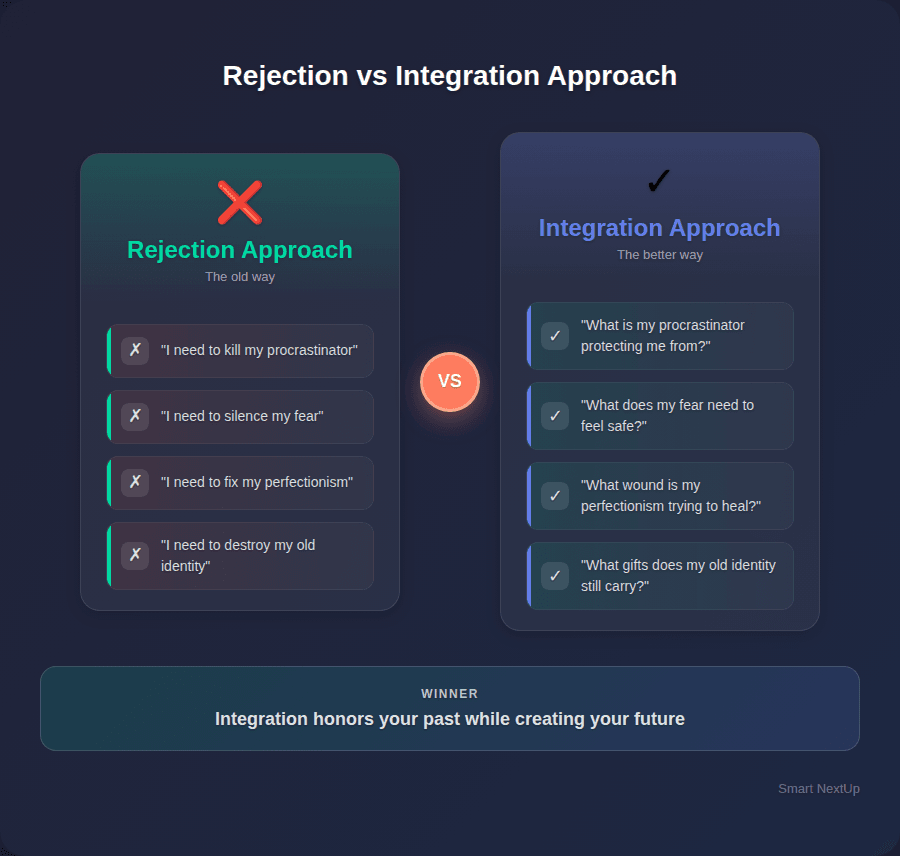
Here’s where people get stuck. They think becoming means replacing—like swapping out old software for new. They try to delete parts of themselves, exile aspects of their identity, start fresh without the baggage.
This never works.
Caution: Attempting to erase or suppress parts of your identity creates psychological fragmentation. The exiled parts don’t disappear—they go underground, emerging as self-sabotage, projection, or sudden regression under stress.
The alternative is integration. Integration asks: what is this part of me trying to protect? What need is it serving? How can I honor the intention while updating the strategy?
| Rejection Approach | Integration Approach |
|---|---|
| “I need to kill my procrastinator” | “What is my procrastinator protecting me from?” |
| “I need to silence my fear” | “What does my fear need to feel safe?” |
| “I need to fix my perfectionism” | “What wound is my perfectionism trying to heal?” |
| “I need to destroy my old identity” | “What gifts does my old identity still carry?” |
Integration is harder than rejection. It requires sitting with discomfort. It requires dialogue with parts of yourself you’d rather exile. It requires patience when you want to just be done with the old already.
But integration is also the only path to sustainable transformation. The parts you reject will haunt you. The parts you integrate will serve you.
The Continuous Climb
There’s a moment in every transformation when you think you’re done. You’ve done the work. You’ve crossed the edge. You’ve become someone new.
Then life hands you another edge.
This isn’t failure. This is the nature of growth. The summit you’re climbing toward isn’t a destination—it’s a direction. Each peak reveals higher peaks. Each expansion creates capacity for more expansion.
Key Insight
The work never ends because you are never finished. This isn’t a bug in the system—it’s the gift that keeps your life meaningful.
You become. You become who. You keep climbing.
The language matters here. “You become who” isn’t a typo or a fragment. It’s a recognition that identity is verb, not noun. You are not a fixed entity that transformation happens to. You are a process of becoming that transformation accelerates.
“Who” is the question and the answer. You become who? You become who you were always capable of being. You become who your edges were pointing toward. You become who the next version of yourself is waiting to meet.
The Practice of Expansion
Understanding transformation intellectually is different from living it. Here’s how to practice expansion in daily life:
Pro tip: When you feel the tension between who you were and who you’re becoming, pause and ask: “What if both can be true?” This question opens space for integration instead of forcing false choice.
| Daily Practice | What It Does | Time Required |
|---|---|---|
| Morning identity check | Connects you to intentional becoming | 2 minutes |
| Integration journaling | Processes the grief of old selves | 10 minutes |
| Edge recognition | Identifies thresholds you’re avoiding | 5 minutes |
| Expansion meditation | Builds tolerance for growth discomfort | 15 minutes |
| Evening reflection | Consolidates the day’s becoming | 5 minutes |
The practices aren’t complicated. They’re consistent. Transformation happens in the small daily choices more than the dramatic breakthroughs. The breakthroughs are just the moments you notice how far you’ve come.
The Person You’re Becoming
The summit isn’t the point. The person you’re becoming is.
This reframes everything. If the summit were the point, you’d be finished when you arrived. Disappointment would follow—because summits are just places. Beautiful, yes. Significant, yes. But just places.
The person you’re becoming is infinite. There’s always another layer. Another edge. Another expansion. This isn’t a reason for despair—it’s a reason for hope. You will never run out of growth. You will never exhaust your capacity to become.
Finite Goal
- Reaching the summit
- Being transformed
- Arriving at identity
- Finishing the work
Infinite Game
- Expanding the climber
- Continuously transforming
- Practicing becoming
- Living the process
The person reading these words is different from the person who started this journey. Not completely different—still recognizably you. But expanded. More capable of holding paradox. More comfortable at edges. More skilled at integration.
And the person you’ll become tomorrow? Next year? In a decade? That person is already forming, already emerging from the seeds planted by every choice you make today.
The Gift That Keeps Giving
Keep becoming who. The work never ends—and that’s the gift.
Imagine if transformation had a finish line. Imagine reaching a point where you were done—fully actualized, completely evolved, no more growth needed. What would you do then?
You’d stagnate. You’d lose the thing that makes life alive: the forward motion, the reaching, the becoming.
The infinity of the work is its own reward. Every edge is an invitation. Every threshold is a doorway. Every version of yourself you meet along the way has something to teach.
| Perspective | What You See | How It Feels |
|---|---|---|
| Work as burden | Endless effort | Exhausting |
| Work as duty | Obligation to fulfill | Heavy |
| Work as path | Journey to walk | Meaningful |
| Work as gift | Opportunity to grow | Grateful |
The shift from burden to gift isn’t about changing the work—it’s about changing your relationship to it. The climb is the same either way. The question is whether you resent each step or savor each step.
The Edge Reference
You started at the edge. That edge felt like an ending. Now you know: edges are beginnings. Every ending is a threshold. Every threshold is an invitation.
And here’s the secret the edges have been teaching you all along: there will always be another edge. You will never run out of thresholds to cross. This isn’t cruelty—it’s abundance. Life keeps offering you chances to become.
You become who. You keep expanding.
The expansion includes everything you were while making room for everything you’re becoming. The old selves don’t disappear—they become foundation for new selves. The edges don’t destroy you—they reveal you.
Four words. Infinite depth. You become—the action of transformation, ongoing, never complete. Who—the question and the answer, identity as exploration rather than destination. You keep—the persistence, the commitment, the refusal to stop growing. Expanding—the direction, always addition, always more capacity, never replacement.
This is the charge. This is the practice. This is the rest of your life.
Final Charge
Stand at each new edge with the knowledge that crossing doesn’t erase who you were—it expands who you can be. The person you’re becoming is waiting on the other side. Keep crossing. Keep becoming. Keep expanding into the fullness of who you are.
The edge is calling. The next version of yourself is already forming. The work continues—and that’s the greatest gift you’ve been given.